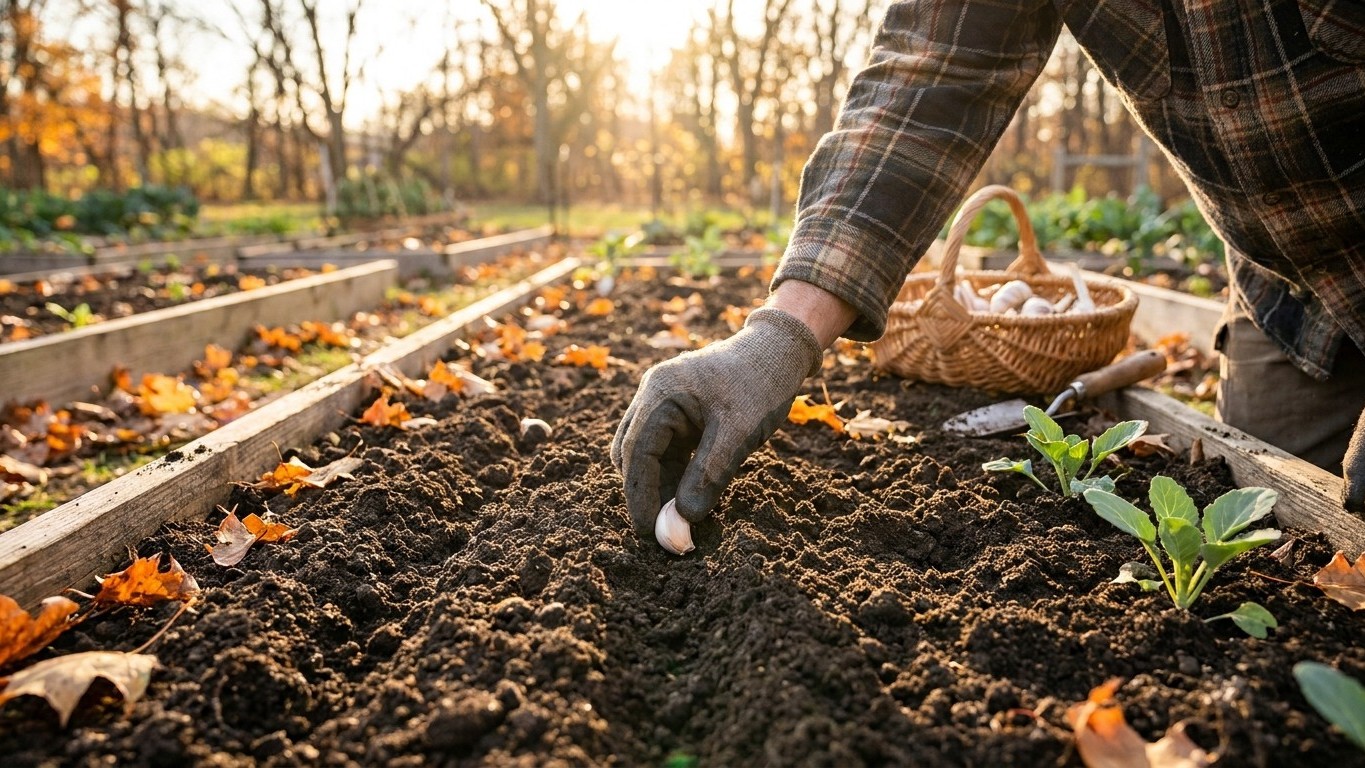

October in Maryland straddles the line between last harvest and first frost. NOAA’s 1991-2020 climate data puts the state’s average first fall frost between October 26 and November 5, which means most of the month still allows planting garlic, cold-hardy greens, spring bulbs and cover crops in open soil. Bare-root trees and shrubs go in now too, while the ground stays workable. What doesn’t belong outdoors: anything tender that hasn’t already come off the vine.
What goes in the ground in October

The frost window is the whole story this month. With the first freeze landing somewhere between October 26 and November 5 across most of Maryland, the first two or three weeks of October behave like a mild autumn, and the back end of the month behaves like the start of winter. That split decides what’s safe and what’s a bet against the odds.
Garlic and shallots are the anchor crop. Individual cloves pushed into loosened, well-drained soil now have roughly six weeks to root before the ground locks up, which sets them up for a strong spring push. Cold-hardy greens, spinach, mache, arugula and mesclun mixes, can still be direct-sown in the first half of the month; sown any later, they risk running out of growing days before frost stalls them for good. Cover crops belong on any bed that’s finished for the season: winter rye and crimson clover both germinate quickly in cool soil and hold ground and nutrients through the cold months.
Fall is also the better half of the year for planting bare-root trees, shrubs and most perennials. Soil temperatures are still warm enough for root growth even after the air cools, and the plant isn’t fighting summer heat stress while it establishes. Spring-flowering bulbs, tulips, daffodils, crocus, go in once soil has cooled, which October usually delivers.
The caution runs both directions geographically. Garrett and Allegany counties, in the mountainous west, tend to freeze weeks earlier than this window suggests, which shrinks the safe planting stretch for greens and pushes garlic planting toward the earlier end of the month. The Eastern Shore runs milder and often buys an extra week or two before frost arrives, so gambling on a slightly later sowing there carries less risk.
What to start under cover
Cold frames and low tunnels do the real work in October, not seed-starting trays on a windowsill. The math runs backward from that first frost window of October 26 to November 5: a baby-leaf green needs roughly 30 to 40 days to reach a pickable size, so anything sown in open ground after the first week of October is racing a clock it’s likely to lose. Move that same sowing under a cold frame or row cover, though, and the extra few degrees of protection buys another three to four weeks of growing time, which is often enough to carry spinach, lettuce and mache through to a real harvest even after outdoor temperatures have dropped.
The two ways this goes wrong mirror each other. Sow too early under cover, before the weather has actually cooled, and heat builds up inside a closed frame on a sunny afternoon, cooking or bolting young seedlings. Sow too late, treating the cold frame as a rescue for crops that should already be in the ground, and the plants enter the cold small and thin, with too little root mass to hold through a hard freeze. The frame extends a season that’s already underway; it doesn’t create one from nothing.
Indoors, October is also the natural month to start forcing bulbs for winter bloom, paperwhites and amaryllis chief among them, since both need eight to twelve weeks of growth before they flower and gardeners generally want that timed for the darkest stretch of the year.
What is ready to pick
October harvests carry real weight in Maryland gardens, because the frost window at the end of the month acts as a hard deadline rather than a suggestion. Anything tender, tomatoes, peppers, eggplant, basil, needs to come off the plant before that first freeze lands, whether that’s October 26 or a bit into November depending on location. Waiting for “one more warm week” is how a whole basil bed turns black overnight.
Winter squash and pumpkins should already be off the vine or coming off now, and the tests are simple: press a thumbnail into the skin, and if it doesn’t dent, the squash has cured enough to store. A dry, corky stem is another good sign. Sweet potatoes need to come out of the ground before soil temperatures drop much below 55°F and well before frost touches the vines, since cold soil can damage the roots even underground.
Brussels sprouts, broccoli and cauliflower often hit their peak in October, since cool nights sweeten brassicas rather than harming them. Apples are in full swing across most of the state through the month as well.
For anything already in storage from earlier harvests, October is a good checkpoint: go through stored onions, garlic and squash and pull anything showing a soft spot or mold before it spreads to the rest of the batch.
The jobs that matter this month
October rewards gardeners who treat it as a closing-out month rather than a coasting one. Mulch newly planted garlic heavily, four to six inches of straw is typical, since the goal is insulating the soil against freeze-thaw cycles that can heave cloves out of the ground over winter. Any tender crops still in the garden as frost approaches need row cover on cold nights, thrown on before sunset and pulled the next morning once temperatures climb back above freezing.
Cleanup and prevention
Pulling spent tomato and squash vines now, rather than leaving them to rot in place, cuts down on the fungal spores and overwintering pests that would otherwise carry into the following season. Diseased material should go to the trash, not the compost pile, since most home compost setups don’t reach temperatures high enough to kill off pathogens like blight.
Planning ahead
This is also the month to test soil pH and nutrient levels while there’s still time to work amendments like lime into beds before they freeze solid. Dividing overgrown perennials, cleaning and sharpening pruning tools, and draining garden hoses before the first hard freeze all belong on the same list. Ordering spring bulbs, if that hasn’t happened yet, needs to happen soon, since garden centers and mail-order suppliers tend to sell through popular varieties before the season’s out. None of these jobs demand much time individually, but skipping them tends to show up as a harder spring.
What not to do in October
The most common mistake is trusting a warm afternoon over the calendar. A run of 70-degree days in mid-October doesn’t mean the frost window has moved; it means frost is still coming on schedule, sometime between October 26 and November 5 for most of the state, and any tender crop left uncovered on the wrong night pays for that optimism. Row covers and cold frames should stay ready to deploy even during a mild stretch, not get put away early because the weather feels forgiving.
Fertilizing with high-nitrogen products this late is another misstep, particularly around trees, shrubs and perennials. Nitrogen pushes soft new growth, and that new growth has no time to harden off before frost damages it, which can weaken a plant heading into winter rather than help it. Established garden beds generally don’t need feeding this late in the season at all.
Planting warm-season vegetables now, on the theory that there’s still a stretch of good weather left, is a gamble that rarely pays off in Maryland; soil temperatures are already dropping, and seeds like beans or squash that need warm ground to germinate will mostly rot before they sprout. Stick to the cold-hardy crops the month actually supports, garlic, greens, cover crops, bulbs, and leave the warm-season planting for spring.
Checking this against your own county
A state-wide frost window is a starting point, not a fixed instruction. Maryland’s USDA hardiness zones run from 5b to 8a, and that range alone signals how much elevation and coastal proximity shift the calendar: the mountains of Garrett County sit at the cold end, while the Eastern Shore and areas near the Chesapeake sit at the mild end. A frost date that holds for the Baltimore-Washington corridor can arrive weeks earlier in the highlands or weeks later along the water.
For a planting window tuned to an actual county rather than the state average, the University of Maryland Extension publishes local guidance and a planting calendar built around Maryland’s specific regions, which is the better reference once the state-wide window has narrowed the question down.
Common questions
Is October too late to plant garlic in Maryland?
No. Garlic planted through most of October still has roughly six weeks to root before the ground freezes solid, which is the window growers generally aim for. Planting later than that cuts into root establishment time, so earlier in the month is safer than later.
Can I still start a vegetable garden in October in Maryland?
Cool-season greens like spinach, arugula and mache can still go in during the first half of the month, especially under a cold frame or row cover. Anything warm-season, tomatoes, beans, squash, is out of season and will not have time to mature before frost.
When exactly will frost hit my garden this month?
NOAA’s 1991-2020 climate normals put Maryland’s average first fall frost between October 26 and November 5, but that’s a state-wide range. Western Maryland tends to freeze earlier, the Eastern Shore later, so local extension guidance is the better source for a specific county.
Should I keep watering the garden through October?
Yes, especially newly planted garlic, greens and any fall-planted trees or shrubs. Cooler temperatures slow water loss, but root establishment still depends on consistent soil moisture until the ground freezes.
Gardeners who plant by the Moon can check the October 2026 moon planting calendar, a tradition rather than a proven method.
Related guides
- What to Plant in Maryland in August
- When to Plant Cucumbers in Maryland
- What to Plant in Maryland in March
- the Maryland planting calendar
- What to Plant in Maryland in September
Elsewhere? See what to plant in October in every state and province.