
Potatoes in Alabama go into the ground 14 to 21 days before the last spring frost, not after it. At the Montgomery reference station, NOAA’s 1991-2020 Climate Normals place that last frost between March 19 and April 3, which pushes the planting window into late February and early March at that location. The count Matters More Than the calendar date, because it tracks soil temperature, not air temperature, and a garden away from the airport often runs a week or two behind it.
The short answer
Count backward from March 19 to April 3, the last-frost window recorded at the Montgomery airport station (USW00003856) in NOAA’s 1991-2020 Climate Normals, and land on 14 to 21 days earlier. That puts seed pieces in Alabama soil somewhere between late February and mid-March at that specific location. Utah State University Extension and the University of Maine Cooperative Extension both describe the same rule for potatoes generally: plant as soon as the soil itself reaches 50 F, which typically happens two to three weeks ahead of the last frost date for a given place.
Why the window is a range, not a date
Three weeks is a wide spread for a gardener trying to pick a Saturday to dig. The spread exists because soil warms at different rates depending on drainage, sun exposure, and whether the bed was mulched over winter. A raised bed on a south-facing slope might hit 50 F a full week before a low, shaded row ten feet away. That is the actual decision point, not the frost date itself; the frost date is only a proxy that happens to correlate with when most Alabama soils cross that 50 F line.
Why the Montgomery figure isn’t your figure
The March 19 to April 3 window comes from one weather station. Suburban and rural gardens typically see their last spring frost later than an airport reading, sometimes by one to two weeks, and more at higher elevation. That means a garden in the hills or well outside town should treat the Montgomery window as a starting reference, then check local frost history or a county extension office before locking in a date. Nobody should plant a whole crop off one airport’s numbers without adjusting for where the garden actually sits.
What actually decides it
Two separate thresholds govern potato timing in Alabama, and they pull in the same direction: plant early. Understanding both means a gardener can reason through a season the frost-count alone won’t cover.
Soil temperature, not the calendar
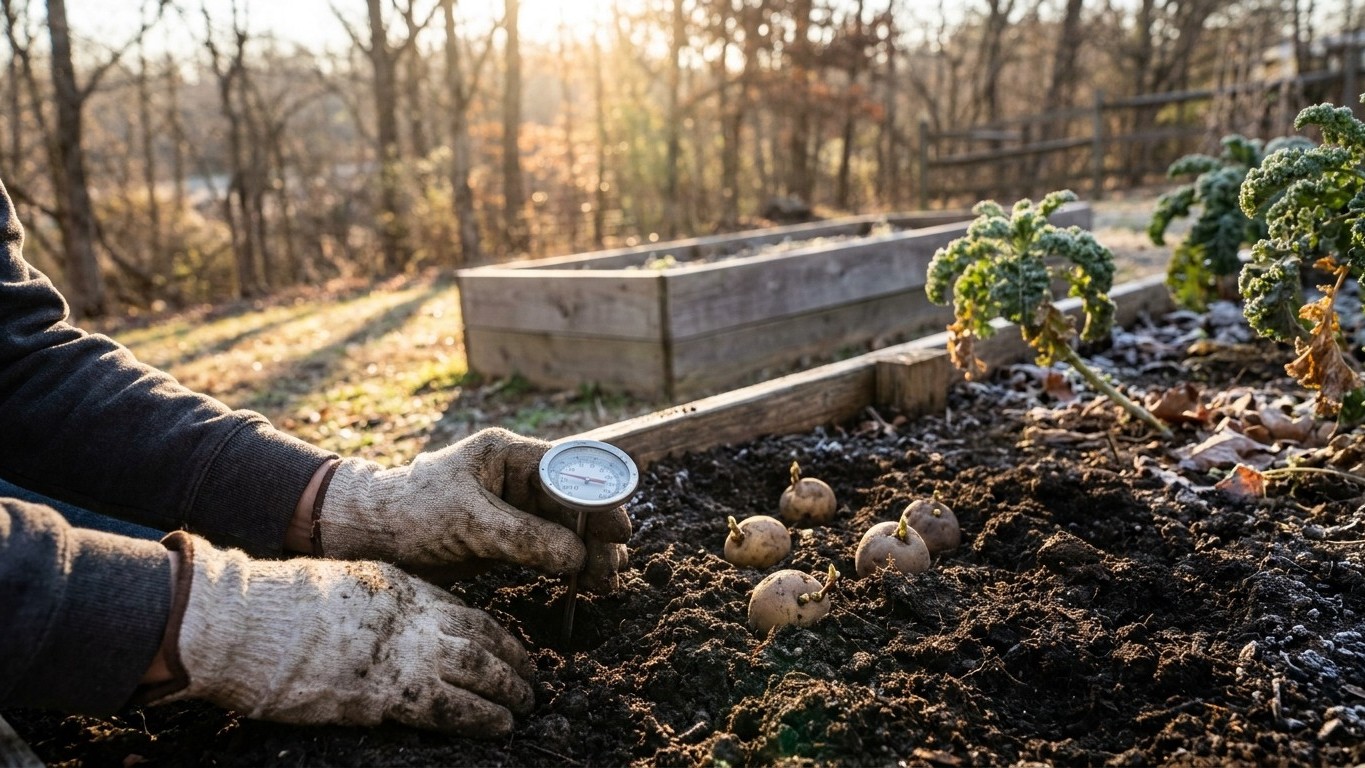
Potatoes are planted as soon as the soil reaches 50 F, according to Utah State University Extension, and that threshold is what the 14-to-21-day count is built around. Air temperature can swing 20 degrees in an afternoon; soil four inches down changes slowly and gives a truer signal of whether a seed piece will rot in cold, wet ground or start growing. A cheap soil thermometer pushed into the bed at planting depth is the actual instrument here, not a printed frost date. If the count says early March but a cold, rainy stretch has kept the soil at 44 F, the sensible move is to wait, not to plant on schedule.
The heat ceiling that ends the season early
The other threshold matters more in Alabama than in cooler states: soils above 90 F inhibit tuber set and fill, according to Utah State University Extension and the University of Maine Cooperative Extension. Watering doesn’t reverse this once it happens. This is the mechanism that decides the whole crop. In a state where soil temperatures climb into that range well before summer’s end, the planting decision isn’t really about avoiding frost damage at all. It’s about giving the plant enough cool weeks to size its tubers before the ground gets too hot to let that happen. That is why the standard advice everywhere is to plant a spring crop and dig it before peak heat, rather than nursing a potato plant through a Southern summer.
How to do it
- Find your own area’s typical last spring frost, using the Montgomery window of March 19 to April 3 as a reference point, and shift it later if your garden sits away from an urban airport station or at higher elevation.
- Count back 14 to 21 days from that adjusted date to set a target planting window.
- Check actual soil temperature at planting depth with a soil thermometer rather than trusting the calendar alone, and wait until it reads at least 50 F.
- Buy certified seed potatoes rather than saving grocery-store tubers; uncertified seed can carry virus that spreads through the whole planting and shows up as poor vigor and reduced yield.
- Cut larger seed potatoes into pieces with at least one eye each, and let the cut surfaces cure for a day or two before planting so they don’t rot in cool, damp soil.
- Choose a season class, early, mid-season, or late, based on how much cool growing time is available before soil temperatures climb toward that 90 F ceiling; earlier classes give more margin in a hot state.
- Plant once soil temperature and timing align, and track the calendar toward harvest with the heat ceiling in mind rather than waiting for foliage to die back on its own.
- Dig the crop before soil temperatures reach the range that stops tuber sizing, since letting the crop sit in hot ground past that point won’t add size, only risk.
What goes wrong
- Planting by a fixed calendar date instead of soil temperature. A gardener who plants on “the same weekend every year” ignores the fact that soil warms at different rates each season. The fix is a soil thermometer at planting depth, checked against the 50 F threshold, not a sticky note on the fridge.
- Using saved grocery-store potatoes as seed. These are not certified and often carry virus that a home gardener can’t see at planting time. The remedy is buying certified seed potatoes each season, which is the only way to know the seed itself isn’t the source of a disappointing crop.
- Planting too late and running into the heat ceiling. Once soil passes 90 F, tuber set and fill stop, and no amount of watering brings that back. The fix is planting at the front of the 14-to-21-day window and choosing an early season class where summers arrive fast, rather than delaying and hoping for a longer cool spell.
- Trusting one airport’s frost date for a garden miles away. The Montgomery window reflects one station; rural and suburban gardens often run later on last frost and earlier on first fall frost. The remedy is treating that window as a starting reference and adjusting with local knowledge or direct soil readings, not applying it uniformly across the state.
- Skipping the seed-piece curing step. Freshly cut seed potatoes planted straight into cold, wet soil are prone to rot before they sprout. Letting cut surfaces dry for a day or two before planting reduces that risk without adding real delay to the schedule.
Common questions
Can I plant potatoes before the last frost date in Alabama?
Yes, that’s the standard approach. Utah State University Extension and the University of Maine Cooperative Extension both describe planting 14 to 21 days before the last frost date, once soil reaches 50 F, rather than waiting until after frost risk has passed.
What if my soil never seems to warm to 50 F on the schedule the frost count suggests?
Wait for the soil, not the calendar. A cold, wet spring can push the 50 F mark later than the count predicts, and planting into colder ground raises the risk of seed-piece rot rather than saving time.
Should I choose early, mid-season, or late potatoes in Alabama?
Neither source publishes days-to-maturity numbers, but they do describe season class. Given how the 90 F soil threshold cuts the growing window short in a hot state, an early or mid-season class generally gives more margin before that ceiling arrives than a late class does.
Does frost damage potato plants once they’re up?
That specific detail isn’t covered in the sources used for this page. What is published is the planting-timing mechanism itself: getting seed pieces into 50 F soil early enough to finish tuber sizing before the ground turns too hot for it to continue.