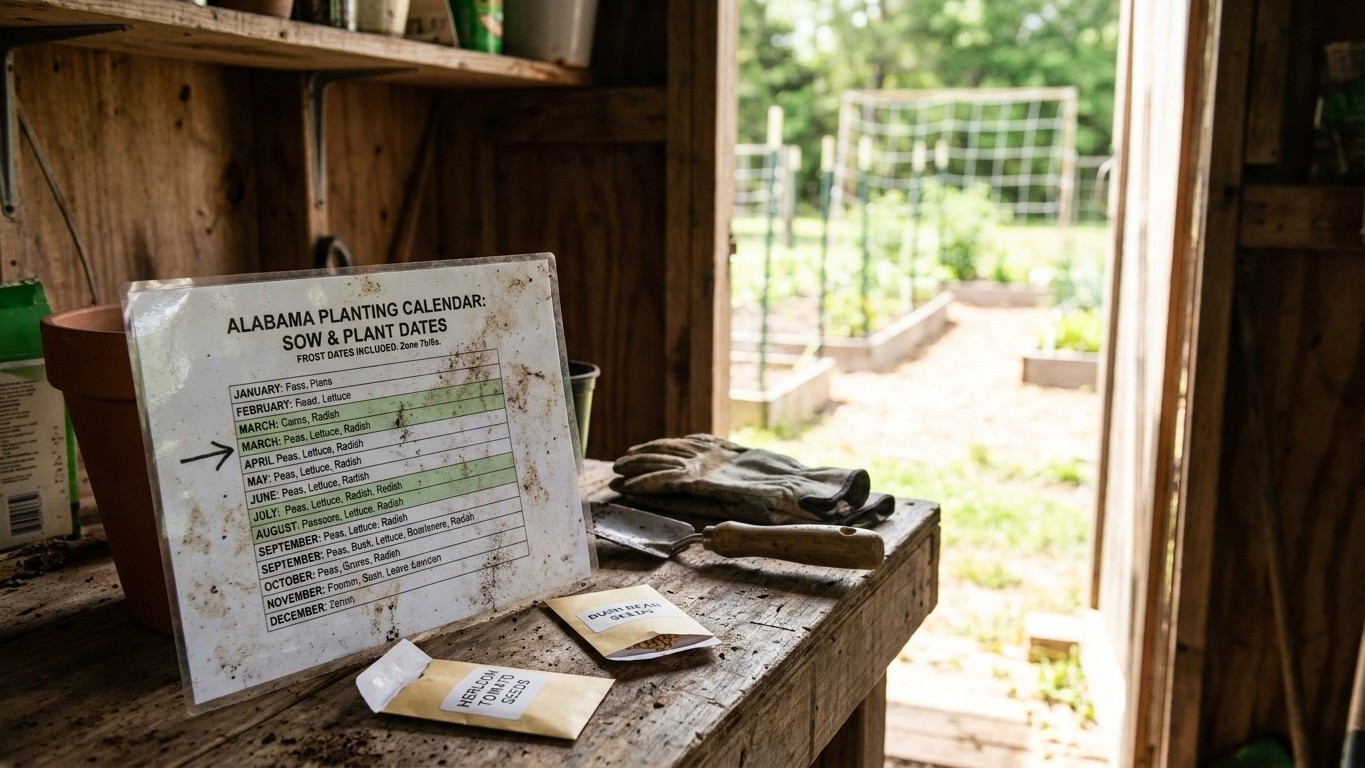

Alabama’s growing season runs from a last spring frost of March 19 to April 3 to a first fall frost of November 2 to November 16, according to NOAA’s NCEI 1991-2020 climate normals measured at Huntsville. That gives roughly seven months of frost-free growing at that station, though the window shifts county by county. Before you sow anything, look up your own county’s frost dates through the Alabama Cooperative Extension System rather than assuming Huntsville’s numbers apply to your yard—that local last frost date is exactly what determines What to Plant in Alabama in March, just as much what determines What to Plant in Alabama in April, and it carries just as much weight for What to Plant in Alabama in June, once the frost risk has fully passed.
The frost window in Alabama

NOAA’s NCEI builds that Huntsville window by running three decades of daily minimum temperatures through a probability model, then flagging the dates where a 32°F freeze has historically occurred in 30 to 70 percent of years. That’s why the agency publishes a range rather than a single date: pin the last frost to March 19 and you’re accepting roughly a 30 percent chance of a freeze after it, while waiting until April 3 drops that risk to near zero. The same math runs in reverse for the fall date. NCEI updates these normals every ten years, so the current 1991-2020 dataset already bakes in a full generation of local warming trends.
What moves the answer is anything that changes the air temperature at ground level relative to that airport sensor. Elevation, distance from the Gulf, and urban heat all shift the window in predictable directions: gardeners near the coast typically see later fall frosts and earlier spring ones than Huntsville’s inland station records, while low-lying valleys and higher ground in the northeast corner trap cold air and can push the last frost a week or two later. Pavement and buildings do the opposite, holding heat and nudging frost dates later in fall, earlier in spring, which is part of why an airport reading runs warmer than the open fields around it. County-level normals from the Alabama Cooperative Extension System are built the same way NCEI builds Huntsville’s, just anchored to a station closer to your own soil, and knowing where you fall in that window matters directly for planning, since What to Plant in Alabama in October depends on how much cool-season growing time remains before that first freeze arrives, What to Plant in Alabama in August depends on how much heat-tolerant growing time remains before that first freeze, and What to Plant in Alabama in November depends heavily on when that first freeze actually hits.
The 225 to 230 day season length that falls out of these dates isn’t fixed either. A shift of even five days on either end changes the total by ten, which is often the difference between fitting in a second cool-season crop after summer vegetables or running out of daylight before the first freeze—timing that makes What to Plant in Alabama in September a useful checkpoint before that window closes, and it starts with how well you use the spring side of that window, since What to Plant in Alabama in May sets up much of what carries right into planning for the following spring, when What to Plant in Alabama in February sets the pace for the next season, and into What to Plant in Alabama in December, once the growing season has fully wrapped uphehomesteadpost.com/alabama/garden/planting-calendar/october/”>What to Plant in Alabama in October as the season winds down, just as knowing your spring frost date shapes decisions covered in What to Plant in Alabama in July, and just as knowing your spring frost date shapes What to Plant in Alabama in January at the other end of the calendar. Year-to-year variability tied to La Niña or El Niño patterns can move the actual frost date outside NCEI’s 30-70 percent band entirely, so treat the county figure as a planning target, then watch your local extension office’s spring forecast updates before committing tender transplants to the ground.
Cool-season crops
- Peas and spinach: direct-sown, tolerate a light freeze once established
- Lettuce: started indoors or direct-sown, bolts once heat arrives
- Brassicas (broccoli, cabbage, kale): usually started as transplants
- Root crops (carrots, beets, radishes, turnips): direct-sown, size up in cool soil
All four groups tolerate a touch of frost and mature better ahead of summer heat than behind it, which is why they go in while Huntsville’s last frost window of March 19 to April 3 is still ahead, not after it has passed.
Sow peas and spinach directly in the soil as soon as it can be worked in late winter, several weeks before the last frost window. Both germinate in cool soil and shrug off a light freeze once established, though a hard, prolonged freeze on very young seedlings can still set them back. Lettuce and brassica transplants are more sensitive as seedlings than peas or spinach, so many gardeners start them indoors and move transplants out a few weeks ahead of the last frost, hardening them off gradually rather than moving them straight from a warm windowsill to open ground.
Root crops go in as direct-sown seed in that same early window, since they don’t transplant well and use the cool soil to develop size and flavor slowly. Radishes are the fastest of the group and can be resown every couple of weeks through early spring for a rolling harvest before the soil warms enough to trigger bolting.
The real limit on cool-season crops isn’t the last frost, it’s the arrival of heat. Once Huntsville’s spring days start climbing well into the 80s, lettuce bolts, spinach turns bitter, and peas stop setting pods. Watch your soil, not the wall calendar: cool-season seed germinates poorly in cold, wet soil, and waiting a week or two for the ground to dry out and warm slightly usually beats rushing seed into mud in late winter.
Warm-season crops

The last spring frost date is the earliest tomatoes, peppers, squash, beans and corn can go outside, not the target date. All five die at the first touch of frost. Soil temperature matters just as much as air temperature here: tomato and pepper roots stall in cold soil even after the air has cleared the frost line, and squash and bean seed can rot in the ground before it germinates if the soil hasn’t caught up. Most gardeners wait one to two weeks past the last frost date before setting out tender transplants, giving the soil time to warm alongside the air.
For indoor seed starting, count backward from your transplant date. Tomato seedlings typically need six to eight weeks indoors before they’re ready to go into the garden. The tomato varieties below are set out early April to mid April in Huntsville’s window, so counting back six to eight weeks puts indoor seed-starting at roughly early February to early March, depending on which end of the transplant range you’re aiming for. Peppers run slower under lights and are often started even earlier than tomatoes.
Matching tomato varieties to the frost window
Catalog days-to-maturity are counted from the transplant date, not from seed, and they shift by a week or so either direction depending on the season’s weather. Set against Huntsville’s frost dates, a fast cherry type like Sakura (55 days from transplant) set out early April to mid April should give first ripe fruit by mid June, leaving around 144 days of margin before the earliest fall frost date. A slower sauce tomato like San Marzano II (78 days from transplant) needs the same early spring transplant date but won’t ripen until early July, still leaving about 121 days of cushion. That margin matters in a state where a wet, cool spring can push transplanting later than planned.
The table below runs the same arithmetic across the full range of tomato varieties in our catalog, all timed off the same early April to mid April transplant window for Huntsville.
| Variety | Type | Days to maturity | First ripe | Margin before frost |
|---|---|---|---|---|
| Sakura | Indeterminate | 55 | Mid June | 144 days |
| Edox | Indeterminate | 55 | Mid June | 144 days |
| Valentine | Indeterminate | 55 | Mid June | 144 days |
| Glacier | Determinate | 55 | Mid June | 144 days |
| Sun Gold | Indeterminate | 57 | Mid June | 142 days |
| Supersweet 100 | Indeterminate | 60 | Mid June | 139 days |
| Juliet | Indeterminate | 60 | Mid June | 139 days |
| Amalfi | Determinate | 68 | Late June | 131 days |
| Cherokee Purple | Indeterminate | 72 | Late June | 127 days |
| Big Beef Plus | Indeterminate | 72 | Late June | 127 days |
| Tiren | Indeterminate | 75 | Early July | 124 days |
| Granadero | Indeterminate | 75 | Early July | 124 days |
| San Marzano II | Indeterminate | 78 | Early July | 121 days |
| Celebrity Plus | Determinate | 78 | Early July | 121 days |
Peppers, squash, beans and corn don’t carry catalog dates in the tomato list above, but the same logic applies: check the days-to-maturity on the seed packet, count forward from your actual transplant or direct-sow date, and compare the result against Huntsville’s fall frost window to see how much margin you’re working with. Beans and corn are usually direct-sown rather than started indoors, and both need soil that has warmed well past the chill of late winter to germinate reliably, so waiting past the last frost date is standard practice, not a sign of a late start.
The fall planting window
Fall planting works backward from the first fall frost, not forward from summer. Huntsville’s first fall freeze falls between November 2 and November 16, per NOAA’s NCEI 1991-2020 normals, and that date is your deadline for a crop to either finish or reach a frost-hardy stage.
To find a fall sowing date for any crop, take the days-to-maturity on the seed packet and add a couple of weeks of buffer, since plants grow more slowly as daylight and temperatures drop through September and October than they would earn the same days-to-maturity figure in the heat of June. Count that total back from Huntsville’s fall frost window to find the latest safe sowing date for your county, adjusting earlier if your garden typically sees frost sooner than the airport station does.
Fast crops are the safest bet for a fall planting: radishes, spinach, lettuce and turnip greens can all be direct-sown in late summer and mature well within the remaining window, even accounting for slower fall growth. Brassicas like broccoli, cabbage and kale need a longer run and are often started as transplants in mid-to-late summer rather than direct-sown, so they’ve already got size on them by the time the days shorten.
Several fall crops actually improve after a light frost rather than being damaged by it. Kale, collards, Brussels sprouts and carrots all sweeten once temperatures drop toward freezing, because the plant converts stored starches into sugars as a natural antifreeze response. A light frost in early-to-mid November isn’t a reason to rush the harvest. It’s often worth leaving these crops in the ground through the first frost or two, covering them with row cover if a harder freeze is forecast, and harvesting afterward for better flavor than you’d get pulling them in October.
The narrower the gap between your last realistic planting date and the first frost, the more the fall garden depends on getting the count-back arithmetic right rather than guessing from a calendar month. A crop sown even a week late in September can lose more growing days than the same week lost in April, since the light and heat are both fading rather than building.
Reading a planting calendar properly
A state-wide planting calendar, this one included, is built from a single weather station and a set of averages. It’s a starting point for figuring out your own timing, not an instruction to follow to the day.
What shifts the dates in your own yard
Elevation is one of the biggest factors: gardens in the higher terrain of northeast Alabama can run a week or two behind Huntsville’s frost dates in spring and ahead of them in fall, simply because cold air pools and lingers longer at altitude. Low-lying gardens near creeks and rivers often see the same effect for a different reason, since cold air drains downhill and settles overnight, creating frost pockets even when nearby higher ground stays clear. Urban and suburban gardens, by contrast, often run warmer than the surrounding countryside thanks to pavement and buildings holding heat, sometimes pushing the last frost earlier and the first fall frost later than a rural garden a few miles away.
A late cold snap after what looked like a settled spring is the single biggest reason gardeners lose a whole planting of tomatoes or peppers. NOAA’s frost dates describe probability, not certainty, and a 30 to 70 percent freeze band means frost is still a real possibility on either side of that window in any given year. Growers just west in Arkansas work with a different frost calendar entirely, covered in our Arkansas Planting Calendar, while gardeners as far north as Michigan, covered in our Michigan Planting Calendar, work with a season several weeks shorter on both ends. That range across just two states is a reminder that Alabama’s own numbers shift meaningfully from Huntsville to the Gulf Coast.
The most reliable planting calendar is the one you build yourself: a simple log of the date you actually see your last frost and first frost each year, kept over several seasons, tells you more about your own yard than any state-wide average ever can.
Local help
For frost dates and soil recommendations specific to your county, the Alabama Cooperative Extension System publishes county-level planting guidance and offers soil testing through its network of local offices, reachable through aces.edu. A soil test through the extension service tells you your actual soil trends and nutrient needs, which matters more for timing warm-season crops than any statewide frost chart. Start with your county office before you finalize a planting date, especially if you garden outside the Huntsville area. For more on gardening tasks across the state, see our Alabama guides.
Common questions
What USDA hardiness zone is Alabama?
Alabama spans more than one USDA hardiness zone, and the exact zone for your property depends on where in the state you garden. Check the USDA hardiness zone map for your specific county, or ask the Alabama Cooperative Extension System office nearest you, rather than relying on a single number for the whole state.
Can I plant a garden in Alabama in February?
Yes, for cold-hardy crops. Peas, spinach and root vegetables can typically go into the ground well before Huntsville’s last frost window of March 19 to April 3, as long as the soil is workable and not waterlogged. Tender crops like tomatoes and peppers still need to wait until after that frost window, and later still for the soil to warm.
How much later should I plant if I live in north Alabama versus south Alabama?
As a general rule, areas farther south and closer to the Gulf Coast see an earlier last frost and a later first frost than north Alabama, which lengthens their season on both ends. Confirm your own dates with your county extension office rather than guessing at an offset.
What do I do if frost is forecast after I’ve already transplanted tomatoes?
Cover the plants overnight with buckets, cloches, or frost cloth that reaches the ground, and remove the covering as soon as temperatures rise the next morning. A light, brief frost is often survivable with protection, but a hard freeze can still kill unprotected tender transplants even under a thin cover.
When should I start seeds indoors for a fall garden in Alabama?
For fall brassica transplants like broccoli and cabbage, start seeds indoors roughly six to eight weeks before you plan to set them out in mid-to-late summer, then count the days-to-maturity on the packet forward from that transplant date to check it lands safely before Huntsville’s first fall frost window of November 2 to November 16. Fast crops like lettuce and spinach are usually direct-sown for fall instead, so this indoor timing mainly applies to the slower brassicas.
Some gardeners layer an older custom on top of frost dates: planting by the moon, which we explain as almanac tradition, not fact.
Related guides
- Mississippi Planting Calendar: When to Sow and Plant, Frost Dates Included
- Tennessee Planting Calendar: When to Sow and Plant, Frost Dates Included
- Arkansas Planting Calendar: When to Sow and Plant, Frost Dates Included