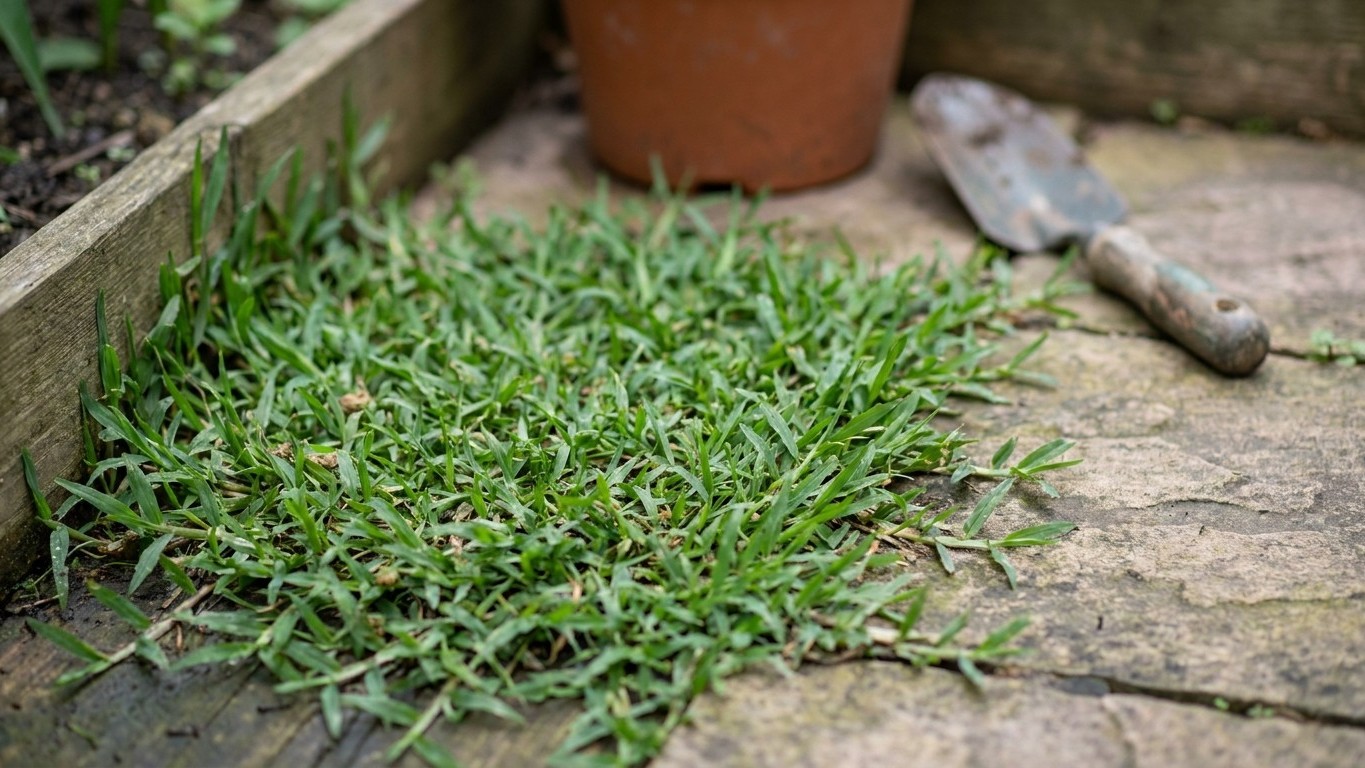

Carpetgrass is a warm-season lawn grass that Clemson Cooperative Extension’s HGIC 1214 lists specifically for wet, acid soils where better-known turfgrasses give up. It spreads by surface stolons into a dense, coarse mat that holds together on ground too soggy and too sour for Bermuda or tall fescue to root well. Its drought tolerance is rated very poor by HGIC, so it only makes sense where the ground stays damp without you having to irrigate it. Check the wettest, most acidic corner of the yard first. If that spot dries out by midsummer, carpetgrass is the wrong grass for it.
What Carpetgrass actually is

That soggy, sour patch where nothing else in the yard will grow — carpetgrass will. It’s a warm-season grass that spreads by surface stolons into a thick, coarse mat, and it’s built for exactly the ground you’re standing on: wet, acidic, the kind of low spot that stays damp on its own without a sprinkler. Go check that spot now — if it’s still moist in the middle of summer without your help, this is the grass for it.
In an existing lawn, look for broad, light green, coarse blades and a flattened stem that roots wherever it touches soil, sending out surface stolons that knit into a low mat. The seed stalk stands up above the mowed leaf with a forked, two-pronged head, which is usually the first thing that tips people off that a wet corner has gone to carpetgrass on its own rather than been seeded on purpose. It shows up uninvited in low, soggy spots for the same reason a homeowner might plant it deliberately: nothing else there is holding the ground.
HGIC rates its shade tolerance as fair, its drought tolerance very poor, its wear tolerance poor, and its cold hardiness poor. Read together, those four ratings describe a grass built for one narrow situation: low ground that rarely dries out completely and rarely sees a hard freeze. Outside that situation, it is not a strong performer, and it is not meant to be judged against grasses built for dry, sunny, high-traffic conditions.
Where it works, and where it fails
Carpetgrass belongs to the warm-season group, so its range follows summer heat and mild winters rather than rainfall alone, though rainfall is what actually decides whether it thrives in a given yard. Several states with long, hot summers and mild winters sit in what HGIC’s broader climate categories treat as first-choice warm-season territory. Arizona logs 169 days a year at 90°F or higher with a coldest month averaging a low of 45°F. Florida logs 73 such days with a coldest month low of 41°F. South Carolina, where HGIC is based, logs 55 days at 90°F or more with a coldest month averaging 38°F.
None of those figures tell you whether carpetgrass specifically will do well there, because heat is only half the equation. Its very poor drought tolerance overrides its warm-season range. Arizona and Nevada qualify as warm-season territory by heat and winter mildness, but both are dry climates overall, and carpetgrass in a typical Arizona yard would brown out and fail unless it sits in a spot that stays wet, a seep, a ditch, or ground fed by a leaking irrigation line. It is a genuinely good fit only where heat and standing moisture coincide, which is more often the case across the humid Gulf South.
| State | Days at 90°F or more | Coldest month average low |
|---|---|---|
| Florida | 73 | 41°F |
| Mississippi | 71 | 35°F |
| Louisiana | 71 | 45°F |
| Alabama | 58 | 32°F |
| South Carolina | 55 | 38°F |
In transition territories, no grass excels, and carpetgrass’s poor cold hardiness makes it a riskier bet than most. Oklahoma logs 71 days at 90°F with a coldest month low of 29°F, and Tennessee logs 40 such days with a coldest month low of 28°F. Colder still, Kansas averages a coldest month low of 22°F and Colorado 17°F, cold enough that a poor-hardiness warm-season grass can thin out or die in patches over a hard winter. A homeowner in one of those states who wants a low-input warm-season lawn on ordinary, well-drained ground is usually better served by Centipedegrass: The Lawn That Asks the Least, which does not depend on constant moisture the way carpetgrass does.
Further north, in cool-season territory, carpetgrass will not hold at all. Nebraska’s coldest month averages a low of 14°F, and Iowa’s does too. Ohio averages 23°F and Indiana 20°F. Winters that cold kill a poor-hardiness warm-season grass outright rather than just thinning it, and the entire warm-season growing pattern is wrong for that climate besides. Homeowners in Nebraska, Iowa, Delaware, West Virginia, Ohio, or Indiana should look at Kentucky Bluegrass: Germination Time, Rhizomes and Where It Grows instead, which is built for exactly the freeze-thaw cycle that ends carpetgrass.
Shade, drought, traffic: what it will take

Shade: fair
HGIC rates carpetgrass’s shade tolerance as fair, which puts it a step above grasses that need full sun but well short of a true shade-lawn choice. Under a mature oak with a filtered, dappled canopy, it will hold on reasonably, especially since shaded ground often stays damper, which plays to its strength. Under a dense, low canopy that blocks nearly all direct light, it will thin out, the same as most turfgrass.
Drought: very poor
This is the rating that governs everything else about the grass. Very poor drought tolerance means it fails the moment the ground dries, not weeks later. A lawn that goes two or three dry weeks in summer without rain or irrigation will show carpetgrass browning and thinning well before a Bermuda or centipede lawn on the same ground would show stress. This is not a grass to plant on a slope, a berm, or anywhere water drains away quickly.
Wear: poor
A poor wear rating means the dog’s daily running line along the fence, the path from the driveway to the back door, and the spot under the swing set will go bare and stay bare. Carpetgrass recovers slowly from traffic because it is not a dense, wiry, self-repairing turf. If the yard sees kids, dogs, or lawn furniture moved around regularly, plan on bare dirt patches in the heaviest-use spots regardless of how well the rest of the lawn fills in.
Cold hardiness: poor
Poor cold hardiness means a harder-than-usual winter can kill patches outright rather than just browning them off for the season, which is the normal warm-season dormancy pattern. That risk is small in a genuinely mild-winter state and real in anywhere that gets an occasional deep freeze, which is part of why the transition-zone states above are a gamble for this particular grass.
Seeding or sodding it
How it gets established
Carpetgrass is established from seed or from sprigs, according to HGIC 1214, not from sod squares the way you’d lay a bluegrass or St. Augustine lawn. Sprigging means planting small rooted pieces of stolon rather than a solid mat, which is slower to fill in and takes more hand labor up front, but it costs less per square foot than sod and gives you plants that are already established rather than seedlings competing with weeds from day one. Seed is the cheaper of the two options by far, but it takes longer to reach a mowable, walkable stand.
When to put it in
As a warm-season grass, carpetgrass goes in on the same general schedule as Bermuda or centipede, around May, while cool-season grasses like fescue or bluegrass are seeded in mid to late September instead, according to Clemson Cooperative Extension’s HGIC 1203. Seeding it in fall the way you would a cool-season lawn wastes a season, because it will not establish through winter dormancy. HGIC 1214 does not publish a specific seeding rate for carpetgrass, so check with your county extension office for the current recommended rate per thousand square feet before you order seed, rather than guessing at a number.
What the choice of method changes
Because it is never sold as sod, a full carpetgrass lawn from scratch is a slower project than laying an instant lawn, and the ground stays exposed to erosion and weed competition longer while seed or sprigs fill in. That is a real consideration on wet ground, since bare soil that stays saturated is also the ground most likely to wash out before roots take hold. If the whole idea of matching a grass type to conditions still feels unfamiliar, the broader rundown at Grass Types is a useful place to work out the pH, drainage, and light situation before you commit to any one option, carpetgrass included.
Mowing and keeping it

Height and frequency
HGIC 1214 puts carpetgrass’s mowing height at 1 to 2 inches, low enough to keep the mat dense but not so low that you scalp the crowns where the stolons root. The one-third rule applies here the same as with any lawn grass: never remove more than a third of the blade length in a single cut, which on a 1 to 2 inch target means mowing before it gets past roughly 2 to 3 inches rather than letting it grow long and knocking it back hard all at once.
What this grass asks that others don’t
Because it spreads by surface stolons rather than staying in a tidy clump, carpetgrass creeps into flower beds, walkways, and gravel paths faster than a bunch-type grass would, so edging is a more regular chore than it is with, say, tall fescue. It also builds thatch where the stolons pile up faster than they break down, so a lawn on constantly wet ground can benefit from an occasional dethatching pass to keep water and air reaching the soil rather than pooling in a spongy mat on top of it.
Reading the dormant season correctly
The lawn will brown after the first hard frost and stay brown through winter, which is normal dormancy for a warm-season grass and not a sign of disease or failure. Resist the urge to overwater or fertilize a brown carpetgrass lawn in winter chasing green that will not come back until the soil warms again in spring.
Common questions
Can I overseed carpetgrass with ryegrass for winter color?
You can, the same way people overseed Bermuda, but on ground this wet the seedbed often stays too saturated for ryegrass to establish cleanly, and it adds a mowing and fertilizing chore during a season carpetgrass would otherwise rest. Most people growing carpetgrass specifically for a problem wet spot skip overseeding and just accept the brown winter look.
Will carpetgrass choke out other grasses if I don’t want it to spread?
It can move into adjoining lawn areas over time through its surface stolons, especially where the ground stays damp enough for it to root as it creeps. A mowed edge or a physical border along beds and walkways keeps it from wandering into the areas you don’t want it in.
Does carpetgrass need fertilizer like a regular lawn?
HGIC 1214 does not list a fertilizer program specific to carpetgrass, and it is generally treated as a low-input grass suited to poor, acid ground rather than one that responds well to a heavy feeding schedule. Check with your county extension office before applying anything, since over-fertilizing a grass adapted to lean acid soil can do more harm than good.
My lawn has patches that look like carpetgrass but I never planted it. Is that normal?
Yes. Carpetgrass often moves in on its own in the lowest, wettest, most acidic parts of a yard where other turfgrasses have already thinned out, which is exactly the niche HGIC 1214 describes it as filling. Its presence is usually a sign of a drainage or pH issue in that spot rather than a problem with the grass itself.