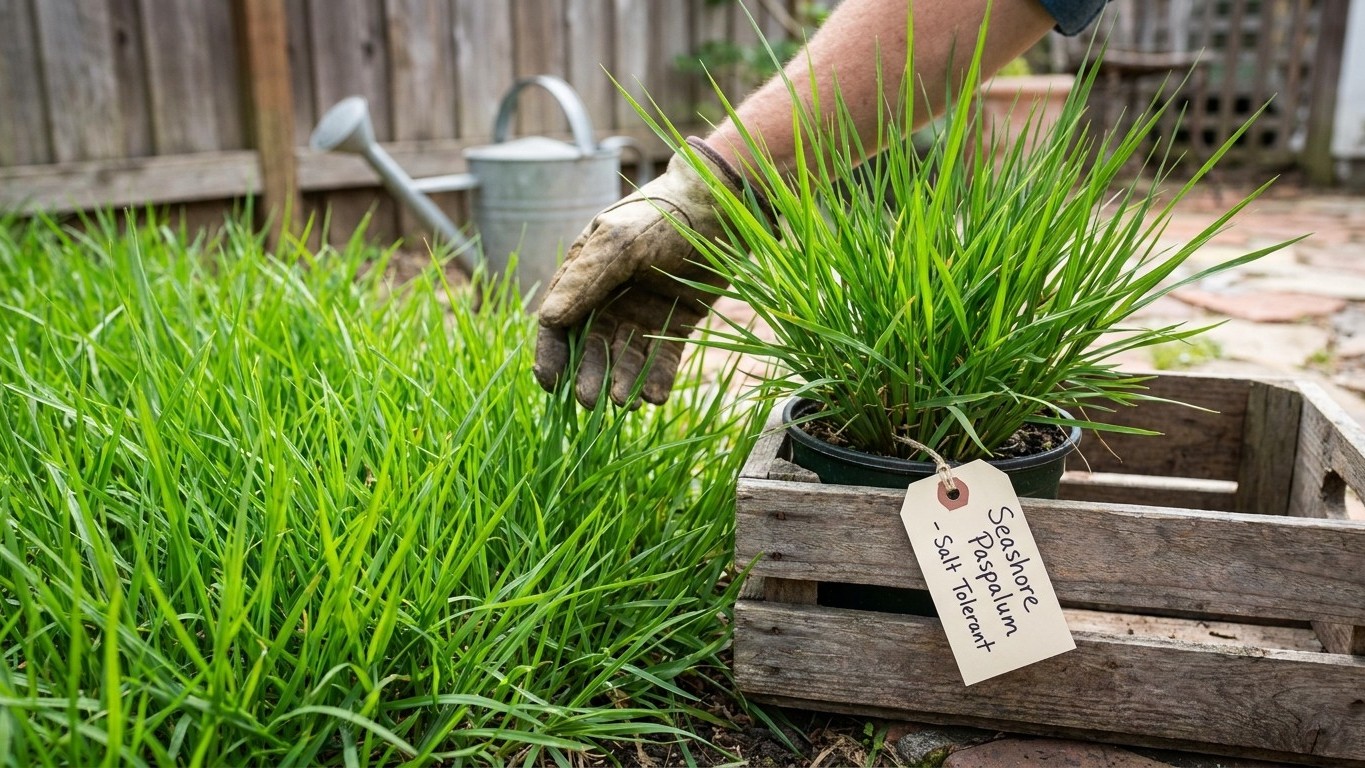

If your only water source is salty, brackish, or reclaimed, this grass will still grow where almost nothing else survives. That’s the one thing it does well, and it’s worth planting for that reason alone. But it buys that trick with terrible cold tolerance, so a winter freeze can kill it outright rather than just browning it off like other warm-season lawns. Before you order sod or plugs, walk outside and think about your coldest night of the year — that number, not the salt problem, is what decides whether this grass has any business in your yard.
What Seashore Paspalum actually is

Seashore Paspalum is a warm-season grass, according to Clemson Cooperative Extension’s HGIC 1214. It greens up in late spring, grows hardest through the hottest months, and browns at the first hard frost, the same pattern as Bermudagrass, Zoysiagrass, and the other warm-season lawns covered on our Grass Types page. That straw color after frost is the plant going dormant for winter, not the plant dying, and it should green up again the following spring provided the cold did not go deep enough to kill the crowns.
The plant spreads low and dense by stolons, the same creeping habit that lets Bermudagrass choke out weeds, and it knits into a tight, fine-bladed turf once established. What actually identifies it on a property is less the leaf than the setting: it turns up on golf courses, resorts, and residential lots close enough to tidal water or a salt-intruded well that ordinary turfgrass struggles. HGIC lists its use as specialized coastal turf rather than a general-purpose lawn grass, and that is the right frame for it: a tool for a specific salt problem, not a default choice for a typical yard.
HGIC’s other four ratings for the species are shade tolerance poor to fair, drought tolerance fair to good, wear tolerance good, and cold hardiness very poor. Each has a practical consequence covered below, but the cold-hardiness figure is the one that decides where the grass survives at all, because a warm-season grass that cannot make it through winter dormancy is a grass you will be replacing.
Where it works, and where it fails
Warm-season grasses are sorted first by whether the local winter kills them, and Seashore Paspalum’s very poor cold hardiness, per HGIC, narrows its range more than almost any other warm-season lawn grass. The table below uses each reference city’s average number of days at 90°F or higher and its coldest month’s average low, both figures drawn from NOAA’s climate normals.
| State (reference city) | Days ≥90°F | Coldest month avg low | Verdict |
|---|---|---|---|
| Arizona | 169 | 45°F | First choice |
| Nevada | 131 | 39°F | First choice |
| Texas | 102 | 43°F | First choice |
| Florida | 73 | 41°F | First choice |
| Mississippi | 71 | 35°F | First choice |
| Louisiana | 71 | 45°F | First choice |
| Arkansas | 69 | 31°F | First choice |
| Alabama | 58 | 32°F | First choice |
| South Carolina | 55 | 38°F | First choice |
| Hawaii | 19 | 66°F | First choice |
| California | 2 | 49°F | First choice |
| Oklahoma | 71 | 29°F | Compromise |
| Kansas | 58 | 22°F | Compromise |
| Utah | 52 | 22°F | Compromise |
| Idaho | 48 | 24°F | Compromise |
| New Mexico | 42 | 26°F | Compromise |
| Tennessee | 40 | 28°F | Compromise |
| Colorado | 40 | 17°F | Compromise |
| Kentucky | 37 | 27°F | Compromise |
| Nebraska | 28 | 14°F | Will not hold |
| Iowa | 18 | 14°F | Will not hold |
| Delaware | 18 | 25°F | Will not hold |
| West Virginia | 16 | 26°F | Will not hold |
| Ohio | 15 | 23°F | Will not hold |
| Indiana | 15 | 20°F | Will not hold |
These figures describe each state’s reference city only. A state as large as Texas or California spans several zones, and the coastline runs warmer than the interior. In the first-choice states, winters rarely drop cold enough to threaten the crowns, and the salt tolerance earns its place on any property irrigated with brackish or reclaimed water. In the transition states, no grass is a clean fit, warm or cool season, and Seashore Paspalum is a genuine compromise: it will likely survive an average winter, but a hard freeze can still kill it back, so plant it there only where the salt problem is severe enough to justify that risk. In the six will-not-hold states, plant a cool-season lawn instead, such as Rough Bluegrass on a damp, shaded site, because a warm-season grass this cold-sensitive will not survive a normal winter there.
Shade, drought, traffic: what it will take

The three remaining HGIC ratings describe what the turf will put up with once it is established, and each one has a specific look in an actual yard.
Shade
HGIC rates the shade tolerance poor to fair. In practice that means full sun to light, high shade, the dappled kind that falls under a young palm or a pergola, not the deep, all-day shade under a mature live oak or maple. Push it into a full canopy and the turf thins into bare patches within a season or two, since low light and dense shade together are exactly what a poor-to-fair rating predicts. For a coastal yard with a genuinely shady side, St. Augustinegrass holds up better under deep shade in the Deep South.
Drought
HGIC rates drought tolerance fair to good, meaning the grass can coast through a dry spell without irrigation longer than a fine-textured lawn grass, though it will not outlast a true xeric planting. In a real dry stretch, expect the lawn to slow growth and dull in color rather than die outright, then recover once rain or irrigation resumes.
Traffic and wear
HGIC rates wear tolerance good, the rating that matters most for a yard with kids, a grill, and a dog that runs the same line along the fence every day. Good wear tolerance means the turf fills back in between beatings, unlike a lawn rated poor for wear, where that same daily path turns to bare dirt within a summer.
Put together, these three ratings describe a grass suited to a sunny, well-trafficked coastal lawn that gets watered rarely but well, not a shaded, low-traffic ornamental strip.
Seeding or sodding it
Seashore Paspalum cannot be established from seed. HGIC lists sod, sprigs, and plugs as the only establishment methods, so budget for one of those three from the start rather than pricing out seed you will never find for this species.
Sod gives an instant lawn and the fastest coverage, at the highest upfront cost per square foot. Sprigs, small pieces of stolon planted into a prepared bed, cost less than sod but take longer to knit into a full cover, and they need consistent moisture while they root. Plugs, individual rooted pieces set on a grid, sit between the two on both cost and speed. Whichever method you choose, warm-season grasses go in around May, according to Clemson Cooperative Extension’s HGIC 1203, timed to the soil warming enough for stolons or plugs to root quickly, not in September the way a cool-season lawn is seeded.
Why the establishment method changes the budget
Because seed is off the table, the upfront cost of a Seashore Paspalum lawn runs higher than a seeded cool-season lawn of the same size from day one, whichever install method you pick. That cost is part of the trade for the grass’s one real advantage, tolerating irrigation water too salty for almost anything else, so it makes sense where that salt tolerance solves an actual problem on the property, and less sense as a general-purpose lawn chosen for looks or price alone.
- Sod: highest cost, immediate cover, best for erosion-prone or highly visible areas
- Sprigs: lowest cost, slowest to fill in, needs frequent watering while rooting
- Plugs: mid-range cost and speed, set on a grid and left to spread
Mowing and keeping it

Mow Seashore Paspalum at 1 to 1.5 inches, according to HGIC. Stay near the low end because the grass forms a dense, fine-textured turf that starts looking stemmy and uneven above roughly two inches, and move toward the higher end where the lawn needs a bit more leaf to shade out weeds. That height is far tighter than most cool-season lawns tolerate, so a rotary mower set up for a fescue lawn will scalp this grass, and most established plantings do better with a reel mower that holds a low cut evenly.
Whatever height you settle on within that range, follow the one-third rule: never remove more than a third of the leaf blade in a single mowing. Skip a week during the summer flush and the grass is already several inches past target, so cutting straight back down to 1 inch in one pass stresses the plant and can scalp it down to bare stolons. Mow more often instead, or step the height down over two or three cuts.
What else this grass asks for
Because it spreads by stolons the same way Bermudagrass does, Seashore Paspalum will creep into flower beds, walkways, and a neighboring cool-season lawn if the edge is not cut back regularly, and a physical edging strip works better than an occasional pass with a string trimmer. Thatch builds up faster in a dense, low-cut turf like this one, so plan on dethatching on roughly the same schedule you would use for Bermudagrass, before spring green-up rather than during it. And when the first hard frost turns the lawn straw-brown, that is normal dormancy for a warm-season grass, not a dead lawn, and it should recover the following spring provided the winter did not exceed what the crowns can survive.
Common questions
Can I grow Seashore Paspalum from seed?
No. HGIC lists sod, sprigs, and plugs as the only ways to establish it, so any seed sold as “Seashore Paspalum” for a home lawn is either mislabeled or a different species entirely.
Will Seashore Paspalum survive a hard freeze?
Not reliably. HGIC rates its cold hardiness very poor, the worst rating on the same scale as Bermudagrass and Zoysiagrass, so in any territory where winter lows regularly dip well below freezing, expect winterkill rather than ordinary dormancy.
Does salty irrigation water hurt other parts of the yard even if the grass tolerates it?
It can. Salt tolerance is a property of the turf itself, not of your soil, irrigation lines, or nearby plantings, and beds, trees, or fixtures downstream of the same water source may still show salt damage even where the lawn looks fine.
Why does my Seashore Paspalum lawn look thin under my patio umbrella and along the fence?
That is the shade tolerance showing, rated poor to fair by HGIC. Anywhere the site moves from full sun into consistent shade, expect the turf to thin, and consider a more shade-tolerant grass for that patch rather than fighting it with more fertilizer.