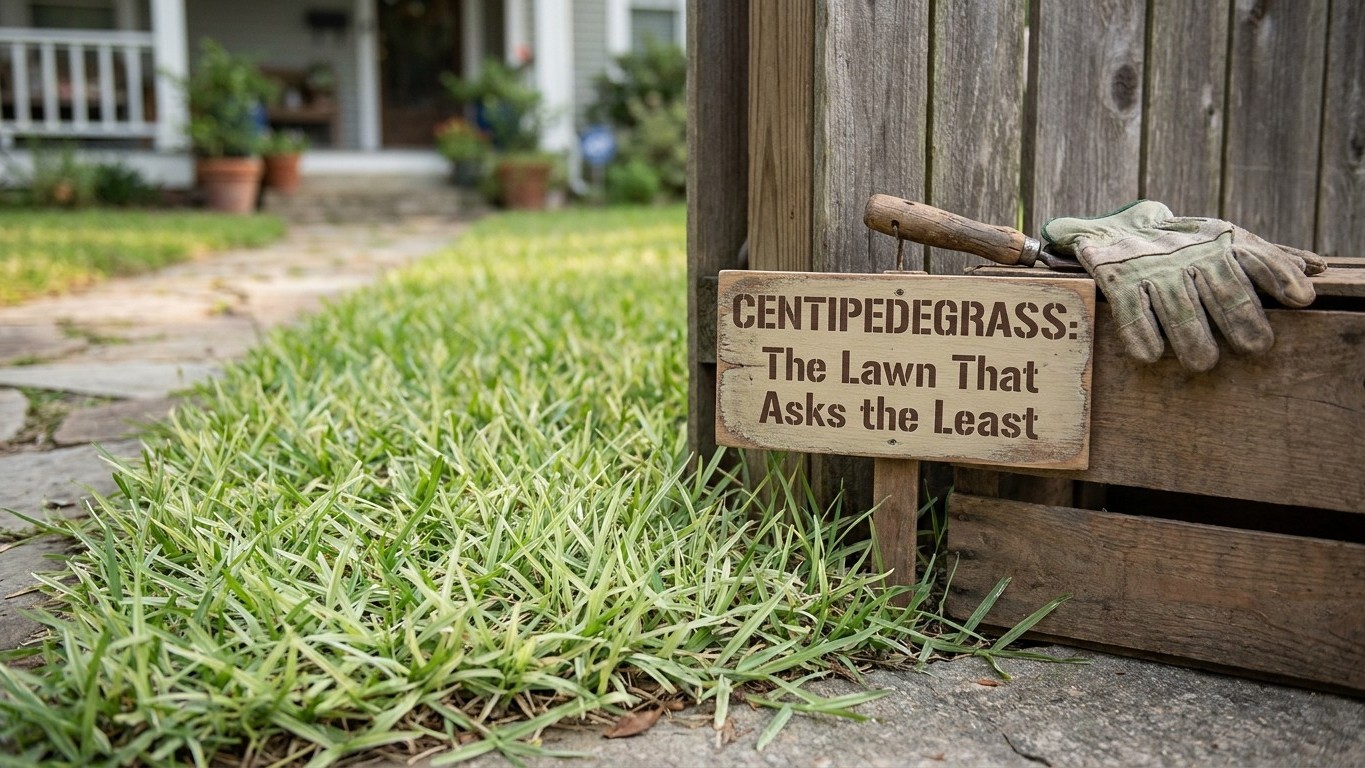

Centipedegrass is a warm-season grass, according to Clemson Cooperative Extension’s HGIC, which means it grows through the hot months and goes brown at the first hard frost. It asks for little fertilizer and little mowing in return for that dormancy. Check your region’s summer heat and winter lows against the figures below before you order sod or seed, since this grass rewards low effort only where its climate needs are already met.
What Centipedegrass actually is

Centipedegrass earned its reputation as the grass you plant and forget, and that reputation only holds up in half the country. The forgetting part is real — the low mowing, the thin diet of nitrogen, the mat it builds by creeping stolons instead of clumping. What the reputation leaves out is the map. Bred for a long, humid summer and a winter that never turns hard, centipedegrass keeps its end of the bargain only where that bargain was struck.
In an existing lawn, centipedegrass shows itself through habit more than color. It spreads by above-ground stolons that creep outward and root as they go, building a low, dense mat rather than clumping the way a bunch-type grass does. That spreading habit is also why it needs less mowing and less nitrogen than the thicker-growing grasses it competes with. Clemson’s HGIC rates its shade tolerance, drought tolerance, wear tolerance, and cold hardiness each individually, and those four ratings, taken together, tell you almost everything you need to know before you commit a whole yard to it.
Where it works, and where it fails
Centipedegrass belongs to the piedmont and coastal plains, according to Clemson Cooperative Extension’s HGIC, and that regional note matters more than any single number. It was bred for a long, hot, humid growing season and a winter that stays mild enough that the grass doesn’t need to rebuild itself every spring. The reference-city figures below, drawn from the summer heat and winter cold each territory experiences, show why it succeeds in some states and struggles in others. A state is not a zone. These are figures for each territory’s reference city, and the far edges of a large state, especially a mountainous or high-elevation one, can sit in a different climate entirely.
First choice, transition, and territories where it will not hold
| State | Category | Days at 90°F or more | Coldest month average low |
|---|---|---|---|
| Arizona | First choice | 169 | 45°F |
| Nevada | First choice | 131 | 39°F |
| Texas | First choice | 102 | 43°F |
| Florida | First choice | 73 | 41°F |
| Mississippi | First choice | 71 | 35°F |
| Louisiana | First choice | 71 | 45°F |
| Arkansas | First choice | 69 | 31°F |
| Alabama | First choice | 58 | 32°F |
| South Carolina | First choice | 55 | 38°F |
| Hawaii | First choice | 19 | 66°F |
| California | First choice | 2 | 49°F |
| Oklahoma | Transition | 71 | 29°F |
| Kansas | Transition | 58 | 22°F |
| Utah | Transition | 52 | 22°F |
| Idaho | Transition | 48 | 24°F |
| New Mexico | Transition | 42 | 26°F |
| Tennessee | Transition | 40 | 28°F |
| Colorado | Transition | 40 | 17°F |
| Kentucky | Transition | 37 | 27°F |
| Nebraska | Will not hold | 28 | 14°F |
| Iowa | Will not hold | 18 | 14°F |
| Delaware | Will not hold | 18 | 25°F |
| West Virginia | Will not hold | 16 | 26°F |
| Ohio | Will not hold | 15 | 23°F |
| Indiana | Will not hold | 15 | 20°F |
The first-choice group shares long, hot summers and winters that rarely bite hard, which is exactly the pattern centipedegrass evolved for. South Carolina’s 55 days above 90°F and a coldest month averaging 38°F sit near the modest end of that group, and the grass still performs there, which tells you the ceiling for success is lower than the Arizona or Texas figures might suggest. If your property sits on a salt-exposed coastal strip within that first-choice zone, note that centipedegrass has no particular salt tolerance, and a lawn irrigated with brackish water or hit by storm surge is better served by Seashore Paspalum: The One You Can Water With Salt.
The transition states are where no single grass excels. Tennessee’s 40 hot days and 28°F coldest-month average, or Colorado’s 40 hot days against a 17°F low, put centipedegrass in a position where a hard winter can thin or kill it back in a way the piedmont and coastal states never see. It can still be grown there, but expect winterkill in a bad year and budget for occasional patching. In the cool-season states at the bottom of the table, the answer is simpler: do not plant centipedegrass at all. Nebraska, Iowa, Delaware, West Virginia, Ohio, and Indiana all sit too cold for it to survive a normal winter, and a cool-season grass suited to that calendar, such as Perennial Ryegrass: How Long It Takes to Germinate (7 to 10 Days), is the grass to plant instead.
Shade, drought, traffic: what it will take

Clemson Cooperative Extension’s HGIC rates centipedegrass fair for shade tolerance, which in a real yard means it will hold on under a stand of pines that lets dappled light through most of the day, but it will thin and eventually give up under a dense, low-canopied tree that shades the same patch of ground from dawn to dusk. Fair is not good. If you’re choosing a grass specifically for a shaded side yard, this is not the grass that wins that fight outright, and you should walk the site at midday in summer before you decide.
Drought and cold, both rated fair
Drought tolerance is also rated fair by HGIC. That translates to a lawn that will slow down and dull in color during a dry stretch but generally recovers once rain returns, rather than a grass that shrugs off weeks without water the way a true drought-tough species does. Cold hardiness carries the same fair rating, and it’s the number that matters most in the transition states from the table above. A fair cold rating means a normal winter is fine, but an unusually hard freeze, the kind that hits once every several years, can kill patches outright rather than just browning the top growth.
Wear tolerance is where centipedegrass draws its hardest line, and HGIC rates it poor. Poor wear tolerance means the path where the dog runs to the fence every day will go bare and stay bare, and a badminton net or a trampoline parked in one spot for a season will leave a scar that takes real time to fill back in through stolon spread. This is the trade the grass makes for asking so little of you the rest of the time: little fertilizer, little mowing, but almost no tolerance for the kind of foot traffic a family yard usually sees.
- Shade (fair): fine under light, high canopy. Thins under a dense low tree.
- Drought (fair): dulls and slows in dry spells, usually recovers with rain.
- Cold hardiness (fair): survives a normal winter, can be hurt by a severe one.
- Wear (poor): does not recover quickly from paths, pets, or play equipment.
Seeding or sodding it
Clemson Cooperative Extension’s HGIC lists centipedegrass as established by seed, sod, sprigs, or plugs, which gives a new lawn owner more entry points than a grass that can only be sodded, but the cost and the timeline differ sharply between them. Seed is the cheapest way to cover ground and the slowest. Sprigs and plugs, which are small pieces of living stolon or turf plugs planted into bare soil, fill in faster than seed but slower than sod and cost more than seed up front. Sod is instant and by far the most expensive per square foot, and it’s the only option if you need a usable lawn within days rather than weeks.
Timing the planting
Because centipedegrass is a warm-season grass, it goes in around May, according to Clemson Cooperative Extension’s HGIC 1203, not in fall the way a cool-season lawn like tall fescue or perennial ryegrass would be seeded. Planting a warm-season grass on a cool-season calendar, or the reverse, is one of the most common ways a new lawn fails before it ever gets a chance to establish, since the soil temperature and day length the seed or sprigs need simply are not there in September for this species.
No seeding rate for centipedegrass is given in the current HGIC lawn-selection sheet, so check with your state’s extension service or the seed bag’s own label for the pounds-per-thousand-square-foot rate before you buy, since sowing too heavy wastes seed and too light leaves bare patches for weeds to fill. Whatever the rate, keep the seedbed consistently moist, not soaked, through germination, because this is the single step most new seedings skip and the one that costs the most in replanting.
Mowing and keeping it

Mow centipedegrass at 1.5 to 2 inches, according to Clemson Cooperative Extension’s HGIC, and hold that line rather than letting it grow tall between cuts. This grass carries a naturally low, dense growth habit, and mowing it at fescue height leaves a shaggy, uneven lawn that also shades out its own stolons at the soil line. The one-third rule still applies here as it does to every grass: never remove more than a third of the blade length in a single pass, which in practice means mowing again before the grass has grown much past 2.5 to 3 inches.
What this grass asks that others do not
Because centipedegrass spreads by surface stolons rather than staying put in a clump, it will creep steadily into a mulched bed or a gravel path if you don’t edge it back every few weeks during the growing season. That same spreading habit means thatch, the layer of old stems and stolons that builds up at the soil surface, can smother new growth if it’s left unchecked for several seasons, so an occasional light dethatching in spring as growth resumes keeps the lawn breathing. And when the first hard frost of the year turns the whole lawn brown, resist the urge to fertilize or water it back to green. That brown is normal seasonal dormancy for a warm-season grass, not a lawn in trouble, and it will green back up on its own once the soil warms the following spring.
Common questions
Why did my centipedegrass turn yellow instead of just going dormant brown?
Yellowing rather than an even tan-brown usually points to a nutrient or iron deficiency, or occasionally centipede decline linked to over-fertilizing with high-nitrogen products meant for other grasses. Ordinary winter dormancy in this species is a fairly uniform straw color across the whole lawn, not a patchy yellow.
Can I overseed centipedegrass with ryegrass for winter color?
You can, but be aware it adds a maintenance step this grass is specifically chosen to avoid, since ryegrass overseeding needs its own mowing and watering through winter and can compete with the centipedegrass as it tries to green up in spring. Most people who choose centipedegrass for its low upkeep skip overseeding and accept the brown season.
How long does centipedegrass take to fill in from plugs?
It depends on plug spacing, soil conditions, and how long the growing season runs, and general figures vary too widely by climate to state a single timeline here. Ask your local extension office for a plug-spacing recommendation suited to your specific growing season.
Is centipedegrass the same as St. Augustine or zoysia?
No. All three are warm-season grasses used in similar climates, but they differ in leaf texture, maintenance needs, and the specific tolerance ratings that decide where each performs best, so check a lawn-selection guide for each species individually rather than assuming one can substitute for another.
Related guides
- Seashore Paspalum: The One You Can Water With Salt
- St. Augustinegrass: Deep Shade, but Only in the Deep South
- Zoysiagrass: Shade and Cold Both, and Slow to Establish