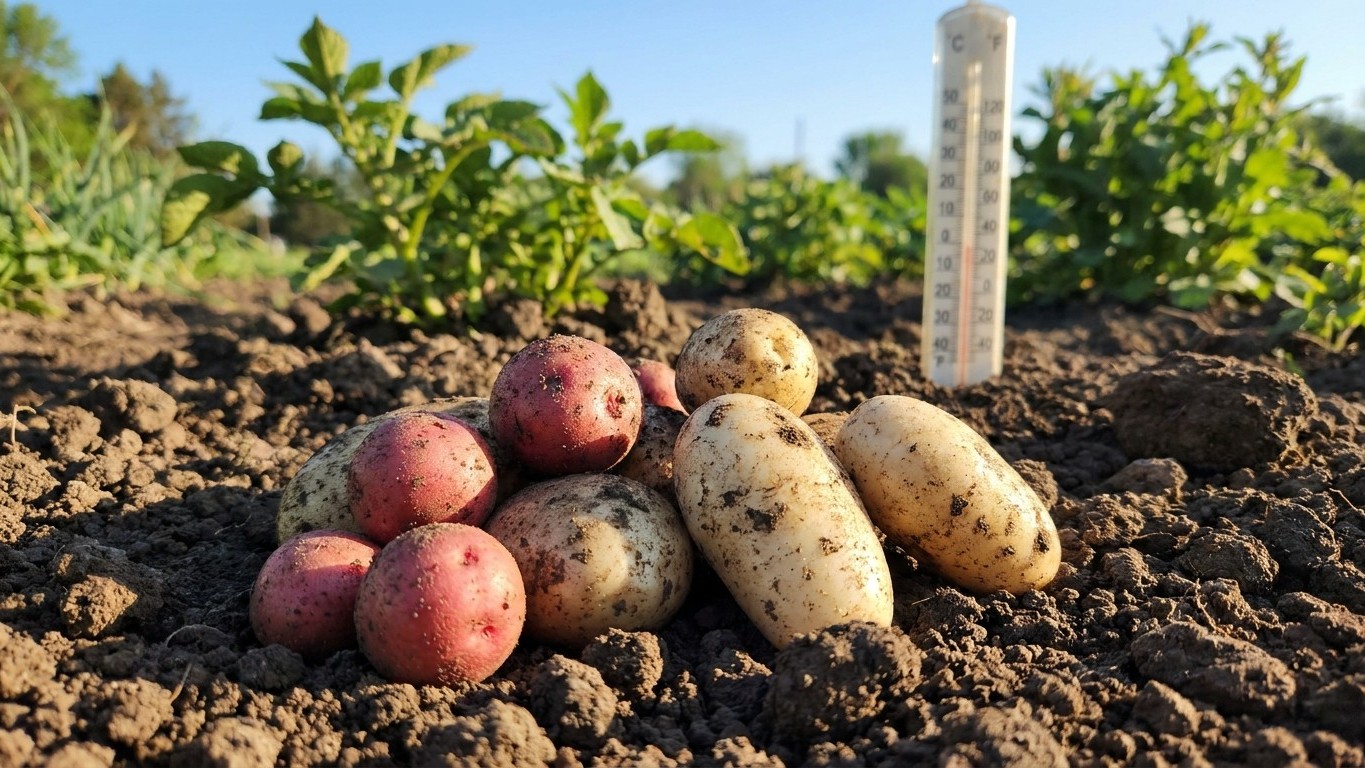

Iowa gardeners do best with early-season and mid-season potato varieties, planted while soil is still cool. The reason is a fixed ceiling: soil above 90°F stops tuber sizing outright, according to Utah State University Extension and the University of Maine Cooperative Extension. Iowa’s summers push past that line often enough that a spring-planted, early-to-mid crop beats anything held for a long late-season fill.
The short answer
Near Des Moines International Airport, NOAA’s 1991-2020 Climate Normals put the last spring freeze somewhere between April 12 and April 24, depending on the year within that record. That’s the anchor date for everything that follows, and it’s narrower than most gardeners assume: a two-week window, not a single circled date on the calendar.
Potatoes don’t wait for that freeze date anyway. Utah State University Extension is specific on this: potatoes go in the ground as soon as soil temperature hits 50°F, which lands 14 to 21 days before the last frost date, not after it. Applied to the Des Moines window, that pushes planting into late March or the first days of April for most seasons in that record. The plant tolerates a light frost on emerging foliage far better than it tolerates hot soil later on, so the early planting isn’t reckless. It’s the whole strategy.
That timing matters because of what happens on the other end of the season. Once soil crosses 90°F, tuber set and fill shut down, per Utah State and University of Maine Extension. Watering harder doesn’t reverse it. The plant can look perfectly green on top while the tubers underneath simply stop getting bigger. Iowa’s July and August soil temperatures cross that threshold with some regularity, which is exactly why an early-season or mid-season variety, planted early and dug before peak summer heat, has an actual chance to finish sizing before the ceiling hits. A late-season variety, which needs more total weeks in the ground, runs a much higher risk of still needing growth time when the 90°F soil arrives.
None of this is a single state-wide number. The Des Moines airport record is one station, and Iowa State University Extension’s county-level data, built from a longer 1950-2021 record, runs about 4 days later in spring and 10 days earlier in fall than that airport station. Treat the airport dates as the optimistic edge of the range, not the guarantee. A garden in northern Iowa is working with a shorter, later-starting season than the Des Moines figures suggest.
What actually decides it
Two mechanisms are doing all the work here, and once you understand them you can apply them to a county the Des Moines record never mentions.
Soil temperature, not the calendar
Air temperature is what people watch, but the 50°F planting trigger is a soil measurement, taken a few inches down, not an air reading off the porch thermometer. Two properties four miles apart can hit 50°F soil on different days depending on drainage, sun exposure, and whether the ground is sandy or heavy clay. A raised bed with southern exposure often reaches 50°F noticeably before a low, shaded, clay-heavy plot does. That’s why the 14-to-21-day window before last frost is a rule to check with a soil thermometer, not a date to write on a calendar in advance.
The 90°F ceiling that ends tuber sizing
This is the mechanism that decides the whole crop, and it’s the one most home gardeners never learn until a harvest disappoints them. Above 90°F soil, tuber initiation and bulking are inhibited, according to both Utah State and University of Maine Extension. It isn’t about the plant wilting or looking stressed on top; the foliage can stay green while the tubers underneath quietly stop growing. Mulching, straw hilling, and afternoon shade all lower soil temperature somewhat, but none of them turn a summer-long crop into one that beats a hard heat ceiling. The only real fix is timing: get the crop far enough along, or dug entirely, before soil regularly crosses that line.
Season class as the variable you actually control
Since no days-to-maturity figure exists in either Extension source, season class (early, mid-season, or late) is the useful lever. An early or mid-season variety needs fewer total weeks between the 50°F planting date and harvest, which means more of its growth happens before soil heat becomes a problem. A late-season variety needs those extra weeks regardless of what the thermometer is doing in July, which is why it’s a harder fit for a region where the frost-free window and the pre-90°F window don’t leave much overlap.
| Season class | Relative time in ground | Best fit for Iowa’s heat pattern |
|---|---|---|
| Early | Shortest | Best match: finishes before peak soil heat |
| Mid-season | Moderate | Workable with an early planting date |
| Late | Longest | Highest risk of hitting the 90°F ceiling before finishing |
How to do it
- Buy certified seed potatoes. Uncertified seed carries virus, and that single fact matters more than any amount of general planting caution.
- Check soil temperature directly, a few inches deep, rather than relying on the air temperature or the calendar date.
- Plant once soil reaches 50°F, which Utah State University Extension places 14 to 21 days before the local last frost date.
- Choose an early-season or mid-season variety over a late-season one, since a shorter total time in the ground means more growth happens before soil regularly exceeds 90°F.
- Select varieties by end use published in Extension fact sheets, such as baking or boiling, rather than by texture terms that neither Utah State nor University of Maine Extension use.
- Hill soil around the stems as the plants grow, which helps keep developing tubers cooler and covered.
- Watch soil temperature again as summer advances, and prioritize digging the crop once soil is consistently pushing toward the 90°F range, rather than waiting for a fixed date.
What goes wrong
- Planting by the frost date instead of soil temperature. Waiting until after the last frost date to plant pushes the crop’s whole schedule later, right into the part of summer when soil heat is highest. Fix: plant 14 to 21 days before the local last frost date, once soil hits 50°F, per Utah State University Extension.
- Choosing a late-season variety for a short window. A late-season potato needs more total weeks than an early or mid-season one, and in a region where soil crosses 90°F by mid-summer, that extra time often runs straight into the heat ceiling. Fix: favor early or mid-season varieties unless the planting date is unusually early.
- Assuming irrigation solves heat stress. Watering more during a hot stretch doesn’t restart tuber sizing once soil passes 90°F, according to Utah State and University of Maine Extension. Fix: treat timing, not water volume, as the tool that prevents the problem in the first place.
- Using saved or uncertified seed potatoes. Seed carried over from a previous crop, or bought without certification, can carry virus into the new planting, and infected seed doesn’t announce itself until yields disappoint. Fix: buy certified seed potatoes every season.
- Treating one region’s frost date as universal. The Des Moines airport record and Iowa State University Extension’s longer county dataset don’t agree; the county figures run about 4 days later in spring. Fix: use the local county reference rather than a single airport station when timing is close.
Common questions
What is the best time to plant potatoes in Iowa?
Based on the Des Moines airport record, soil typically reaches the 50°F planting threshold 14 to 21 days before the local last frost date, which falls between April 12 and April 24 in that record. That generally puts planting in late March to early April, though it should be confirmed with a soil thermometer rather than the calendar alone.
Can late-season potato varieties work in Iowa?
They’re a harder fit. A late-season variety needs more total time in the ground than an early or mid-season one, and Iowa’s soil regularly crosses the 90°F ceiling that inhibits tuber sizing, per Utah State and University of Maine Extension. Early and mid-season varieties leave more margin before that ceiling arrives.
Does watering help potatoes survive hot soil?
No. Tuber set and fill are inhibited once soil passes 90°F, and neither Utah State University Extension nor University of Maine Cooperative Extension describes watering as a fix for that. Extra irrigation can help with general plant stress, but it doesn’t restart tuber sizing once the heat ceiling is crossed.
Why does certified seed matter so much?
Uncertified seed potatoes, including tubers saved from a previous garden crop, can carry virus into the new planting without any visible sign at planting time. That single risk is enough reason to buy certified seed every season rather than reuse stock.