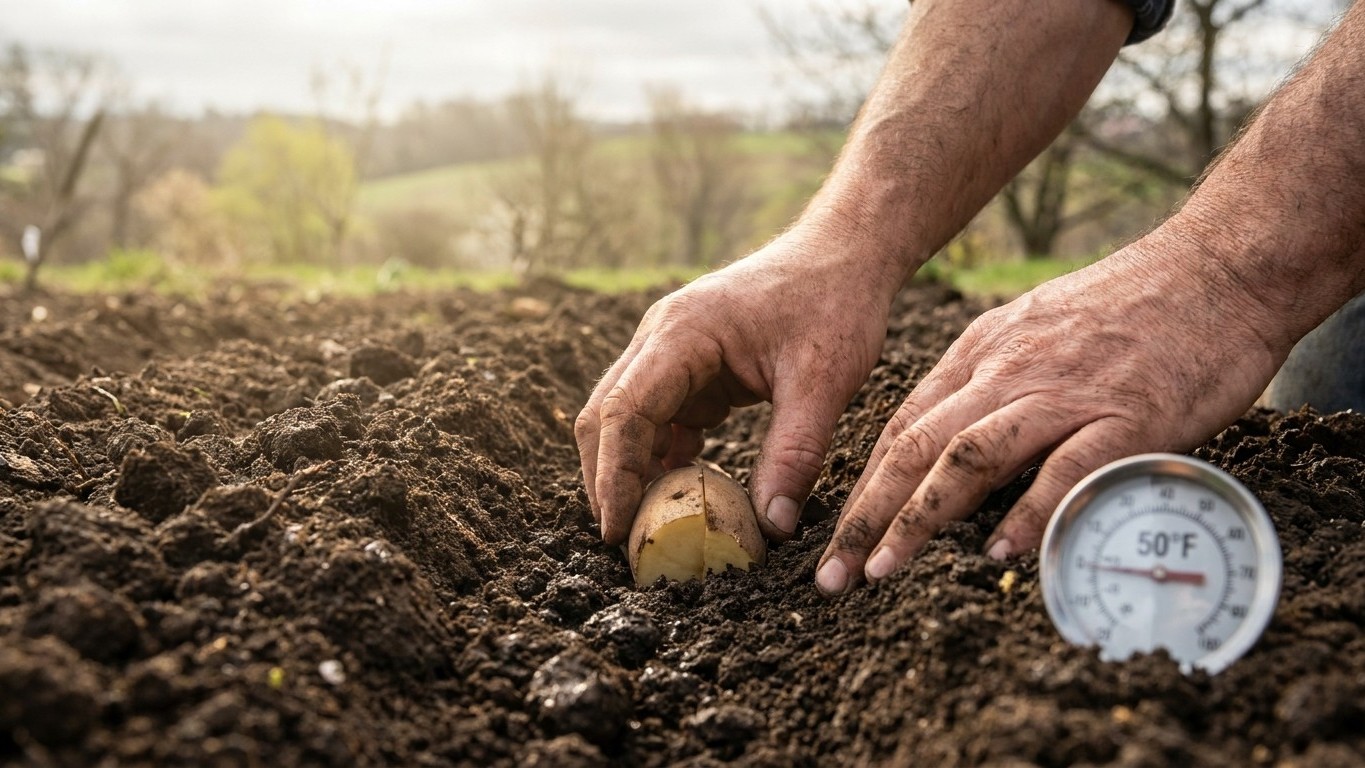

Plant Iowa potatoes 14 to 21 days before your last spring frost, as soon as the soil reaches 50°F. At the NOAA climate station referenced for central Iowa, in Des Moines, that frost date falls between April 12 and April 24, which puts seed potatoes in the ground roughly late March into early April for much of the state. County extension figures often run a few days later than that airport reading, so treat this window as an early estimate, not a guarantee for every yard.
The short answer
The figure that matters comes from NOAA NCEI’s 1991-2020 Climate Normals for the station at Des Moines, which puts the 32°F freeze probability window between April 12 and April 24. That’s the 30 to 70 percent band, meaning frost is genuinely a coin-flip risk across those two weeks rather than a hard cutoff on either end. Counting back 14 to 21 days from April 12 opens a planting window around March 22. Counting back the same span from April 24 puts the far edge of that window around April 10. Stack those two calculations together and you get a realistic seed-potato date somewhere between late March and mid-April for a location matching this station’s climate.
That’s the arithmetic, but it only works if you also respect the caution attached to it. Iowa State University Extension’s county-level records, drawn from 1950 through 2021, run about four days later in spring than this airport station. A grower relying on county figures rather than the airport reading should nudge the whole window a few days later, not earlier. The two datasets aren’t measuring the same thing in the same place, and treating the airport number as universal is how gardeners in cooler counties get caught by a late frost on emerged foliage.
None of this replaces watching the soil itself. Utah State University Extension’s guidance on potatoes is blunt about it: the crop goes in the ground once soil temperature hits 50°F, and that threshold typically lands 14 to 21 days ahead of the last frost date because soil warms slower than air. A warm stretch in March can push soil past 50°F early; a cold, wet spring can hold it below that mark well past the calendar date a chart suggests. The frost-date range from NOAA tells you when to start checking. The soil thermometer tells you when to actually plant.
What actually decides it
Two separate thresholds run this decision, and they pull in opposite directions. One sets the earliest safe planting date. The other sets a hard ceiling on how late the harvest can run before the crop stops improving. Missing either one costs yield, but they fail in different ways.
The 50°F soil trigger, not the calendar date
Utah State University Extension and University of Maine Cooperative Extension both frame planting around soil temperature rather than a fixed day on the calendar. Seed pieces sitting in cold, wet soil below 50°F don’t just wait patiently, they rot before they sprout, or the sprouts emerge weak and disease-prone. That’s why the 14-to-21-day-before-frost figure is really a soil-warming estimate dressed up as a frost countdown. In a location where the frost date runs April 12 to April 24, soil hitting 50°F on schedule lines up with planting in late March to early April. In a wet spring where soil temperature lags, the safe planting date slides later even if the frost-date range on the chart hasn’t moved at all.
The 90°F ceiling that ends tuber sizing
The second threshold sits at the other end of the season. Both extension sources note that tuber set and tuber fill, meaning the actual process of a potato plant putting size onto its tubers underground, is inhibited once soil temperature climbs above 90°F. Watering more doesn’t reverse it. Once soil crosses that line, the plant is not adding meaningful size to what’s already there, regardless of how green the foliage looks above ground. This is the mechanism that should decide how a grower plans the whole season in a hot-summer state: where soil regularly crosses 90°F for stretches in mid-summer, the strategy is to plant as early as the 50°F trigger allows and treat the harvest as a spring crop that finishes before the heat arrives, not a summer-long planting nursed through July and August.
Put those two mechanisms together and the entire planting calendar makes sense. The frost date sets the floor. The heat ceiling sets a hard limit on how much runway exists between that floor and the point where further growing stops paying off. A gardener anywhere with a similar frost window and hot summers is working the same math, even if the exact dates differ from Des Moines.
How to do it
- Find your local last-frost reference. Use a frost-date range for your area as the starting point, and if you’re working from county-level extension data rather than an airport station, add a few days of buffer on the spring end, since county figures tend to run later.
- Start checking soil temperature roughly a month before that frost window opens. A simple soil thermometer pushed 4 inches deep in the morning gives a reliable reading; wait for it to hold near 50°F rather than planting on a single warm afternoon.
- Buy certified seed potatoes rather than saving pieces from a previous harvest or using grocery-store potatoes. Uncertified seed carries virus that won’t show up as an obvious problem this season but drags down vigor and yield for as long as you keep planting from it.
- Choose a season class, early, mid-season, or late, based on how much runway your location has before soil temperature is likely to push past 90°F in summer. Neither Utah State nor University of Maine publishes a days-to-maturity number for named varieties, so lean on the season-class label on the seed bag rather than guessing at a specific date.
- Cut larger seed potatoes into pieces with at least one eye each, and let the cut surfaces callus for a day or two before planting, which reduces rot risk in cool, damp soil.
- Plant once soil has held at or above 50°F, aiming for the 14-to-21-day window ahead of your local frost date rather than a single fixed calendar day.
- In areas where summer soil regularly exceeds 90°F, plan the harvest around that ceiling rather than the calendar. Once soil crosses that line, dig what’s there instead of waiting for more size that isn’t coming.
What goes wrong
- Planting by the calendar date instead of the soil. A gardener sees “mid-April” on a chart and plants regardless of conditions. If a cold, wet spring has kept soil below 50°F, seed pieces sit and rot. The fix is a soil thermometer, not a date circled on a calendar.
- Using the airport frost date without adjusting for county conditions. The NOAA station range reflects one specific location. Iowa State Extension’s county figures run about four days later in spring. A grower who plants on the airport’s earliest date in a cooler county risks losing emerged foliage to a frost the local record would have flagged.
- Planting uncertified seed to save money. Seed saved from last year’s harvest, or potatoes bought for eating, can carry virus that isn’t visible at planting time. The plants may grow, but vigor and yield decline, and the problem compounds if pieces from that same stock get replanted the following season. Certified seed avoids this from the start.
- Ignoring the 90°F ceiling and expecting a late-summer recovery. Once soil temperature crosses that line, tuber set and fill stall, and extra watering doesn’t restart the process. Growers who plant late, hoping the crop will “catch up” in a hot stretch, are working against a mechanism that doesn’t reverse. The remedy is planting as early as the 50°F trigger allows and harvesting before the ceiling hits, not trying to push the season later.
- Choosing a season class that doesn’t match the local heat load. A late-season class planted where summer soil regularly exceeds 90°F may not finish sizing before growth stalls. Matching the season class, early, mid-season, or late, to how much cool-soil runway exists before that ceiling arrives keeps the harvest realistic.
Common questions
What is the last frost date for Iowa?
There isn’t one single statewide date. The NOAA climate station referenced here, in Des Moines, shows a 30 to 70 percent probability band for 32°F freezes running from April 12 to April 24. County-level figures from Iowa State University Extension tend to run about four days later in spring, so a location outside central Iowa should treat that range as an early estimate rather than a fixed answer.
Can I plant potatoes before the last frost?
Yes, and that’s the normal practice. Utah State University Extension’s guidance puts planting 14 to 21 days before the last frost date, timed to when soil reaches 50°F, since seed potatoes are planted well ahead of the frost date rather than after it.
Should I use seed potatoes from the grocery store?
No. Certified seed potatoes are grown and inspected specifically to limit virus carryover. Grocery-store potatoes or saved pieces from a previous harvest can carry virus that isn’t visible when you plant, and it will reduce vigor and yield without an obvious cause.
What potato season class grows best in Iowa’s heat?
Neither Utah State University Extension nor University of Maine Cooperative Extension names a single best class for a whole state, since the deciding factor is how much cool-soil time exists before local soil crosses 90°F in summer. Where that ceiling arrives early and stays for long stretches, an early or mid-season class planted as soon as soil hits 50°F gives the crop more time to size before growth stalls.