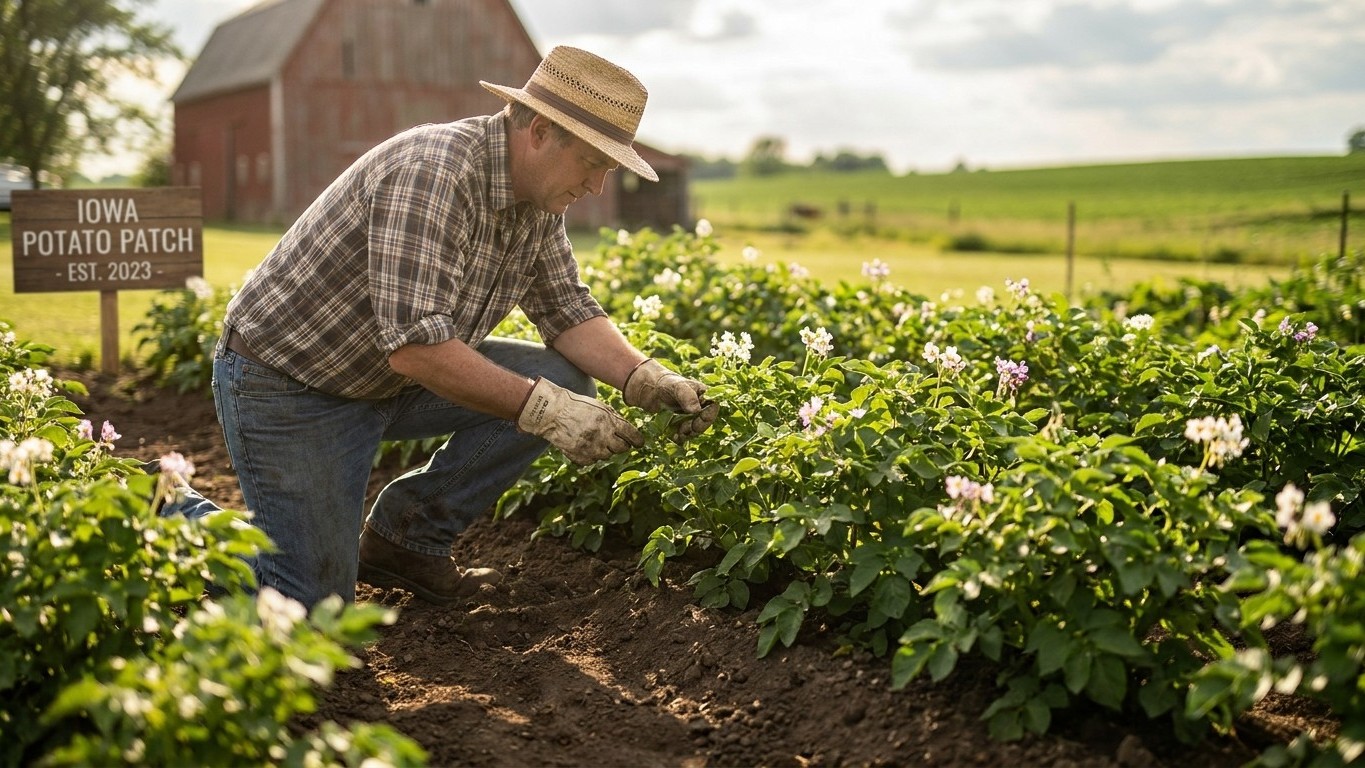

Iowa’s summer heat load is moderate, not severe: Des Moines averages 18.4 days a year at 90°F or hotter, well under the threshold that stalls a potato crop. Combined with a last spring frost window of April 12 to April 24, that means most home gardeners here can grow potatoes as a full-season crop rather than rushing to dig before summer arrives. Timing the planting date still matters more than picking a heat-tolerant variety.
The short answer

Two numbers decide whether a state can grow a full potato season or has to treat the crop as a spring sprint. The first is heat load: Des Moines averages 18.4 days a year reaching 90°F or higher, according to NOAA NCEI Climate Normals covering 1991 to 2020. The second is the frost calendar: the same station’s data puts the last spring frost somewhere between April 12 and April 24, based on 32°F freeze probabilities in the 30 to 70 percent band.
Set those two figures side by side and the picture is encouraging. Utah State University Extension publishes the mechanism that actually kills a potato crop’s productivity: tuber set and fill shut down once soil temperatures climb above 90°F. That’s a soil measurement, not an air-temperature one, but the two track closely enough that a location with only 18.4 days a year of 90°F air temperature rarely sees soil hit that ceiling for any sustained stretch. Iowa, stays mostly under the line that matters.
What that means for the growing season
A grower in a state where 90°F days pile up by the dozen through July and August has to plant early, dig early, and accept a shortened harvest window before the heat locks tubers in place. Iowa doesn’t force that trade-off. With fewer than three weeks a year that hot, the soil has room to stay in the productive range through most of the summer, which means a full-season crop, planted at the right soil temperature and harvested when the vines die back naturally, is a realistic goal rather than a race against the thermometer. For a full breakdown of timing that harvest and curing the crop for storage, see Harvesting and Storing Potatoes in Iowa.
That doesn’t erase the value of choosing season class deliberately. Early-season types reach harvest readiness sooner and give a grower flexibility if a hot stretch does show up unusually early. Mid-season and late types make full use of the longer window Iowa’s climate allows, provided the crop went into the ground on time. Neither Utah State nor the University of Maine Cooperative Extension publishes a specific days-to-maturity count for named varieties, so the honest way to plan is by season class, not by a number pulled from a seed catalog. For guidance on choosing the right planting date for your season class, see When to Plant Potatoes in Iowa. For guidance on choosing among season classes, see Potato Varieties That Suit Iowa.
When to plant here
Potato planting date isn’t picked off a calendar page. It’s calculated backward from two things: the local last frost date, and the fact that potatoes go into the ground once soil temperature reaches 50°F, which typically falls 14 to 21 days before that last frost. Here’s how the arithmetic works using Iowa’s own numbers.
- Start with the reference frost window. NOAA NCEI’s 1991-2020 normals put the last spring frost at the Des Moines-area station between April 12 and April 24.
- Adjust for your county. Iowa State Extension’s county-level data, drawn from 1950 through 2021, runs about 4 days later in spring than this airport station. That shifts the practical window to roughly April 16 to April 28 for most counties outside the immediate Des Moines area.
- Subtract 14 to 21 days for soil warming. Soil needs to hit 50°F before tubers go in, and that threshold is typically reached 14 to 21 days ahead of the last frost date.
- Run the subtraction at both ends of the range. Taking April 16 (early end of the county-adjusted window) minus 21 days lands around March 26. Taking April 28 (late end) minus 14 days lands around April 14.
- Treat the result as a planting window, not a single date. That gives a working range of roughly late March through mid-April for most of the state, with soil temperature as the final check before the shovel goes in.
A soil thermometer pushed 4 inches down is worth more than any date on this list. Calendar math gets a gardener into the right neighborhood; the thermometer confirms the soil is actually ready.
What the heat does to the crop
The mechanism here is the whole point of planning around heat: potato plants don’t fail dramatically when soil temperature climbs above 90°F. They just stop working. Tuber set (the process where the plant begins forming new potatoes underground) and tuber fill (the bulking-up phase that determines final size) both shut down once soil crosses that line, according to Utah State University Extension’s potato fact sheet. The plant doesn’t die. It simply stops putting energy into the part of the crop a gardener actually wants.
This is why watering harder during a hot stretch doesn’t rescue a stalled crop. Water addresses drought stress, which is a real and separate problem, but it does nothing to lower soil temperature enough to restart tuber development once that ceiling is crossed. A gardener who sees a plateau in July and responds by running the hose more often is treating the wrong symptom.
Iowa’s 18.4 days a year of 90°F-plus air temperature at the Des Moines reference station means soil temperatures crossing that same ceiling for extended stretches is uncommon, not routine. That’s the practical upside of growing potatoes here compared to hotter states: a full-season crop, planted at the right soil temperature in spring and left to develop through summer, has a realistic shot at avoiding the shutdown that growers farther south have to plan around every year. Mulching and consistent watering still help moderate soil temperature swings on the hottest individual days, but they’re a buffer, not a fix for a soil profile that’s genuinely over the line for a sustained stretch.
Season class as risk management
| Season class | Typical use noted by extension sources | How it fits Iowa’s window |
|---|---|---|
| Early | Boiling, general table use | Reaches harvest readiness before peak summer heat risk |
| Mid-season | Boiling and baking, general use | Uses the full spring-to-summer window typical here |
| Late | Baking, storage | Benefits most from Iowa’s comparatively low 90°F day count |
What goes wrong here
- Uncertified seed potatoes. Seed that isn’t certified disease-free carries a real risk of virus, which can quietly cut yield without any obvious symptom the first season. Buying certified seed each year, rather than replanting last year’s harvest, is the single cheapest insurance against this.
- Planting into cold, wet soil. Getting eager and putting seed pieces into soil that hasn’t reached 50°F invites rot before the plant ever emerges. The soil thermometer check described above exists specifically to prevent this.
- Skipping the hilling and getting green tubers. Potatoes exposed to sunlight near the soil surface turn green and develop solanine, a compound that makes them unsafe to eat. Hilling soil up around the base of the plant as it grows keeps developing tubers covered and prevents this.
- Digging too early. Pulling tubers before the vines have died back naturally sacrifices size and skin toughness that develops in the final weeks. Given that Iowa’s moderate heat load allows a full season rather than forcing an early dig, there’s little reason to rush this step here.
Checking this against your own county
A statewide frost window is a starting point, not a instruction to follow blindly. Iowa spans real differences in elevation and latitude, and the gap between the northern counties and the southern tier can shift both the last spring frost and the first fall frost by real weeks, not days. The NOAA figures cited here come from a single reference station near Des Moines, and Iowa State Extension’s own county-level data already shows a 4-day spring shift and a 10-day fall shift compared to that airport reading.
The reliable next step is checking those numbers against local data rather than assuming the statewide figure applies exactly to a specific yard. Iowa State University Extension maintains county-level guidance that accounts for these local variations, and it’s the resource worth consulting before finalizing a planting date for any specific county.
Common questions
Can potatoes handle a light frost after planting?
Young potato foliage is sensitive to freezing temperatures, which is exactly why the planting date is calculated backward from the last frost window rather than pushed earlier just because soil has warmed. The frost figures cited in this article come specifically from NOAA NCEI’s 1991-2020 normals; no separate light-frost or hard-freeze threshold is published in the sources used here.
Does mulching lower soil temperature enough to prevent the 90°F shutdown?
Mulch buffers soil temperature swings and helps retain moisture, which reduces drought stress. But once soil is genuinely holding above 90°F for a sustained period, mulch is a moderating factor, not a reversal of the tuber set and fill shutdown described by Utah State University Extension.
Why does certified seed matter more than saving last year’s potatoes?
Certified seed potatoes are produced and inspected specifically to be free of the viruses that build up in home-saved tubers over successive seasons. That virus load doesn’t always show obvious symptoms, but it steadily reduces yield, which is why extension guidance treats certified seed as a baseline rather than an optional upgrade.
Is a full-season potato crop realistic everywhere in Iowa?
The statewide heat load, 18.4 days a year at 90°F or above measured at Des Moines, supports a full-season crop across most of the state. But local elevation and the north-south spread across Iowa still shift both frost dates and the practical growing window, which is why checking county-level data through Iowa State University Extension before finalizing dates is worth the extra step.