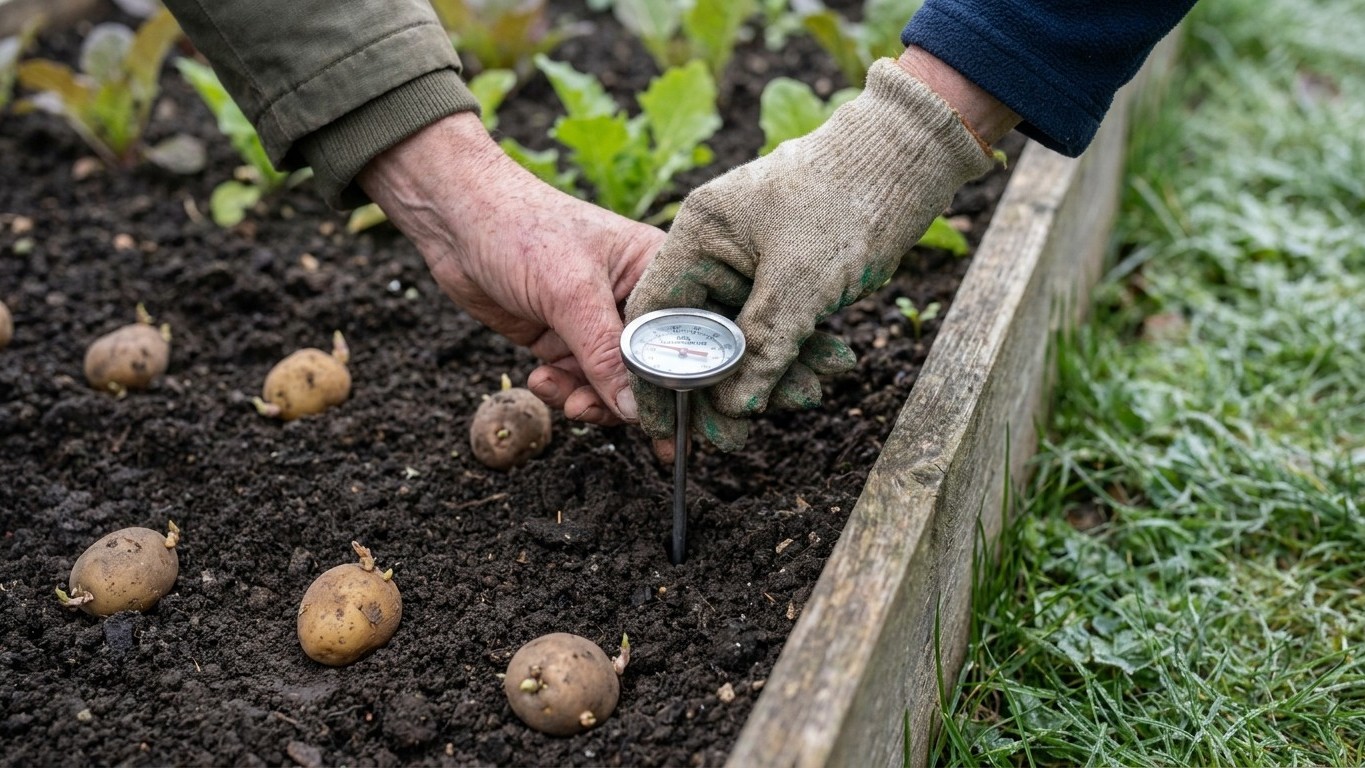

Soil temperature decides potato planting day in Maine, not a date on a seed packet. Once the ground reaches 50 F, seed potatoes go in, and that usually lands 14 to 21 days before the local last frost date, per University of Maine Cooperative Extension and Utah State University Extension. Near Portland, NOAA’s 30-year climate data puts that frost window between April 22 and May 1. Inland and northern Maine run later.
The short answer
Near Portland, the reference station used in NOAA’s National Centers for Environmental Information 1991-2020 Climate Normals shows a 30 to 70 percent probability band for the last 32 F freeze running from April 22 to May 1. That’s the anchor point for a southern-coastal Maine garden, and it’s the only frost-date figure that’s actually published for this state in the data behind this page.
Work backward from it. University of Maine Cooperative Extension and Utah State University Extension both describe the same rule: seed potatoes go into the ground once soil temperature hits 50 F, which typically falls 14 to 21 days ahead of the last frost date. Applied to the Portland window, that puts a coastal planting date somewhere in the first half of April, contingent on the soil actually being at 50 F rather than the calendar simply arriving at that point. A cold, wet spring can push the real planting day later than the math suggests, and a warm one can pull it earlier. The frost date is a guide for backward counting, not a substitute for checking the soil itself.
That April 22 to May 1 window belongs to coastal southern Maine specifically. It’s the mild end of the state’s frost calendar. Move away from the coast, gain elevation, or head north, and the frost season stretches out on both ends, later in spring and earlier in fall. This page doesn’t carry a specific figure for those inland and northern zones, and no source used here publishes one, so the honest answer for a garden in, say, the Aroostook County potato belt is that the counting-back method still applies, but against a local frost date that runs later than Portland’s, not against the Portland figure itself.
One more piece belongs in the short answer, because it changes what “planting” even means for parts of the state: soil above 90 F stops tuber set and fill, and no amount of watering reverses that once it happens. That threshold, published by Utah State University Extension and echoed in University of Maine Cooperative Extension Bulletin #2077, is why an early planting date matters more in Maine’s warmer interior valleys than the frost date alone would suggest. Getting potatoes into the ground close to that 50 F soil mark, rather than waiting for a comfortable spring afternoon, buys distance from the summer heat ceiling before it ever becomes a problem.
What actually decides it
Two separate thresholds run this whole calendar, and they pull in different directions. Understanding both is what lets a gardener reason through a site this page never names, a frost pocket in a river valley, a south-facing slope that warms early, a coastal garden a few miles from Portland with its own microclimate.
Soil temperature, not air temperature
Air temperature is what shows up on a weather app, but it’s soil temperature that a seed potato actually experiences. University of Maine Cooperative Extension and Utah State University Extension both peg 50 F soil as the planting trigger. That number sits ahead of the last frost date, not after it, which is why the 14-to-21-day backward count exists in the first place: soil warms more slowly than air, and a sunny 60 F afternoon in early spring can sit on top of soil that’s still in the low 40s. A gardener who plants by the calendar instead of a soil thermometer is gambling on a correlation that doesn’t always hold, especially in a state where spring soil warms unevenly between a sandy coastal garden and a heavier inland clay.
The 90 degree ceiling
The other threshold sits at the opposite end of the season. Once soil temperature climbs above 90 F, tuber set and fill shut down, according to Utah State University Extension, and University of Maine Cooperative Extension Bulletin #2077 carries the same caution. This is the mechanism that quietly decides whether a Maine potato crop succeeds, because it isn’t fixable mid-season. Watering a bed that’s baked past 90 F doesn’t restart tuber sizing. It just keeps the plant alive while the window for a good harvest closes.
This is where geography inside the state matters more than the frost date does. A coastal Portland garden, moderated by ocean air, spends fewer days near that ceiling than an inland valley in central or interior Maine, where summer heat builds up in still air with no sea breeze to knock it down. Where a location runs hot in July and August, the working answer isn’t to delay planting and chase a longer season. It’s to plant as early as the 50 F soil threshold allows and treat the crop as a spring-timed harvest, finished and out of the ground before the heat ceiling becomes the limiting factor rather than the frost date.
How to do it
- Buy certified seed potatoes rather than saving grocery-store tubers or last year’s harvest; uncertified seed carries virus that builds up in a planting over successive seasons, and certification is the one safeguard against starting a bed already compromised.
- Choose a season class suited to your goal, early, mid-season, or late, since neither University of Maine Cooperative Extension nor Utah State University Extension publishes a days-to-maturity figure for individual varieties. The season class tells you roughly how the plant paces itself, without pretending to a precision the data doesn’t support.
- Match variety to purpose rather than texture labels: some are grown for baking, some for boiling, and the extension fact sheets describe use, not whether a potato is “waxy” or “floury,” a distinction that isn’t part of either source’s published guidance.
- Track soil temperature directly with a soil thermometer at planting depth rather than relying on air temperature or the calendar date.
- Count backward from your local last frost date, not necessarily the Portland figure, and expect soil to reach 50 F roughly 14 to 21 days before that date.
- Plant once soil holds at 50 F consistently, rather than on the first day it briefly touches that mark during a warm afternoon.
- In interior or northern parts of the state where summer heat runs higher, favor the earliest safe planting window so the crop sizes before soil temperatures approach the 90 F ceiling.
- Hill soil around the emerging plants as they grow, keeping developing tubers covered and protected from light exposure.
What goes wrong
- Planting by the calendar instead of the soil. A gardener sees the frost date pass and plants the following weekend, regardless of whether the ground has actually reached 50 F. The remedy is a soil thermometer, not a calendar reminder; wait for the reading, not the date.
- Using uncertified seed. Grocery-store potatoes or saved tubers from a previous planting can carry virus that never shows dramatically in year one but drags yields down over time. The remedy is buying certified seed potatoes each season, which is the standard safeguard both extension sources point to.
- Ignoring the heat ceiling in warmer interior sites. A gardener in a hot inland valley plants on the same schedule as a coastal grower, expecting a full summer season, and soil temperature crosses 90 F right as tubers should be sizing. The remedy is planting at the earliest safe date the 50 F threshold allows and treating the crop as an early-season harvest rather than a full-summer one.
- Applying Portland’s frost window to a different part of the state. The April 22 to May 1 range belongs to the mild coastal reference station behind it, and using it for an inland or northern garden pushes planting too early for that location’s actual frost risk. The remedy is counting back from a local last frost date rather than borrowing the coastal figure wholesale.
Common questions
Is the April 22 to May 1 frost window true for all of Maine?
No. That figure comes from the NOAA reference station near Portland, the mildest part of the state. Inland and northern Maine see later last-frost dates in spring, though no specific figure for those areas is published in the data behind this page.
Why not just plant on the last frost date itself?
Because the 50 F soil threshold that triggers planting typically arrives 14 to 21 days before the last frost date, according to University of Maine Cooperative Extension and Utah State University Extension. Waiting for the frost date itself means planting later than the soil actually calls for.
Can watering fix a crop that’s hit the 90 F soil ceiling?
No. Utah State University Extension is clear that tuber set and fill stop above that threshold, and irrigation doesn’t restart the process once it’s shut down. The only real defense is planting early enough that sizing finishes before soil temperature climbs that high.
Does variety choice change the planting date?
Season class, early, mid-season, or late, affects how the plant paces its growth, but the planting trigger itself stays the same: 50 F soil, counted back from the local last frost date. Neither extension source ties the planting date itself to variety.