
The short answer: plant potatoes 14 to 21 days before your last spring frost, once soil temperature reaches 50 degrees F, not on a fixed calendar date. Near Newark, NOAA’s 30-year climate data puts the last spring frost between March 29 and April 6, which pushes the planting window into mid-to-late March for that area. Your own county may run later.
The short answer
Utah State University Extension’s fact sheet on potatoes is blunt about the mechanism: seed potatoes go in the ground as soon as the soil warms to 50 degrees F, and that moment typically lands 14 to 21 days before the last frost date, not after it. Potatoes tolerate a light frost on the foliage better than most vegetable starts, and the tubers themselves are underground, insulated from the cold snap that would kill a tomato transplant. That’s the whole logic behind planting “early” for this crop.
For New Jersey, the only frost figure with a named, checkable source is the NOAA National Centers for Environmental Information’s U.S. Climate Normals for 1991 to 2020, drawn from the airport weather station near Newark. That data shows the last spring freeze at 32 degrees F falling somewhere between March 29 and April 6, in the range where the historical odds run from 30 to 70 percent. Counting back 14 to 21 days from that window lands the Newark-area planting date in the second half of March.
That figure describes one weather station, not the state. Suburban yards in Bergen or Morris County, and rural gardens further from the coast or up in elevation, commonly see their last frost run one to two weeks later than the Newark reading, and their first fall frost arrive that much earlier. A garden in the Pinelands or along the Delaware River in Warren County is working from a different calendar than a driveway plot ten miles from Newark Liberty. Pull your own county’s frost data before you count backward, and treat the Newark figure as the reference point, not the rule.
The reason growers count backward from frost instead of forward from a fixed date is that soil temperature, not air temperature, decides when it’s safe to plant. A cold, wet April delays the 50-degree threshold regardless of what the calendar says, and a warm dry stretch in March can hit it early. The frost date tells you the outer boundary for risk; the soil thermometer tells you the actual go signal.
What actually decides it
The 50-degree floor
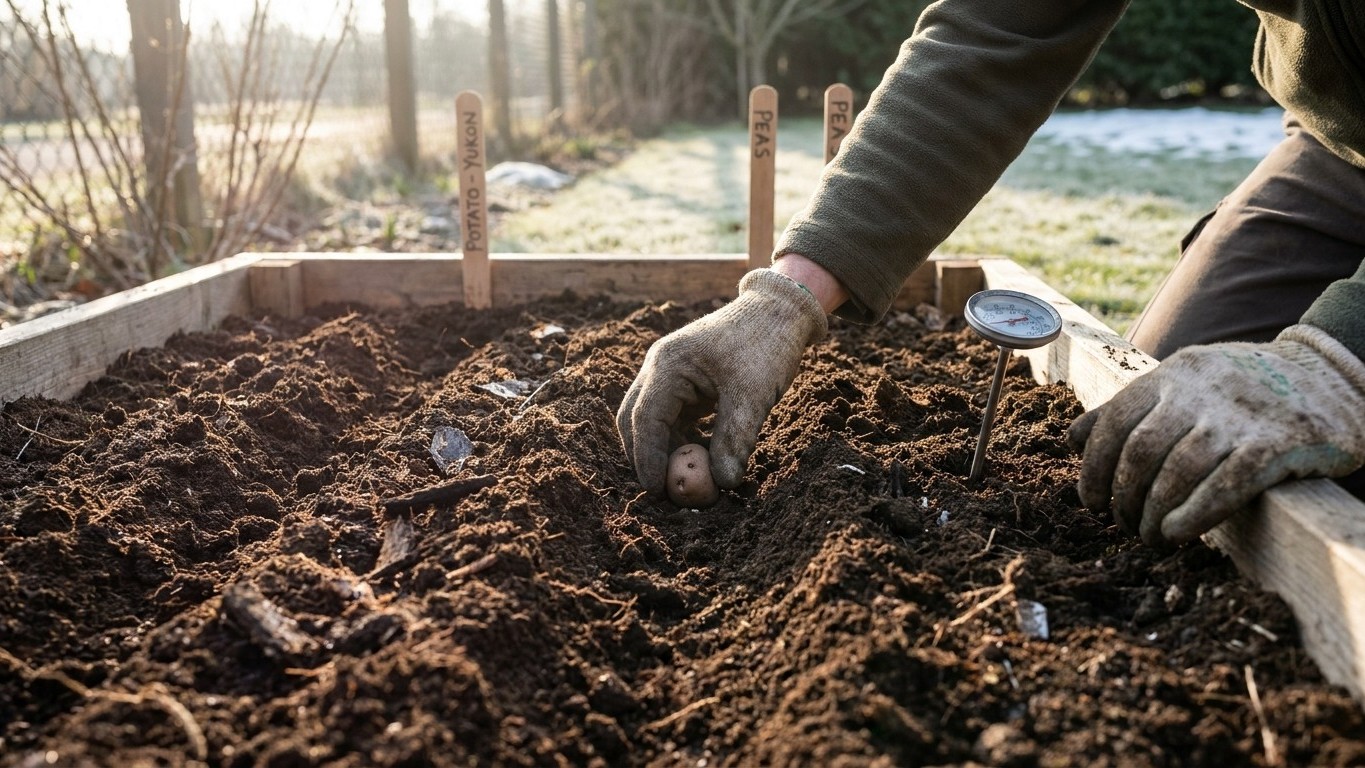
Seed potatoes rot in cold, wet soil before they sprout. Below 50 degrees F, the seed piece sits in the ground absorbing moisture without generating enough growth to outpace fungal and bacterial decay. That’s why Utah State Extension anchors the whole planting decision to that single number rather than to a date on the wall. A thermometer pushed 4 inches into the bed, checked in the morning before the sun has warmed the surface, tells you more than any seed packet or planting chart. Once that reading holds at 50 degrees F for a few consecutive days, planting can happen even if the calendar still says the frost-free date is weeks away.
The 90-degree ceiling
The other end of the season carries a threshold too, and it’s the one gardeners tend to miss. Once soil temperatures climb above 90 degrees F, tuber set and tuber fill both shut down, according to Utah State Extension and the University of Maine Cooperative Extension’s Bulletin #2077. This isn’t a watering problem. A plant sitting in 95-degree soil, even with a perfectly moist root zone, simply stops sizing its tubers, because the biochemical process that fills them out doesn’t run at that temperature. No amount of irrigation reverses it.
This is the fact that should shape how a New Jersey gardener plans the whole season, not just the planting date. Where a location logs a high number of 90-degree days, the strategy isn’t to baby a crop through the hottest stretch of July. It’s to plant as early as the 50-degree floor allows, and get a spring crop into the ground and out of it before the heat ceiling closes the tuber-fill window. Counties along the Delaware Bay and inland South Jersey, which tend to run warmer and log more high-heat days than the northern highlands, are the places where this timing matters most.
How to do it
- Source certified seed potatoes rather than grocery-store tubers. Uncertified seed commonly carries viruses that stunt the plant and reduce yield, and there’s no way to see that damage before you plant it.
- Cut larger seed pieces so each has at least one or two eyes, then let the cut surfaces callus for a day or two in a cool, dry spot before planting, reducing rot risk in cold soil.
- Check your county’s last spring frost date rather than relying on the Newark-area figure alone; local extension offices and nearby weather stations will run closer to your own yard’s conditions.
- Push a soil thermometer 4 inches deep into the planting bed on a few consecutive mornings until it consistently reads 50 degrees F or higher.
- Plant 14 to 21 days ahead of your local last frost date once that soil temperature threshold is met, even if frost risk technically remains.
- Choose a season class, early, mid-season, or late, based on how many 90-degree days your area typically logs; warmer South Jersey locations favor earlier classes that finish tuber fill before peak summer heat arrives.
- Hill soil around the base of the plants as they grow, covering emerging tubers to protect them from sun exposure and green skin.
- Watch soil temperature again as summer approaches; if a heat wave threatens to push soil past 90 degrees F, mulch heavily to buffer the root zone rather than increasing irrigation alone.
What goes wrong
- Planting by a fixed calendar date instead of soil temperature. A cold, slow spring can leave soil under 50 degrees F well past the date a seed packet suggests. Check the soil with a thermometer instead of trusting the date alone.
- Using uncertified seed potatoes from the grocery store. These frequently carry viral disease invisible at planting time, and it shows up later as weak growth and poor yield. Buy certified seed potatoes specifically.
- Relying on the Newark-area frost window as if it applies statewide. A garden in a colder inland county or at higher elevation can run one to two weeks behind that reference figure. Pull local frost data for your own county before counting backward.
- Trying to push a full-season crop through a hot South Jersey summer. Once soil crosses 90 degrees F, tuber fill stops regardless of watering. Extra irrigation during a heat wave doesn’t restart sizing; it just wastes water.
- Planting seed pieces the same day they’re cut. Fresh-cut surfaces are vulnerable to rot in cool, damp soil. Letting them callus for a day or two first cuts that risk substantially.
Common questions
What if my county’s last frost date runs later than the Newark-area figure?
Count backward from your own local last frost date, not the Newark one. NOAA’s climate normals figure for the area near Newark Liberty is a single-station reference; inland, elevated, or northern counties in New Jersey commonly see frost linger later into spring, which shifts the whole 14-to-21-day planting window later as well.
Can I plant potatoes before my area’s frost-free date?
Yes, and Utah State Extension’s guidance treats that as normal, not risky, for this particular crop. Seed potatoes go in once soil hits 50 degrees F, which routinely falls 14 to 21 days ahead of the last frost. The tubers are underground and insulated, and potato foliage tolerates a light frost better than tender vegetable transplants do.
Should South Jersey gardeners favor an early season class?
Given that South Jersey and coastal areas tend to log more days above 90 degrees F than the northern part of the state, planting early and choosing an early or mid-season class, rather than a late one, gives the crop a better chance of finishing tuber fill before the heat ceiling shuts it down. Neither Utah State nor the University of Maine publishes a days-to-maturity figure for any variety; they classify by season length, early, mid-season, or late, and that’s the distinction worth planning around.
Does it matter if I use certified seed potatoes instead of ones from a bag at the store?
It matters more than most other planting decisions. Uncertified tubers, including grocery-store potatoes, frequently carry viruses that don’t show visible symptoms until the plant is already stunted and yielding poorly. Certified seed potatoes are tested specifically to avoid that problem, and it’s a one-time decision at purchase that affects the entire season’s outcome.