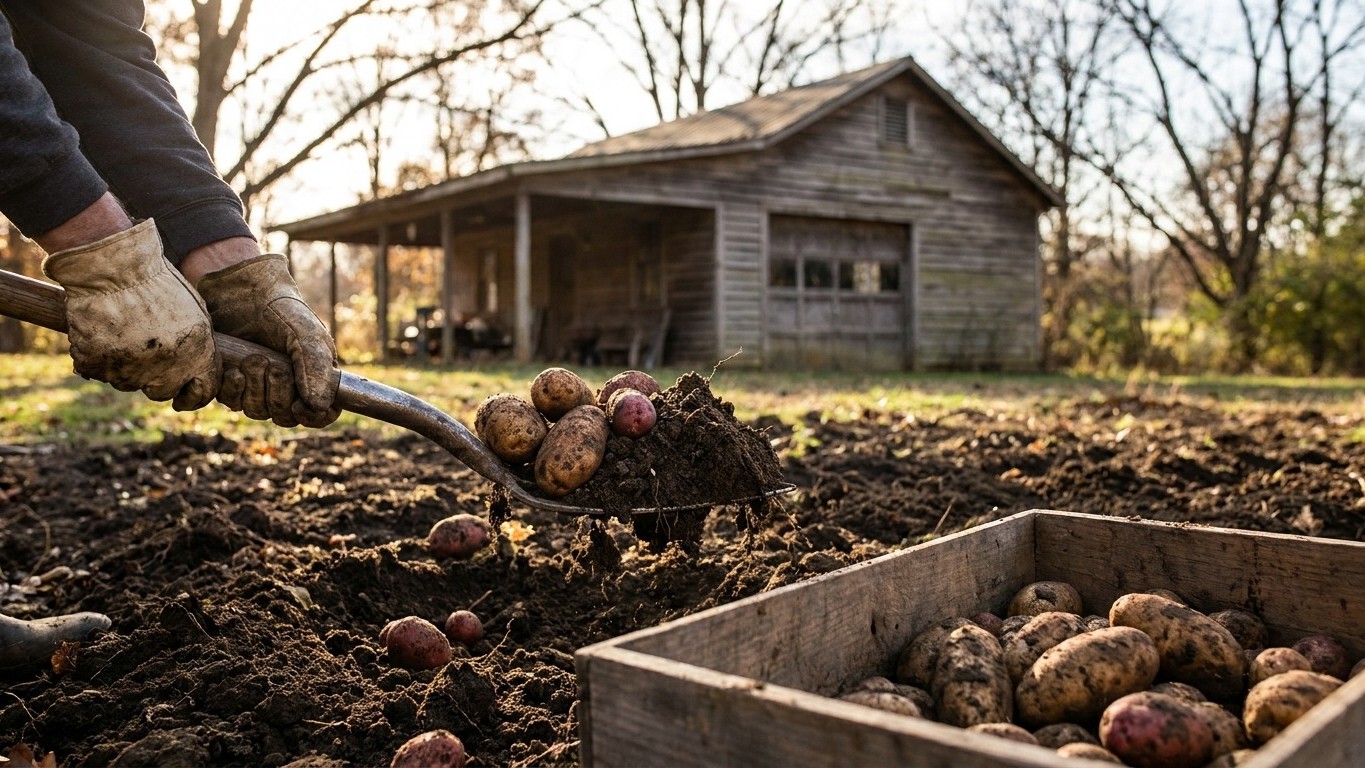

Dig potatoes in the Piedmont before the first fall frost, which arrives between October 30 and November 8 most years. Cure the crop at 55-60 degrees Fahrenheit with high humidity for two to three weeks, per Utah State University Extension guidance, then move it to a dark space holding 40-45 degrees. An unheated garage or porch in this climate hovers close to that range through the coldest month, but it isn’t guaranteed to stay there every night.
The short answer
Two numbers decide the whole calendar. The first is the fall frost window for the Charlotte area, October 30 to November 8, drawn from NOAA’s 1991-2020 climate normals. The second is the mean minimum temperature of the coldest month, 31.8 degrees Fahrenheit, also from that same NOAA dataset. Together they tell you when to pull the crop and what kind of winter your storage space is actually facing.
Harvest has to happen before that frost window closes. Potato vines die back with the first hard cold, and once the foliage is gone the tubers stop sizing up and start sitting exposed in soil that’s about to chill fast. Growers in the Piedmont generally aim to have the crop out of the ground by late October, giving themselves a buffer before that October 30 to November 8 stretch turns into a freeze. Wait past it and you risk digging frozen or frost-damaged tubers that won’t cure or store well no matter what you do afterward.
The coldest-month figure matters just as much, and it’s easy to misread. A mean minimum of 31.8 degrees is an average of nightly lows across the whole month, not a hard floor. It means many nights sit right around freezing, some sit warmer, and some sit colder. An unheated, uninsulated garage or shed in the Piedmont will spend a good chunk of the winter within reach of the 40-45 degree storage target, but it will also see nights that dip below 32 degrees, especially during multi-day cold snaps. That’s the gap this article works through: not whether the state gets cold enough to hurt stored potatoes, but whether any single unheated structure stays consistently in the safe range or swings both ways.
One caution worth repeating: Charlotte sits in the Piedmont, and that’s the reference point for both figures here. The mountains to the west see frost weeks earlier in fall and hold colder overnight lows all winter, so growers there should plan around an earlier harvest and expect their storage spaces to run colder, not milder. The coastal plain trends the opposite direction, with frost arriving later and winter lows running a bit warmer than the Piedmont figures suggest. If you’re gardening outside the immediate Charlotte area, treat these two numbers as a starting point, not a fixed date on your calendar.
Curing, and where
Curing is the step gardeners skip, and it’s the reason so many stored potatoes turn soft or rot within a month of harvest. Utah State University Extension specifies 55-60 degrees Fahrenheit with high humidity for two to three weeks. That combination heals over the small cuts and abrasions that happen during digging, and it also toughens the skin enough for weeks of storage. Skip it, and even perfectly grown potatoes bruise, weep, and break down fast.
Finding that temperature band in the Piedmont at harvest time takes some thought, because late October afternoons here often run warmer than 60 degrees, while the shoulder-season nights can dip below it. The exact daily highs and lows for that harvest window aren’t published in the sources behind this article, so rather than guess at a number, here’s how to work with what you have on hand.
- Harvest on a dry day and let the tubers sit on the soil surface for an hour or two to dry off, then brush away loose dirt without washing them.
- Move them out of direct sun immediately. Full sun on a warm Piedmont afternoon can push surface temperatures well above the curing target and cause greening.
- Choose the coolest, most humid indoor or covered space you have access to. A basement corner, an unheated garage with the door mostly closed, or a shaded, enclosed porch all tend to run closer to 55-60 degrees than an open shed baking in fall sun.
- Spread the tubers in a single layer, or in shallow crates, so air moves around each one instead of trapping moisture against the skin.
- Check humidity by feel. If the space feels bone dry, cover the crates loosely with burlap or cardboard to slow moisture loss without sealing off airflow.
- Hold them there for two to three weeks, checking periodically for soft spots and pulling any damaged tubers before they spread rot to healthy ones.
A basement usually beats a garage for this step in the Piedmont, since basements stay more temperature-stable and don’t swing with the afternoon sun the way an above-ground structure does. A detached garage can work too, but only if it has some shade and isn’t a metal building that heats up fast under direct light.
Storing through this winter
Once curing is done, the target shifts. Utah State University Extension puts long-term storage at 40-45 degrees Fahrenheit in the dark, while the University of Maine Cooperative Extension gives a tighter figure, 38 degrees at 95 percent humidity. Both agree on the essentials: cold, dark, and humid, just with a few degrees of difference in exactly how cold.
Set against a Piedmont coldest-month mean minimum of 31.8 degrees, the picture is mixed rather than simple. That average tells you the typical overnight low in January is a few degrees below the USU storage target, which sounds like good news for anyone using an unheated space. But an average hides the spread. Some nights during the coldest stretch will sit well above 31.8 degrees, keeping an unheated garage or shed too warm and risking early sprouting. Other nights, particularly during an Arctic outbreak, will drop well below it, and a thin-walled, unheated structure can follow the outdoor temperature down into the low 20s or worse. Potatoes exposed to hard freezing turn soft, sweet, and eventually mushy as the cell walls break down, and there’s no fixing that once it happens.
A basement again has the advantage here. The ground insulates it from the day-to-day temperature swings that an above-ground shed or garage experiences, so it tends to hold a steadier number through the winter, though that number may run warmer than 45 degrees unless the basement is unheated and partially below grade. An attached garage that shares a wall with a heated house often stays too warm for good storage, closer to 50-55 degrees than 40-45. A detached, unheated garage runs colder and closer to outdoor conditions, which helps most of the winter but leaves the crop exposed during a hard freeze unless you add insulation, such as blankets or straw over the storage bins, or bring the crop inside for the worst nights.
Whatever space you use, keep it dark. Light exposure, even the low light from a garage window, triggers greening and the bitter, mildly toxic compound solanine that comes with it. A cardboard box inside a dark closet, a lidded bin inside an unheated room, or a curtained-off basement corner all block light while still allowing the temperature control the space naturally provides.
What goes wrong here
- Harvesting after the frost window closes. Waiting past early November risks digging tubers that have already been chilled or damaged by a light freeze in the ground. Dig before October 30 if possible, and don’t push the crop later just to let it size up.
- Curing in full sun on a warm Piedmont afternoon. Direct light and heat during curing greens the skin and can push surface temperatures well past the 55-60 degree target. Cure in shade, indoors, or under cover instead.
- Storing in an attached, heated garage. Shared walls with a heated house often keep these spaces in the 50s all winter, well above the 40-45 degree target, and the crop sprouts early. Move storage to a detached structure or a cooler basement corner.
- An uninsulated shed freezing solid during a cold snap. Even with a Piedmont coldest-month average minimum of 31.8 degrees, a single hard freeze night can drop an unheated, thin-walled structure well below 32 degrees. Insulate the storage bins with blankets or straw, or bring the crop inside on forecasted hard-freeze nights.
- Storing tubers where any light reaches them. A garage window or a gap under a door is enough to green the skin over weeks of storage. Use opaque bins or a fully dark closet.
- Skipping pest and disease checks before storage. Damaged or diseased tubers rot fast in storage and can spread to healthy ones nearby. Utah State University Extension recommends appropriate insecticides and an appropriate fungicide during the growing season to reduce the damage that shows up later at harvest.
Common questions
How long before the first frost should I plan to harvest?
Aim to have the crop out of the ground well ahead of the October 30 to November 8 window for the Piedmont, since digging right up against a frost date leaves no margin if the freeze arrives on the early end of that range.
Can I cure potatoes outdoors in North Carolina?
Only in shade, and only if you can keep the space out of direct afternoon sun. Open, sunny curing spots in this climate tend to run hotter than the 55-60 degree target from Utah State University Extension, which encourages greening and skin damage rather than the toughening curing is meant to achieve.
Is a garage cold enough for winter storage here?
It depends on the garage. A detached, unheated one usually tracks close to the outdoor coldest-month average minimum of 31.8 degrees, which sits near the low end of the 40-45 degree storage target, but it can also freeze during a hard cold snap. An attached, heated garage typically runs too warm instead.
What temperature actually ruins stored potatoes?
The sources behind this article don’t publish a single freeze-damage threshold, but both extension sources agree the safe storage range sits between 38 and 45 degrees. Anything that drops the tubers into a hard freeze, well below that range, breaks down their cell structure and turns them soft and unusable.