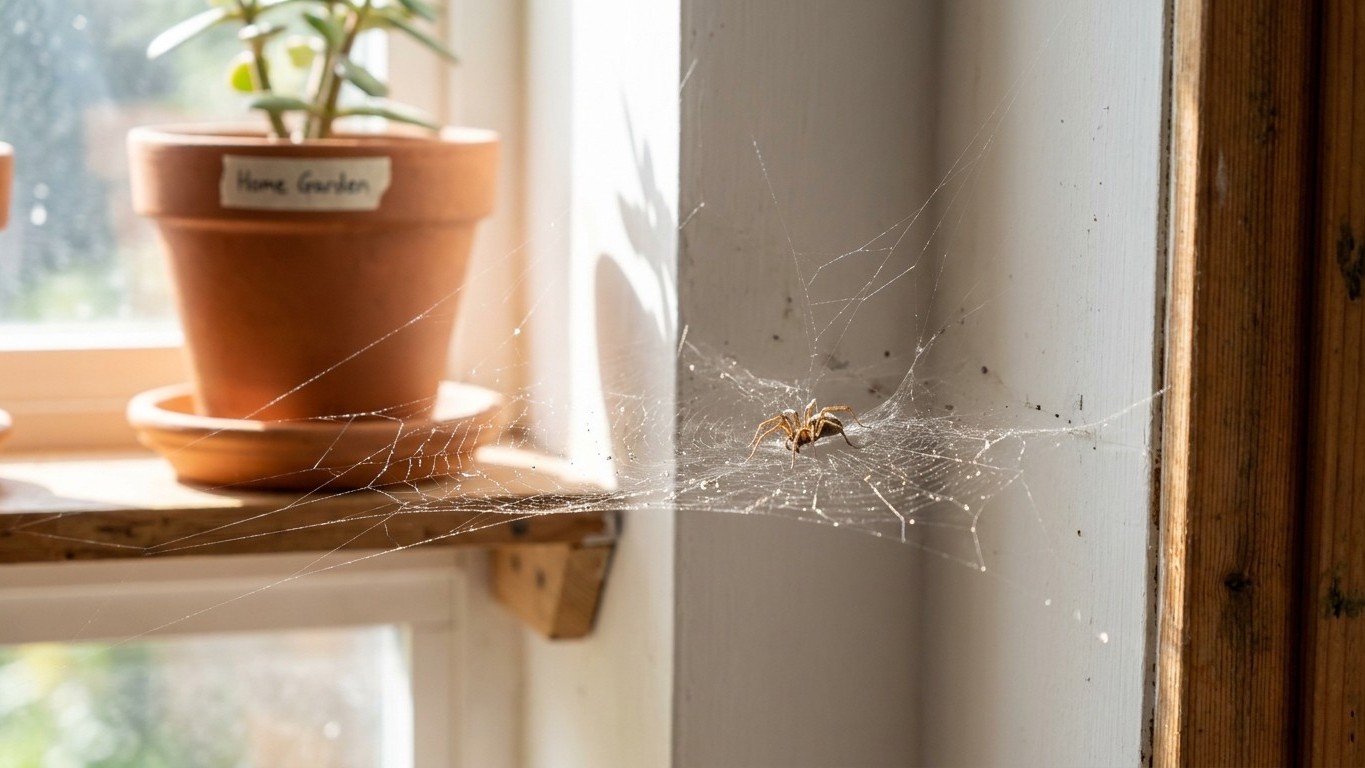

House spiders showing up inside almost always trace back to one thing: bugs already living in your home. Most species in U.S. houses are harmless web-builders that feed on flies, moths, and other insects, and their presence is more diagnostic than dangerous. The real question isn’t how to kill the spider in the corner. It’s what that spider found to eat, and whether it signals a bigger insect problem you haven’t noticed yet.
What you are dealing with

The species doing most of the work in American homes are a short list: the American house spider (Parasteatoda tepidariorum), cellar spiders with their long thin legs, and occasionally wolf spiders that wander in from outside. None of them build webs in your living room by accident. A spider stays where there’s food, and food for a spider means other bugs: fruit flies near a drain, gnats around a houseplant, moths drawn to a porch light, ants tracking in from the yard. Every one of these is a meal ticket.
That’s the fact that reframes the whole problem. A house spider is a symptom, not the disease. Spraying the web away without addressing what drew the spider there buys you a few days before a new web appears in the same spot. By the time you see three or four webs, the insect population feeding them has usually been building for a while.
Three separate questions decide what you should do. The first is identification: is this actually a common house spider, or something that looks similar but behaves differently, like a wolf spider that hunts on the ground, or a species people worry is venomous when it almost certainly isn’t? Getting this wrong changes everything downstream. The second is source: why does this particular home, this particular room, keep producing spiders? Moisture, clutter, and an insect food supply each play a different role, and the fix depends on which one applies. The third is method: once you know what you’re dealing with and why it’s there, what actually reduces the population without turning your house into a chemical storage unit? That’s a matter of sequence more than product.
Recognizing them
Most confirmed sightings come down to a handful of signs: irregular, messy webs tucked into corners, closet ceilings, or behind furniture; small silk-wrapped egg sacs the size of a pea; spiders seen at night rather than during the day; and a web that reappears in the same spot within a day or two of being cleared, which tells you the spider (or a replacement) still finds that location worth staying in.
The confusion usually runs in one of two directions. People see a cellar spider and assume it’s a “daddy longlegs,” which is actually a completely different, non-spider arachnid (a harvestman). Or they see a large, fast-moving wolf spider and jump straight to worrying about a brown recluse, when the two look and behave quite differently once you know what to check. Neither mix-up is dangerous, but it leads to the wrong response.
Web placement also tells you something useful before you even see the spider. Webs low near baseboards and in undisturbed corners point toward cobweb spiders feeding on crawling insects. Webs near light fixtures or windows suggest the spider is cashing in on flying insects drawn to light at night. A web strung across a doorway that gets rebuilt every morning is often cellar spiders, which tend to stay put for long stretches in the same corner.
None of this requires an entomology degree, but it does require actually looking at the web, the location, and the timing rather than reacting to the first spider you spot. A full walkthrough of what to look for, including the specific signs that separate a nuisance species from one that warrants more caution, is worth reading before deciding on next steps.
Why they are here
Every spider infestation traces back to the same three conditions: food, water, and shelter. Food means insects, and it’s almost always the dominant factor for house spiders specifically, since their whole survival strategy depends on prey walking into a web. Water shows up as condensation in a basement, a slow drip under a sink, or humidity in a crawl space, all of which also attract the insects spiders eat. Shelter is simply clutter and undisturbed space: boxes in a garage, items stacked against a wall, a corner behind furniture that never gets vacuumed.
The U.S. Environmental Protection Agency frames prevention as the starting point for any pest problem, not an afterthought. As the agency puts it, “As a first line of pest control, IPM programs work to manage the crop, lawn, or indoor space to prevent pests from becoming a threat.” For a home dealing with spiders, that means managing the conditions before reaching for a product: reducing outdoor lighting that draws flying insects to windows and doors, sealing gaps where insects and spiders both get in, fixing the moisture source in a damp basement, and clearing the clutter that gives spiders undisturbed corners to build in.
Seasonal timing plays a role too. Spider sightings tend to spike in late summer and early fall in most of the country, partly because outdoor species are moving toward shelter as temperatures drop, and partly because indoor insect populations, built up over a humid summer, are at their peak just as spiders are looking for a place to overwinter. A house that seemed spider-free in June can suddenly have webs in every corner by October, without anything having changed except the season.
Working through each of these conditions in your own home, room by room, is the difference between a fix that lasts and one that needs repeating every few weeks. The specific triggers for spiders, and how they differ from what draws in ants or rodents, are covered in more depth in the causes section of this guide.
What works
The EPA’s Integrated Pest Management framework exists precisely because reaching for a spray first tends to waste money and skip the step that actually solves the problem. As the agency describes it, “Integrated Pest Management (IPM) is an effective and environmentally sensitive approach to pest management that relies on a combination of common-sense practices.” The order those practices follow matters as much as the practices themselves.
The sequence, in order
IPM starts with a threshold, not a reaction. The EPA notes that “Before taking any pest control action, IPM first sets an action threshold, a point at which pest populations or environmental conditions indicate that pest control action must be taken.” One spider in a garage doesn’t clear that bar. A new web every day in three different rooms does.
Next comes identification, because the wrong diagnosis leads to the wrong fix: “IPM programs work to monitor for pests and identify them accurately, so that appropriate control decisions can be made.” Then prevention, covered above, which the EPA treats as the actual first line of control. Only after that does the framework move to intervention, and even then it favors the least aggressive option: “Effective, less risky pest controls are chosen first, including highly targeted chemicals… or mechanical control, such as trapping or weeding.” For house spiders, that plays out as vacuuming webs and egg sacs, sealing entry points, and using sticky traps to monitor and reduce numbers before anything else. Broad chemical treatment sits at the very end of the list. As the agency puts it plainly, “Broadcast spraying of non-specific pesticides is a last resort.”
When to call a professional
Most house spider situations resolve with cleaning, sealing, and addressing the insect food source, no professional required. That changes if you’re seeing a genuinely large population despite doing the prevention work, if you suspect a species that actually carries a medical risk (a licensed pest control operator or your local health department can help confirm identification), or if the spiders are just one symptom of a larger structural pest issue, like a rodent or termite problem feeding the same spaces. In those cases, a pest management professional has tools and access, to wall voids, crawl spaces, attics, that a homeowner doesn’t.
Pesticides are built to be toxic to the pests they target, and the EPA is direct that they can also be toxic to people when used improperly, with children, older adults, and people with compromised immune systems facing the highest risk. Read and follow the label on any product exactly, since that label carries the force of law and the specifics vary by state and by product. If you have questions about a specific product before or after using it, the National Pesticide Information Center takes calls at 1-800-858-7378. A full breakdown of the control methods that fit each stage of infestation, from a single web to a recurring problem, is covered in the control section of this guide.
Common questions
Are house spiders dangerous?
The species commonly found inside U.S. homes, American house spiders, cellar spiders, and most wolf spiders, are not considered a threat to people. They avoid contact and bite only when directly handled or trapped against skin. Species that do carry medical significance exist in some regions, which is exactly why accurate identification matters before deciding how concerned to be.
Do house spiders bite?
They can, but it’s rare and typically happens only when a spider is pressed against skin, in bedding or clothing, for example. For common house species, a bite usually causes no more than mild, localized irritation. Anything beyond that, spreading redness, significant swelling, or symptoms elsewhere in the body, is a reason to contact a healthcare provider rather than assume it’s a spider bite at all.
How do I get rid of house spiders naturally?
Vacuuming up webs, egg sacs, and visible spiders, sealing gaps around doors and windows, reducing outdoor lighting near entry points, and clearing clutter in basements and garages address the actual causes rather than just the visible symptom. These prevention steps, following the EPA’s IPM approach, resolve most household spider situations without needing any pesticide product at all.
Why do I keep finding spiders in my bedroom or bathroom?
Bathrooms tend to have the moisture that both spiders and their insect prey are drawn to, while bedrooms often have quiet, undisturbed corners, behind headboards, under beds, that spiders use as shelter. Check for a moisture source (a slow leak, poor ventilation, condensation) and for the small flying insects, drain flies or gnats, that may be feeding the spider population in that specific room.