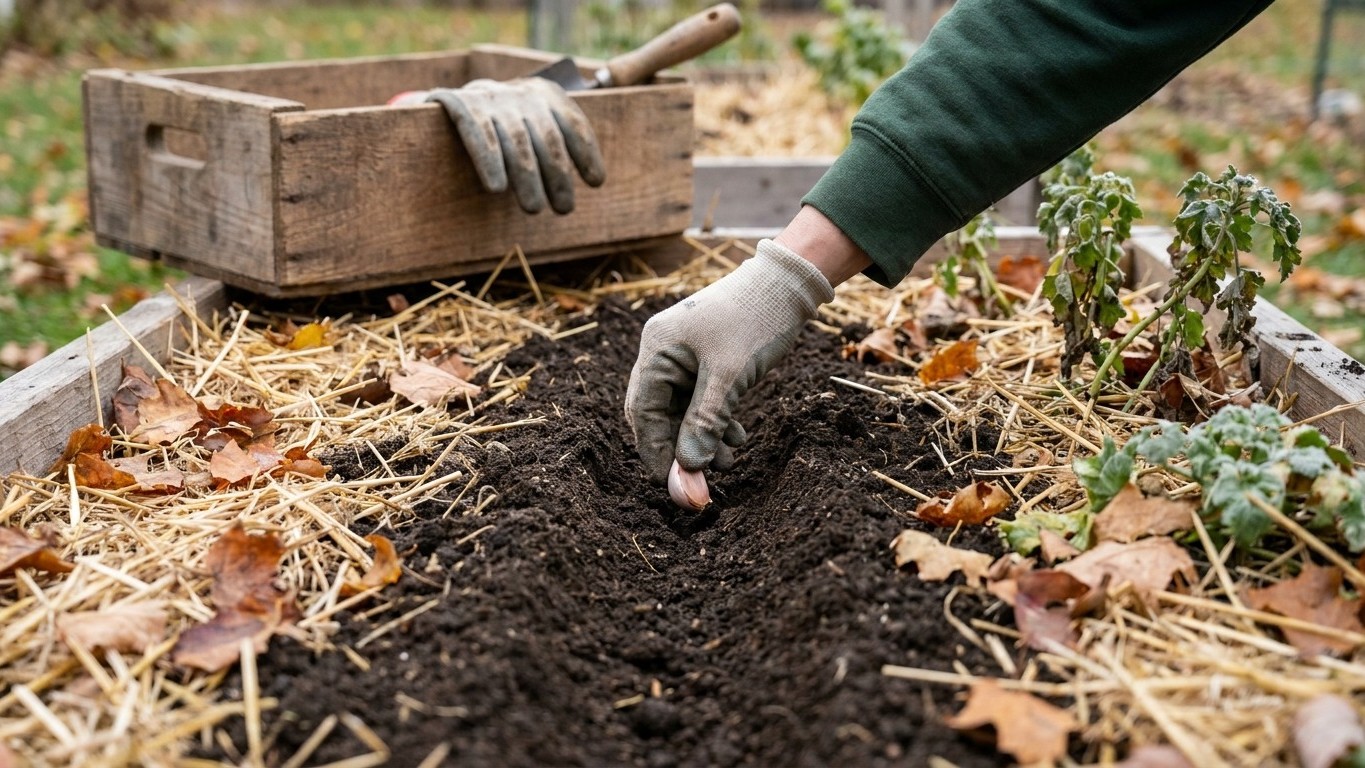

By November, Nunavut has no outdoor planting window of any kind. The ground has been frozen solid for weeks, daylight is shrinking toward the polar night, and nothing goes into open soil until well into next season. The only real gardening happens indoors: microgreens under lights, forced bulbs, and a hard look at whatever is still in storage from summer.
What goes in the ground in November

The mean first fall frost at Rankin Inlet A lands around September 13, according to Environment and Climate Change Canada’s 1981-2010 climate normals. That means by the time November arrives, the ground has typically been frozen for a month and a half already, on top of a growing season that runs, on average, from June 19 to September 13, barely twelve weeks in a good year. Those are mean dates, not guarantees; in one year out of two the frost falls later than the average, but by November the point is moot either way. The soil is locked.
So the honest answer is that nothing goes into open ground here this month. No garlic cloves pressed into a bed, no bare-root shrubs heeled in, no cold frame sown with hardy greens. In much of Canada a cold frame stretches the season by weeks. In Nunavut, with air temperatures well below anything a cold frame or low tunnel can buffer and daylight hours dropping fast, that trick stops working long before November arrives.
What is still realistic is entirely indoors. Garlic and shallots meant for next season’s harvest need to wait for a spring planting window, not a fall one, given how late and short the frost-free stretch runs here. Forcing chicory roots or a potted rhubarb crown in a dark closet or under a box, using stock pulled from storage, is one of the few “planting” acts that actually work this month. It asks nothing of the ground outside and gives a fresh vegetable indoors during the darkest stretch of the year.
If there is a community greenhouse or hoop structure in the settlement, November is the month to make sure it is sealed, drained of any standing water in irrigation lines, and closed for the season rather than treated as a place to keep something alive outdoors.
What to start under cover
Counting backward from a last-frost mean of June 19 is the right way to time indoor sowing anywhere, and it is also what rules out most of it in November. Onion or leek seedlings destined for transplant typically want ten to twelve weeks under lights before the ground is workable and frost risk has passed. Counted back from a mean date in June, that lands in March or April, not now. Starting them in November means leggy, rootbound plants sitting in trays for months before there is anywhere for them to go.
That does not make a grow light useless this month. It just changes the goal. Under cover in November is for crops meant to be eaten indoors, not transplanted outdoors later: cut-and-come-again lettuce in a shallow tray, microgreens on a windowsill, sprouted peas or radish seeds that are ready in days rather than months, and herbs like chives or basil kept going in a pot near a south-facing window if the settlement’s light allows it.
The two failure modes still apply, just in a different form. Starting something now with the idea of transplanting it outdoors in a few weeks is starting far too early, and it will sit and decline long before the ground thaws. Waiting until spring to start the actual transplant-bound seedlings, on the other hand, risks running out of season altogether given how short the frost-free window is here. November’s job is separate from that: it is about keeping something green and edible on the counter through the dark months, not about getting a jump on next year’s outdoor bed.
What is ready to pick
Outdoors, the honest answer is nothing. There is no overwintered kale poking through snow here the way there might be in a milder province; the ground is frozen too hard and too early for that kind of season-stretching. Anything left in a garden bed by November is not coming back out until the whole cycle turns again.
What still feeds the household comes from two places: what is growing indoors right now, and what was put into storage from the short summer harvest. Microgreens and sprouts are the fastest indoor crop, ready in a matter of days rather than weeks, and they are worth keeping in rotation through the darkest months precisely because they do not depend on daylight hours the way a full-size plant does.
The other job this month is going through whatever potatoes, onions, or root vegetables were grown or brought in and stored over summer. Check them by hand: a potato that has gone soft at one end, an onion with a damp neck, a carrot that has started to shrivel or weep. Pull those out now rather than later, because one turning vegetable in a storage bin speeds up the decline of everything around it. It is a small task, but skipping it in November often means losing a much larger share of the stored harvest by midwinter.
The jobs that matter this month

A winter month in Nunavut is not an empty page. It is a planning and maintenance month, and the deadlines are real even if nothing is in the ground.
Seed ordering belongs here, not later. Given how short and unpredictable the frost-free stretch is at this latitude (a mean growing season of roughly June 19 to September 13, with frost arriving later than average in half of all years), the list of varieties that reliably mature in that window is already narrow. The fastest-maturing, cold-tolerant varieties tend to sell out first, and ordering now means having the right seed in hand rather than settling for whatever is left when spring finally allows planting.
Any woody plants that do survive at this latitude, dwarf willows or hardy shrubs kept in a sheltered spot, should be checked now for wind or ice damage rather than left until a thaw reveals broken stems. Tools used over the brief summer deserve real attention too: cleaning off soil, sharpening blades, and oiling anything metal before it sits unused for months in cold storage.
Soil planning also happens now. If raised beds or a greenhouse plot produced anything this past summer, November is the time to think through what depleted the soil and what a rotation should look like once the ground is workable again. Testing soil, where that is practical, and sketching out next season’s bed layout costs nothing now and saves scrambling later. Compost, where it is kept going at all in a climate this cold, needs checking to make sure it has not frozen solid and stalled completely.
What not to do in November
The most common mistake at this latitude is trusting a mild afternoon. A day that feels almost warm compared to the week around it does not mean the ground has thawed or that it is safe to uncover anything left outside. Soil temperature at depth lags air temperature by days or weeks, and a single warmer afternoon changes nothing about a frozen bed.
Uncovering a cold frame, greenhouse bed, or mulched area after what seems like a break in the weather is a related error. Once something is sealed up for winter, opening it back up on a whim exposes it to a hard refreeze that does more damage than the cold it was protected from in the first place. Leave winter covers alone once they are on.
Feeding nitrogen to anything still green indoors or in a greenhouse at this point is also a mistake. Nitrogen pushes soft new growth, and soft new growth is exactly what struggles most under the low light and cold this month brings. If a potted herb or indoor green looks like it needs help, more light or a slightly warmer spot does more good than fertilizer.
Finally, resist the urge to start transplant-bound seedlings early just because a grow light is sitting idle. Starting them now, months ahead of any realistic transplant date, produces exactly the leggy, rootbound plants that struggle once they finally do go into soil.
Checking this against your own county
A territory-wide month is a starting point, not an instruction. Nunavut spans an enormous range of latitude and coastline, and conditions in one community can differ sharply from another only a few hundred miles away. The frost dates and hardiness figures cited here come from the Rankin Inlet A station; a community farther north or on a different coastline may see its frozen season start earlier and last longer still.
For anything more specific to a particular settlement, Agriculture and Agri-Food Canada is the right federal starting point: https://agriculture.canada.ca/en.
Common questions
Can anything be planted outdoors in Nunavut in November?
No. The ground is frozen well before November arrives, given a mean first fall frost around September 13 at Rankin Inlet A. Any planting this month has to happen indoors.
What hardiness zone is Nunavut, and does it matter for November planting?
The reference city sits in Canadian hardiness zone 0a, using the Canadian system, which is built on seven climate variables rather than the single-variable USDA system used elsewhere in the US. It cannot be converted directly to a USDA zone, and it is not a substitute for checking your own community’s actual conditions.
Is a cold frame or greenhouse useful in Nunavut in November?
Not for extending the outdoor season this month. By November, cold and lack of daylight overwhelm what a cold frame or unheated greenhouse can buffer at this latitude. Any structure like that should be sealed and drained for winter rather than opened for planting.
What should be checked in stored crops during November?
Any potatoes, onions, or root vegetables held over from summer should be inspected by hand for soft spots, sprouting, or dampness at the neck. Removing a single turning item promptly protects everything stored around it.
Gardeners who plant by the Moon can check the November 2026 moon planting calendar, a tradition rather than a proven method.
Related guides
- the Nunavut planting calendar
- What to Plant in Nunavut in October
- What to Plant in Nunavut in December
Elsewhere? See what to plant in November in every state and province.