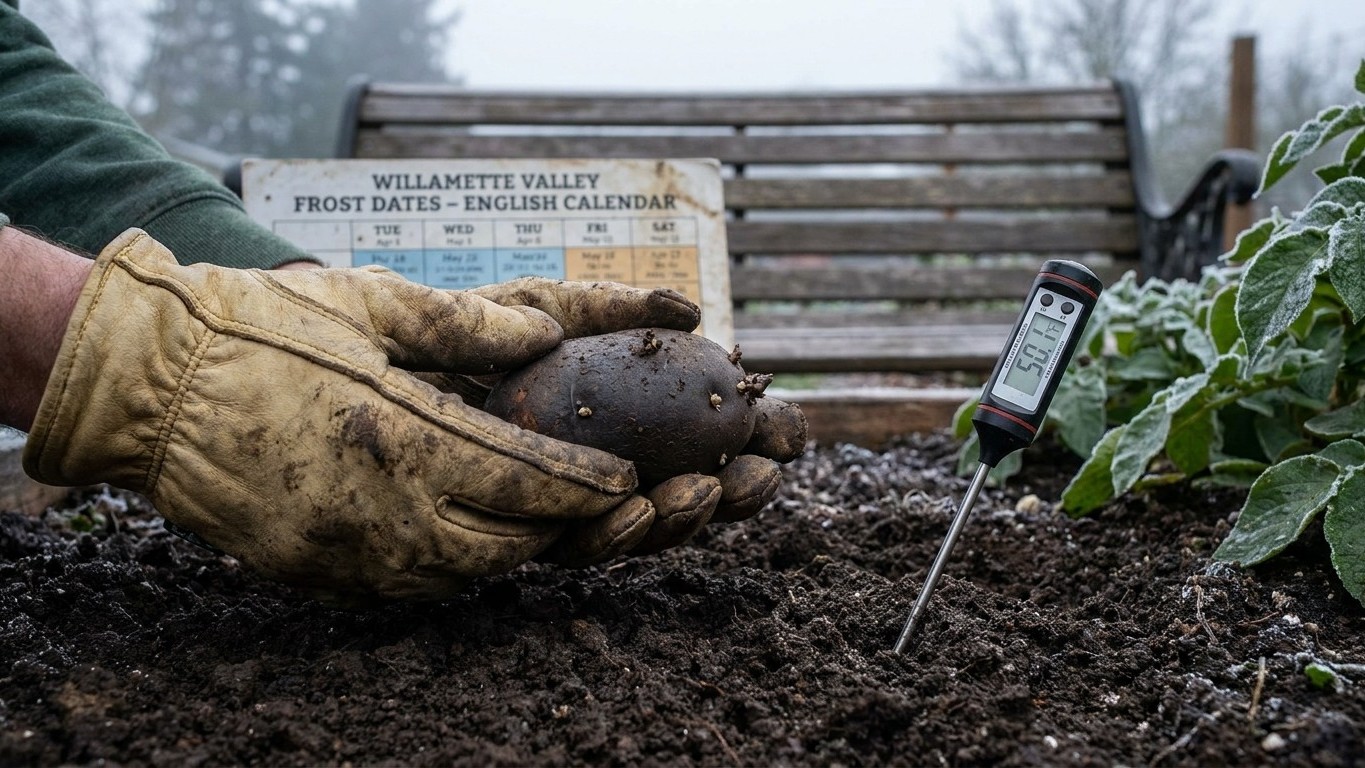

In Portland and other spots west of the Cascades, potatoes go into the ground 14 to 21 days before the last spring frost, once soil temperature reaches 50°F. That last frost date runs from March 6 to March 21, according to NOAA’s National Centers for Environmental Information, 1991-2020 Climate Normals for station USW00024229. Counting back puts planting in mid-February to early March for that region alone.
The short answer
Start with the number that matters: March 6 to March 21. That’s the 30-70% freeze-probability window for the last 32°F frost at the Portland weather station, as published in NOAA NCEI’s 1991-2020 U.S. Climate Normals. It’s not a guess averaged from folklore or a farmers’ almanac. It’s a statistical band built from three decades of daily temperature readings at one specific station, and it applies to that station’s immediate area, not to the whole state.
Working backward from that window is the entire method. Potatoes don’t care what the calendar says. They care what the soil says. Utah State University Extension and the University of Maine Cooperative Extension both frame planting the same way: get seed potatoes into ground that has reached 50°F, and do it 14 to 21 days ahead of your last frost date. For a Portland-area gardener using the March 6 to March 21 window, that math lands somewhere in the second half of February through the first week of March, depending on how quickly soil warms in a given spot.
Here’s the catch that trips up a lot of people moving to Oregon from other states: this window belongs to the Willamette Valley and the rest of the mild, marine-influenced country west of the Cascades. It does not belong to Bend, Burns, or anywhere in the high desert east of the mountains. Those regions run on a shorter, harsher growing season with their own frost timing, and NOAA’s Portland station data simply doesn’t describe them. If you garden in central or eastern Oregon, the mechanism (count back from your last frost, plant at 50°F soil) still applies. The dates attached to it do not.
So the honest short answer has two parts. West of the Cascades, near Portland, the count-back window opens as early as mid-February. Everywhere else in Oregon, you need your own local frost date before the math means anything, because a state this geographically split doesn’t have one planting day that works for all of it.
What actually decides it
Soil temperature, not calendar date
The date on your kitchen calendar has no effect on a potato. Soil temperature does. Utah State University Extension identifies 50°F soil as the trigger point, and that’s why the 14-to-21-day window before last frost exists in the first place: it’s simply how long it typically takes soil to climb to 50°F once the region is trending toward its frost-free stretch. A cold, wet spring can push that 50°F mark later even if the calendar frost date arrives on schedule. A gardener with south-facing, sandy soil that drains and warms fast might hit 50°F noticeably earlier than a neighbor with heavy clay in a shaded low spot. The frost date sets the general season. The soil thermometer sets the actual planting day.
The heat ceiling: why timing matters more east of the Cascades
The other half of the mechanism sits at the opposite end of the thermometer. Both Utah State University Extension and the University of Maine Cooperative Extension point to the same upper limit: soil temperatures above 90°F inhibit tuber set and fill. Once the ground gets that hot, the plant stops sizing up its potatoes, and no amount of extra watering reverses it. That’s not a drought problem you can irrigate your way out of. It’s a heat problem baked into the timing decision itself.
This is exactly why the same count-back method produces very different strategies depending on where in Oregon you’re standing. West of the Cascades, summers stay moderate enough that the 90°F soil ceiling is rarely the limiting factor, so the planting conversation mostly revolves around the cool end, waiting for 50°F soil without waiting so long that you lose growing time. In central and eastern Oregon’s high desert, summer heat arrives harder and stays longer, which raises the odds of soils crossing that 90°F line while tubers are still trying to size up. In that kind of climate, the smart move isn’t to nurse a crop through the hottest stretch of summer. It’s to plant as early as soil allows and aim to dig a spring crop before peak heat closes the window.
| Region | Last frost timing | Season character | Planting implication |
|---|---|---|---|
| West of the Cascades (Portland reference) | March 6 to March 21 (NOAA NCEI) | Mild, marine-influenced, longer frost-free stretch | Standard 14-21 day count-back from local last frost |
| Central and Eastern Oregon (high desert) | Not published in the facts used here | Shorter season, sharper summer heat | Plant as early as soil allows; target a spring crop ahead of peak heat |
How to do it
- Find your own local last spring frost date rather than assuming Portland’s March 6 to March 21 window applies to your yard, especially if you’re east of the Cascades or in a valley pocket with its own microclimate.
- Count back 14 to 21 days from that local last frost date to estimate your target planting window, following the timing Utah State University Extension and the University of Maine Cooperative Extension both use.
- Check actual soil temperature with a soil thermometer rather than relying on the calendar alone, and wait until it reads 50°F before planting.
- Choose certified seed potatoes rather than potatoes from a grocery bin or last year’s saved crop. Uncertified seed carries a real risk of carrying viruses into your soil and your future harvests.
- Select a season class suited to your climate and your plans, early, mid-season, or late, since none of the source material publishes a specific days-to-maturity number for any variety.
- Match the variety to its intended use rather than to texture labels. Choose potatoes described as good for baking, or good for boiling, depending on how you plan to cook them.
- Cut and cure seed pieces if needed, then plant once soil temperature and your count-back window both line up.
- In regions with a higher risk of crossing the 90°F soil threshold during summer, plan the crop as an early, spring-timed harvest rather than a season-long one, so tuber fill finishes before the heat ceiling is reached.
What goes wrong
- Planting by the calendar instead of the soil. A gardener plants on the “right” date from a chart, but a cold, wet spring has kept soil well under 50°F. Remedy: check soil temperature directly and delay planting until it actually reaches 50°F, regardless of what the date says.
- Applying Portland’s frost window to a different part of Oregon. The March 6 to March 21 range comes from a single NOAA station in Portland and describes conditions west of the Cascades. Remedy: look up frost timing specific to your own area rather than borrowing Portland’s numbers for the high desert or another region entirely.
- Assuming more water fixes stalled tuber growth in summer heat. Once soil crosses 90°F, tuber set and fill are inhibited according to Utah State University Extension and the University of Maine Cooperative Extension, and irrigation doesn’t reverse that. Remedy: plant early enough that the bulk of tuber sizing happens before soil regularly hits 90°F, particularly in hotter regions.
- Using uncertified seed potatoes to save money. Seed from a grocery store or a saved harvest can carry viruses that weaken plants and reduce yield, sometimes without obvious symptoms the first season. Remedy: buy certified seed potatoes each time you plant.
- Choosing a variety by texture guesswork instead of published use. Terms like waxy or floury aren’t the language the source material uses. Remedy: pick a variety based on its stated best use, baking or boiling, and its season class, early, mid-season, or late.
Common questions
Does the March 6 to March 21 frost window apply to all of Oregon?
No. That window comes from NOAA NCEI data at a single Portland-area station and reflects conditions west of the Cascades. Central and eastern Oregon’s high desert has its own, shorter growing season not covered by that figure.
What soil temperature should I wait for before planting potatoes?
Utah State University Extension identifies 50°F soil as the planting trigger, reached roughly 14 to 21 days before the local last frost date.
Can I keep watering potatoes through a heat wave to protect the harvest?
No. Once soil rises above 90°F, tuber set and fill are inhibited according to Utah State University Extension and the University of Maine Cooperative Extension, and watering doesn’t reverse that effect. The better fix is timing the crop earlier so sizing finishes before the heat arrives.
Why does this page recommend certified seed potatoes specifically?
Uncertified seed, including potatoes from a grocery store or saved from a prior harvest, carries a meaningfully higher risk of introducing viruses into your soil and future crops. Certified seed is grown and inspected specifically to limit that risk.