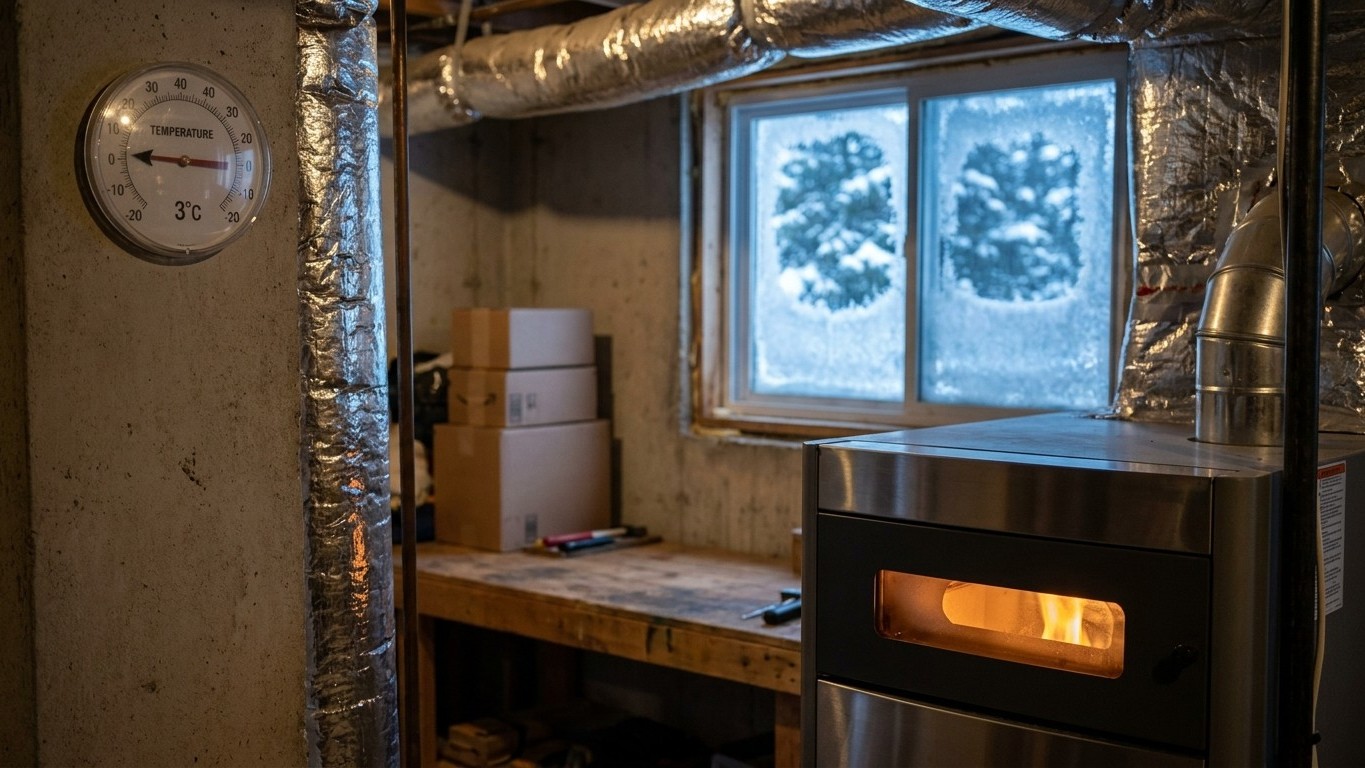

In Newfoundland and Labrador, the answer isn’t a month at all. At St. John’s, the 30-year average temperature stays below the 18°C heating threshold in every single month, including August. There’s no “on” switch to flip because the heating season never fully turns off. Demand simply rises and falls, peaking hard in January.
When the heating season starts in Newfoundland and Labrador
There’s no starting month to give here, and naming one would misrepresent the climate data. At the St. John’s A station, the mean daily temperature never climbs above the 18°C base used to calculate heating degree days, not even in the warmest month. August, the mildest stretch of the year, still averages 16.1°C, which is enough below the threshold that some heating demand persists straight through the calendar. This is one of the few places in North America where the heating season is effectively year-round rather than seasonal in the usual sense.
What does change is intensity. Demand peaks in January, when the region logs 698 heating degree days below 18°C, the highest monthly total of the year. From there, the load eases through spring, bottoms out in midsummer, then climbs again as fall sets in. The shape of that curve matters more here than any single start date, because it tells you when a furnace or baseboard system is coasting and when it’s working flat out.
A word of caution before the numbers: these are 30-year averages, not a forecast for any particular week. The first genuinely cold night of any given fall can land well ahead of what a monthly normal would suggest, so treat the table below as a guide to the season’s rhythm, not a countdown.
| Month | Heating Degree Days (below 18°C) |
|---|---|
| January | 698 |
| February | 646 |
| March | 638 |
| April | 484 |
| May | 359 |
| June | 216 |
| July | 85 |
| August | 76 |
| September | 172 |
| October | 329 |
| November | 449 |
| December | 603 |
How hard the winter works here
Add up those monthly figures and St. John’s lands at roughly 4,755 heating degree days a year below 18°C. That number is a stand-in for fuel use: a house that racks up twice the degree days of another, all else equal, burns roughly twice the energy to stay warm. It’s a rough proxy, not an exact bill, but it scales in the right direction.
What the annual figure alone can’t show you is the shape of the load, and that’s where the monthly table earns its keep. Two places can post the same yearly total and still feel completely different to live in, one carrying a long, mild grind and the other a short, brutal spike. Newfoundland’s pattern, based on the numbers above, leans toward the former: degree days never disappear even in midsummer, and the climb into fall and the retreat out of it are gradual rather than sudden. That’s a different kind of demand on a heating system than a short, sharp winter followed by months of nothing to do.
This figure is counted on an 18°C base over the 1981-2010 period at a single station, so it describes St. John’s specifically, not the province as a whole, and it isn’t something you’d ever want to line up against a heating degree day total from south of the border. Different base temperature, different measurement period, different math entirely.
What most homes in Newfoundland and Labrador actually heat with
Statistics Canada’s most recent survey of primary heating systems in the province shows a clear leader, and it isn’t the one most Americans would expect.
| Primary Heating System | Share of Homes |
|---|---|
| Electric baseboard heaters | 56% |
| Forced-air furnace | 9% |
| Heat pump | 8% |
| Boiler with hot-water or steam radiators | 6% |
| Heating stove | not reported |
That “not reported” line for heating stoves isn’t a zero. It means the sample size was too small for Statistics Canada to publish a reliable estimate, not that nobody in the province burns wood or pellets for heat.
Electric baseboard heaters dominating this province tells you what was cheap and straightforward to install when a lot of the housing stock went up, not what’s necessarily the right call for a given house today. That distinction matters, because a majority share is a snapshot of installation history, not a recommendation.
Baseboard heat has real strengths for a climate that stays cold this long: no ductwork to leak, no central blower to break down, and room-by-room control that lets you keep a bedroom cooler while the living room runs warm. The tradeoffs show up elsewhere. There’s no whole-house air filtration, no dehumidification, and no central air conditioning riding along on the same system. The one maintenance item that catches people out is airflow. Baseboard units heat by convection, pulling cool air in low and pushing warm air out the top, and a couch, curtain, or stack of boxes pushed against one blocks that cycle, forces the unit to run longer to hit the same room temperature, and creates a hot surface where nothing should be sitting.
Run it once before you need it
A heating system that’s going to fail tends to fail on the first genuinely cold night, which is exactly when every technician in the region is already booked solid. Given how gradually St. John’s slides into its winter load, the smart window to test everything is during the summer lull, July or August, when the monthly degree-day count bottoms out and a system that needs attention won’t leave anyone cold while it gets fixed.
- Turn the system on for a short cycle, even in warm weather, and just listen. Rattling, grinding, or a burner that won’t catch on the first try are all worth noting now rather than in November.
- Expect a faint burning-dust smell on that first firing. It’s normal, caused by dust that settled on heating elements or a heat exchanger over the summer, and it should clear within a few minutes. A smell that lingers or gets stronger is not normal.
- If the system has a filter, forced-air furnaces do, heat pumps often do, check it and replace it if it’s gray with buildup. A clogged filter forces the blower to work harder for less heat delivered to the room.
- Clear the space around baseboard units, radiators, or an outdoor heat pump unit. Six inches of clearance in front of a baseboard heater and a clean, unobstructed outdoor coil both matter for how efficiently the system moves heat.
- For anyone on a forced-air furnace, keep in mind that in a typical house, about 20%-30% of the air moving through the duct system is lost to leaks, holes, and poorly connected ducts. A furnace can be running perfectly and a room can still stay cold because of what’s happening between the furnace and the register.
- Test the carbon monoxide alarm. Any fuel-burning heating system can produce carbon monoxide if something goes wrong, and a working alarm is the backstop that catches it before anyone notices a problem.
If the short test cycle turns up a smell that won’t clear, a sound that doesn’t stop, or a carbon monoxide alarm that fails its test, that’s the point to call a technician rather than wait and see. Better to find out in July than January.
What turning it down is actually worth
The U.S. Department of Energy puts a specific number on thermostat setbacks: “You can save as much as 10% a year on heating and cooling by simply turning your thermostat back 7-10 F for 8 hours a day from its normal setting.” That’s a yearly figure tied to a specific setback range and a specific number of hours, covering both heating and cooling combined, not a per-degree formula and not a winter-only number.
In a place where the heating load barely lets up, even in midsummer, that setback has more hours in the year to work with than it would somewhere with a short, hard winter and a long shoulder season of no heating at all. A programmable or smart thermostat set back overnight or during an empty house during the workday is doing something almost every month here, not just for a few concentrated weeks.