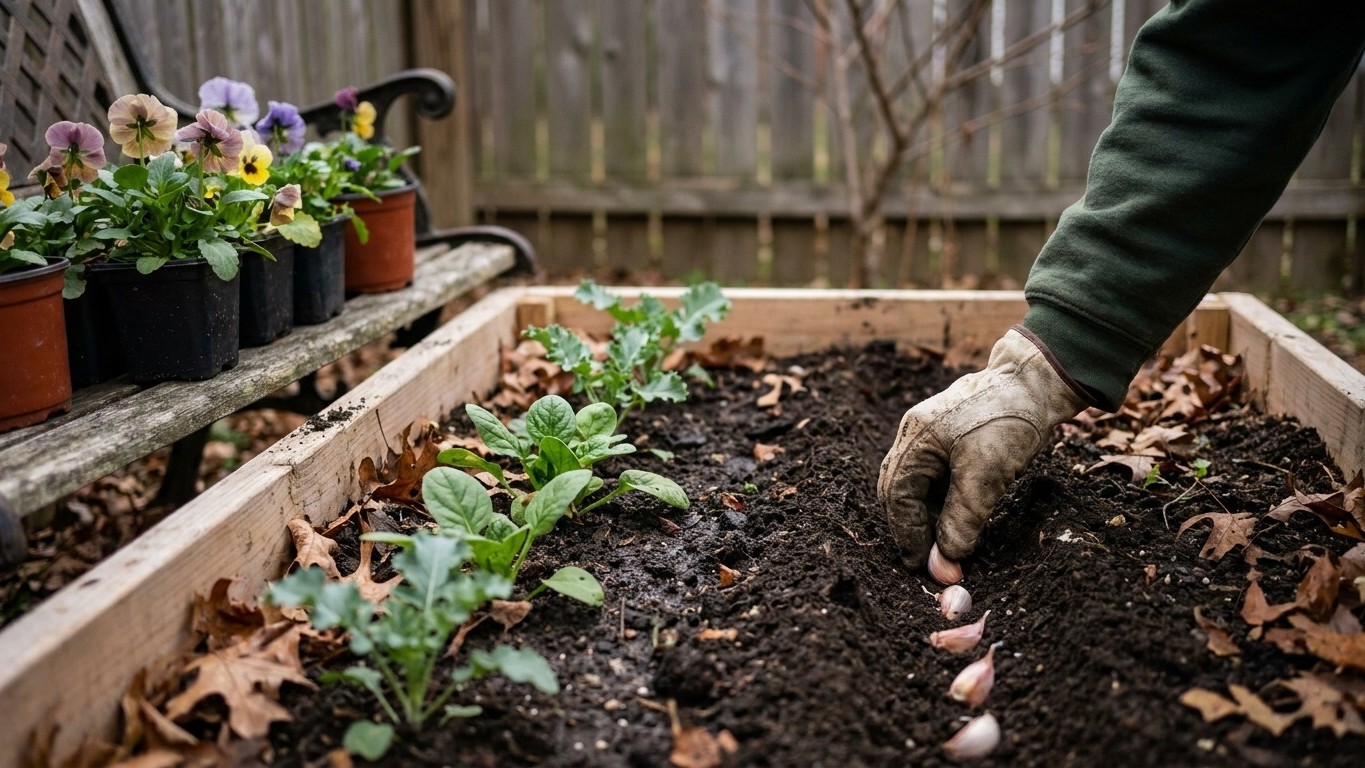

By October, West Virginia gardens are past their summer peak and running against the first fall frost, which lands somewhere between October 18 and November 1 in the Charleston valley. That means garlic, cover crops and the last hardy greens go in now, while anything tender needs to come out or come under cover before that window closes.
What goes in the ground in October

The decision this month isn’t the calendar, it’s soil temperature and how many frost-free days are left. NOAA’s 1991-2020 climate normals put the first 32°F freeze at station USW00013866 (Charleston) between October 18 and November 1. That’s a river-valley reading. Higher elevations across the state, the ridges and the eastern panhandle counties in particular, tend to see that first freeze noticeably sooner, so treat early October in those areas the way you’d treat late October in Charleston.
Garlic and shallots are the signature October planting here. Cloves want cool soil to root into before the ground locks up, without pushing top growth that a hard freeze would damage. Push individual cloves root-down about two inches deep, space them roughly six inches apart, and mulch after planting rather than before, so the soil has a chance to cool first.
Early in the month, while soil is still workable and warm from summer, there’s a narrow window for quick-maturing greens: spinach, mesclun mixes, radishes and turnip greens can still make a harvest if they go in during the first week or two and the weather cooperates. Past mid-month, that window is closing fast in most counties.
Cover crops belong in the ground now too. Cereal rye, winter wheat and crimson clover need enough time to establish roots before hard frost sets growth back, so aim to have them sown by the middle of the month rather than the end.
What doesn’t go in: tomatoes, peppers, beans, squash, cucumbers, anything that dies at 32°F. If it’s warm-season, October is a month for pulling it out of the garden, not planting it.
What to start under cover
Cold frames and low tunnels stretch the season, but the arithmetic still runs backward from that same first-frost window. A cold-frame planting of lettuce, spinach, mâche or claytonia typically needs four to six weeks of decent growing conditions before shortening daylight slows things down for the winter. Counting back from the October 18 to November 1 range, that puts the practical sowing date for a fall cold-frame crop somewhere in the first half of the month for most of the state, earlier for the higher, colder counties.
The two ways this goes wrong are predictable. Sow too early into soil that’s still summer-warm and covered, and seedlings can bolt or stretch into leggy, weak plants before cold weather even arrives to slow them down. Sow too late and the seedlings are still tiny when daylight drops below the level that supports active growth, leaving them undersized and vulnerable heading into winter rather than established enough to hold and resume growth once light returns.
There’s a middle path worth knowing: many gardeners in this climate treat a cold-frame or low-tunnel planting as a two-stage crop, growing it to a usable size before growth nearly stops, then harvesting through the cold months as a standing larder rather than expecting continuous growth. That changes the target date, not the backward-counting logic. Either way, the frame or tunnel needs to be in place and closed by the time night temperatures start dipping into the 30s consistently, which for most of the state tracks close to that same fall frost window.
What is ready to pick
October is a harvest month more than a planting one for most of what’s already growing. Winter squash and pumpkins come out once the rind resists a fingernail and the skin has lost its shine; leave them in the field too long past a hard freeze and the stems soften, cutting their storage life short. Potatoes are ready once the vines have died back on their own, not before.
Sweet potatoes need to be dug ahead of frost damage to the vines, since a chilled vine can let rot travel down into the tuber even if the soil itself hasn’t frozen. Late tomatoes still on the vine when frost is forecast are worth picking green and ripening indoors rather than leaving to gamble against the window.
Basil is the one herb that can’t wait. It browns and collapses at the first real chill, well before most other crops show damage, so it’s worth cutting and preserving before the rest of the frost-sensitive harvest comes in. Brassicas, on the other hand, actually improve with the first light cold snaps: cabbage, kale and broccoli tend to sweeten as sugars concentrate in response to cooler nights, so there’s no rush to pull those.
For anything already in storage, apples and squash from earlier harvests are worth checking now for soft spots or bruising. One rotting apple in a bin will take its neighbors down with it faster than most people expect.
The jobs that matter this month

Tender bulbs and tubers, dahlias, gladiolus, canna, need to come out of the ground before a hard freeze damages them, then cure and store in a cool, dry spot. This is a hard deadline tied directly to that first-frost window, not a flexible one.
Fall is also a strong time to plant spring-flowering bulbs like tulips and daffodils, since they need a stretch of cool soil to root before the ground freezes solid. Getting them in during October, rather than waiting until the ground is nearly frozen in November, gives roots more time to establish.
Established trees and shrubs can go in the ground this month too. Cooler air combined with soil that’s still warm from summer favors root growth without the stress of pushing top growth, which is exactly what you want heading into winter.
Clearing spent plant debris matters more than it looks. Diseased leaves and stems left in the bed over winter give fungal spores and insect eggs a place to overwinter close to next year’s crop. A clean bed now is a healthier bed in spring.
This is also the month to pull a soil test if one hasn’t been done, since lime needs months to shift pH and fall application gives it that lead time before spring planting. Sharpen and clean tools, order garlic if it hasn’t gone in yet, and get spring seed orders in before the varieties worth having sell out. None of these are glamorous jobs, but skipping them shows up as a worse garden months down the line.
What not to do in October
The most common mistake is trusting a warm afternoon over the calendar. A run of mild days doesn’t cancel the seasonal shift, and the first frost in the Charleston valley can still land anywhere in that October 18 to November 1 range regardless of how the week feels. Tender crops left uncovered on the assumption that “it’s still warm” are the ones lost overnight.
Pruning trees and shrubs now is another trap. Cutting back growth in October can trigger a flush of new, tender shoots right when frost is closest, and that new growth is exactly what gets damaged first. Dormant pruning belongs later in the winter, once the plant is fully shut down for the season.
Feeding lawns or perennial beds with a high-nitrogen fertilizer this month pushes soft new growth at the worst possible time, right as the plant should be hardening off for winter rather than expanding. If a fall feeding is planned, it should lean toward the kind formulated for root and hardiness support, not general green-up blends meant for the growing season.
Piling mulch on too early, while soil is still holding summer warmth, is also worth avoiding. Heavy mulch on warm soil traps moisture and invites the kind of fungal issues and rodent nesting that a slightly later mulching, once the ground has started to cool, largely sidesteps.
Checking this against your own county
A state-wide frost window is a starting point, not a fixed instruction. West Virginia spans USDA hardiness zones 5a through 7a, and the Charleston river valley numbers above will run earlier at elevation and later in the milder eastern panhandle. A ridge-top garden and a valley garden twenty miles apart can see their first frost weeks apart from each other.
For a planting calendar tuned to a specific county, the West Virginia University Extension Service is the reliable next stop, with local agents who can speak to elevation and microclimate effects.
Common questions
Can I still plant tomatoes in October in West Virginia?
No. Tomatoes are killed by frost, and the state’s first fall frost typically arrives between October 18 and November 1 in the Charleston valley, earlier at higher elevations. October is a month for harvesting remaining tomatoes, not planting new ones.
When should garlic go into the ground in West Virginia?
October is the standard window, since cloves need cool soil to establish roots before the ground freezes without pushing vulnerable top growth. Planting too early in still-warm soil can encourage premature shoots.
What USDA hardiness zone is West Virginia?
The state spans zones 5a to 7a according to the USDA Plant Hardiness Zone Map, based on 1991-2020 average extreme minimum winter temperatures. That’s a wide range across one state, so a garden’s actual zone depends heavily on elevation and location.
Is it too late to sow a cover crop in October?
Early in the month, no. Cereal rye, winter wheat and crimson clover still have time to root before frost if sown in the first half of October. Waiting until the last week or later cuts into the establishment period they need before cold weather stops growth.
Gardeners who plant by the Moon can check the October 2026 moon planting calendar, a tradition rather than a proven method.
Related guides
- What to Plant in West Virginia in February
- What to Plant in West Virginia in January
- What to Plant in West Virginia in March
- the West Virginia planting calendar
- What to Plant in West Virginia in September
Elsewhere? See what to plant in October in every state and province.