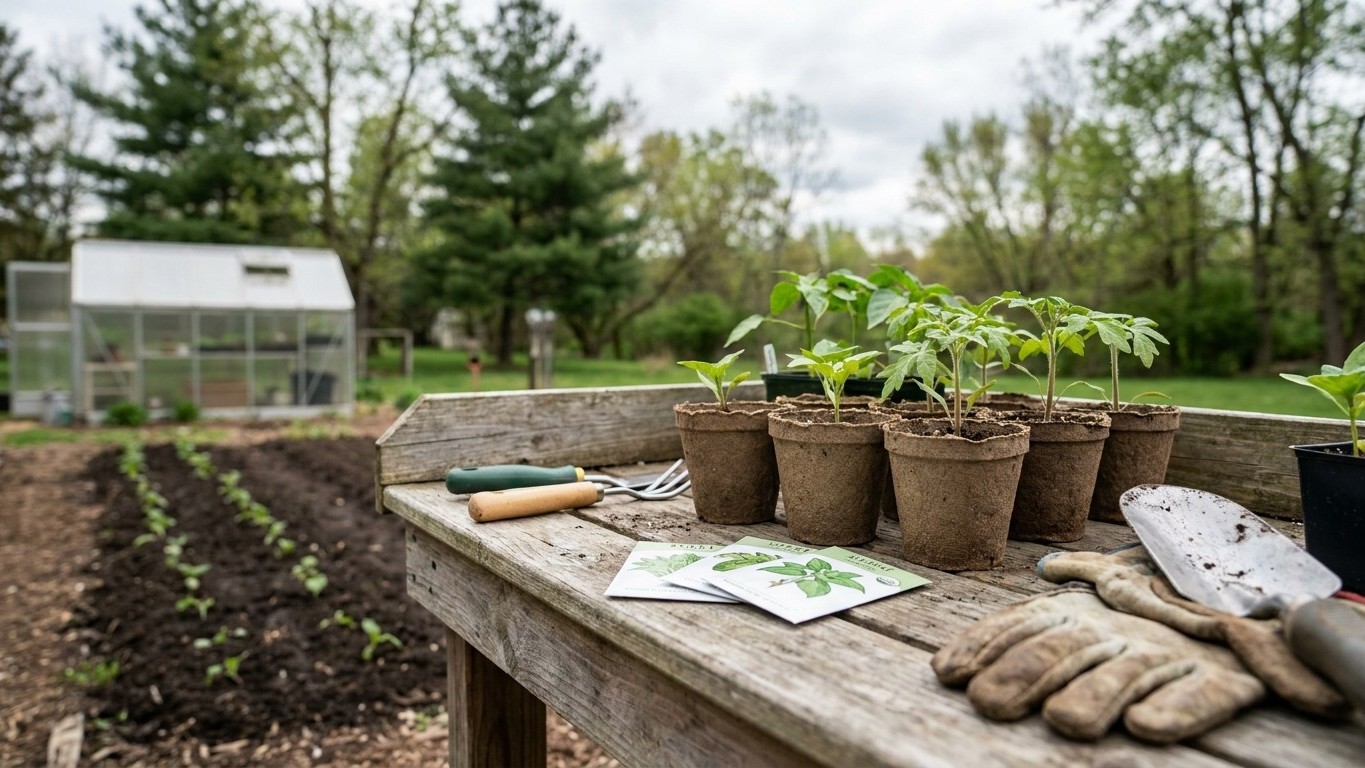

April in Wisconsin is a hardy-crop month, not a tomato month. Direct-sow peas, spinach, radishes, and lettuce once the soil is workable, and get onion sets, seed potatoes, and asparagus or rhubarb crowns into the ground. Start warm-season seeds indoors under lights. Tender transplants stay inside until the last spring frost window, April 16 to April 29, has passed in your part of the state.
What goes in the ground in April
The calendar says April, but the soil doesn’t care what the calendar says. What matters is whether the ground has dried out enough to crumble in your hand instead of forming a wet ball, and whether soil temperature has climbed enough for seeds to germinate instead of rotting. That’s the real gate, not the date on the seed packet. Wisconsin’s last spring frost falls somewhere between April 16 and April 29, according to NOAA’s 1991-2020 climate normals for the state’s official reporting station. That’s a two-week band, and it means anything frost-tender is still a gamble through most, if not all, of the month.
What tolerates that risk is a short, useful list. Peas go in as soon as the soil can be worked, since a light frost barely slows them. Spinach, lettuce, and other leafy greens shrug off temperatures well below freezing once they’ve got a couple of true leaves. Radishes are fast enough to sneak between cold snaps. Onion sets and onion transplants handle frost without complaint, and so does garlic if you missed the fall planting window and are dividing or resetting cloves in workable ground. Seed potatoes can go in toward the back half of the month in southern counties, though a hard freeze after sprouting can nip the foliage back (the tubers underground usually survive fine). Asparagus and rhubarb crowns, along with bare-root fruit trees, brambles, and strawberry plants, are dormant-planting jobs that belong in April specifically because the plants haven’t broken dormancy yet.
Everything else, tomatoes, peppers, beans, squash, cucumbers, basil, stays out of open ground. Wisconsin spans USDA hardiness zones 3b to 6a, a range built on average extreme minimum winter temperature rather than spring timing, but it’s a useful reminder that a warm afternoon in Milwaukee doesn’t mean the same thing as a warm afternoon in Hayward. Treat any warm stretch before the frost window closes as weather, not a signal to plant tender crops.
What to start under cover
April is prime seed-starting season indoors, and the math runs backward from that same frost window rather than forward from a fixed date. Tomatoes typically need six to eight weeks of indoor growth before they’re ready to go outside, so seed started now is aimed at a transplant date in May, after the April 16-29 window has closed in your county. Peppers and eggplant run slower, often eight to ten weeks, which means they should already be up and growing by early April if the goal is sturdy, not leggy, transplants. Squash, cucumbers, and melons are the opposite case: they resent root disturbance and grow fast, so starting them indoors in April, three to four weeks ahead of the outdoor transplant date, is usually enough. Start them too soon and you’ll be fighting rootbound, yellowing seedlings before the ground is even ready.
The two ways this goes wrong both trace back to ignoring the frost window instead of counting from it. Start tomatoes in February expecting an April planting and you’ll end up hardening off tall, weak stems that snap in the first stiff wind. Wait until late April to start peppers and you’ll be transplanting small, underdeveloped plants into a Wisconsin summer that’s already shortening by the time they’d finally produce. The fix is the same either way: pick your likely outdoor planting date based on your county’s typical frost clearance, then count backward using the weeks-before-transplant figure for that specific crop, not a generic “start seeds in spring” instinct.
April is also the month to pot up anything started in February or March that’s outgrowing its cell trays, and to begin hardening off the earliest starts, cold-tolerant brassicas especially, by setting trays outside for a few hours a day once temperatures stay above freezing.
What is ready to pick
Outdoors, April in Wisconsin gives up little. The garden is still mostly bare ground and mud, and anything that looks green is more likely a weed getting a head start than a harvest. Rhubarb may be pushing up its first tightly rolled stalks toward month’s end in southern counties, but pulling stalks before the plant has a few fully unfurled leaves weakens the crown for the rest of the season, so patience matters more than eagerness here.
Where the real April harvest happens is under cover and indoors. Cold frames or low tunnels planted the previous fall with spinach, mâche, or arugula often have usable leaves by April, sometimes surprisingly vigorous ones, since those crops resume growth the moment daylight and soil warmth return. Indoors, sprouts and microgreens are the fastest payoff in the garden calendar: a tray of pea shoots or radish microgreens goes from seed to scissors in seven to fourteen days, no soil temperature or frost window to worry about.
This is also the month to go through the root cellar or pantry with a critical eye. Stored squash that’s held since fall starts showing soft spots and sunken skin around now; anything with a give when you press near the stem end should be used first, not left for later. Potatoes that have started sprouting eyes are still edible once the sprouts are rubbed off, but they’re signaling that storage life is running out. Onions that have gone soft at the neck or started growing a green shoot belong in the next meal, not back in the bin. Treating April as a checkpoint on stored food, not just a planting month, keeps less of it going to waste.
The jobs that matter this month
Soil, pruning, and planning
The single most consequential mistake window in April isn’t a planting mistake at all, it’s working soil before it’s ready. Wet spring soil compacts under a shovel or tiller in a way that can affect drainage and root growth for the rest of the season, so the squeeze test (grab a handful; if it forms a muddy ball instead of crumbling, wait) matters more than any date on a chart. Once soil is workable, this is the month to get a soil test done if you haven’t in a few years, since amendments like lime take time to adjust pH before the growing season is underway.
Dormant pruning of fruit trees, grapevines, and cane berries needs to wrap up before buds swell and break; pruning cuts made after growth starts cost the plant stored energy it needs for the season ahead. If seed orders haven’t gone in yet, April is late but not too late, though the most popular varieties of tomatoes, peppers, and specialty greens routinely sell out earlier in the season, so a shrinking catalog is a sign to order from what’s left rather than wait for a restock.
Maintenance that pays off later
Compost piles benefit from a turn now that the coldest weather has passed, since microbial activity picks up with warmer temperatures and a turn speeds decomposition ahead of when finished compost is needed for spring beds. Tools that spent winter in a shed deserve a cleaning and a sharpening edge before the first heavy use; a dull hoe or pruner does more plant damage, through tearing rather than cutting, than most gardeners realize. Raised beds, trellises, and fencing that took winter damage should get repaired before plants are in the ground and repairs become disruptive. None of these jobs are glamorous, but skipping them in April usually means doing them in June under worse conditions, with plants already in the way.
What not to do in April
The classic April mistake in Wisconsin is trusting the air instead of the frost window. A run of 65-degree afternoons feels like permission to set out tomato transplants, but the last spring frost falls anywhere from April 16 to April 29 depending on location, and a single clear, calm night after a warm stretch is exactly when radiational cooling drops temperatures fast. Warm-season transplants set out early don’t just risk death; a near-miss frost can stunt them permanently even if they survive, leaving them behind all season compared to plants held a couple more weeks.
A related error is uncovering perennial beds, pulling back mulch from strawberries or perennial flower crowns, too early after a mild stretch. That mulch is doing frost protection work, not just looking tidy, and stripping it off during a warm week leaves tender new growth exposed when temperatures inevitably swing back down, which they reliably do in a Wisconsin April.
Fertilizing is the third trap. Applying a high-nitrogen feed early in the month, before plants are actively growing, tends to push soft, lush growth that’s more vulnerable to the very frosts still likely in the forecast, and much of that nitrogen simply leaches away before roots are established enough to use it. Holding off on nitrogen until plants are actively growing, and leaning on a balanced or lower-nitrogen feed at planting time instead, avoids feeding growth the weather isn’t ready to support yet.
Checking this against your own county
A statewide frost window is a starting point, not an instruction specific to your yard. Elevation, distance from Lake Michigan or Lake Superior, and simple latitude move that April 16-29 range by weeks in either direction: lakeshore counties often see a delayed but milder spring, while inland and northern counties can run colder and later. A garden in Bayfield County isn’t on the same clock as one in Kenosha County, even though both sit under the same statewide date range.
The most reliable way to narrow that range for a specific address is through the University of Wisconsin-Madison Division of Extension, which maintains county-level offices and planting guidance built around local conditions rather than a single statewide average.
Common questions
Is it too late to start seeds indoors in April in Wisconsin?
No. Slower crops like peppers benefit from an earlier start, but fast-growing crops such as squash, cucumbers, and many flowers are often better started in April for transplanting a few weeks later, since they resent sitting too long in small containers before the ground is ready.
Can I plant tomatoes outside in April in Wisconsin?
Not safely in most of the state. The last spring frost falls between April 16 and April 29, and tomatoes have zero frost tolerance, so they belong indoors under cover until that window has passed in your specific county.
What vegetables can handle a Wisconsin April frost?
Peas, spinach, lettuce, radishes, kale, and onion sets or transplants all tolerate frost well and are commonly direct-sown or planted in April once the soil is workable, well ahead of the frost window closing.
Why does my county’s frost date differ from the statewide range?
Lake effect, elevation, and north-south position all shift local frost timing, sometimes by several weeks, which is why the statewide April 16-29 range should be treated as a guide to check against county-level data from UW-Madison Extension rather than a fixed date for every yard.