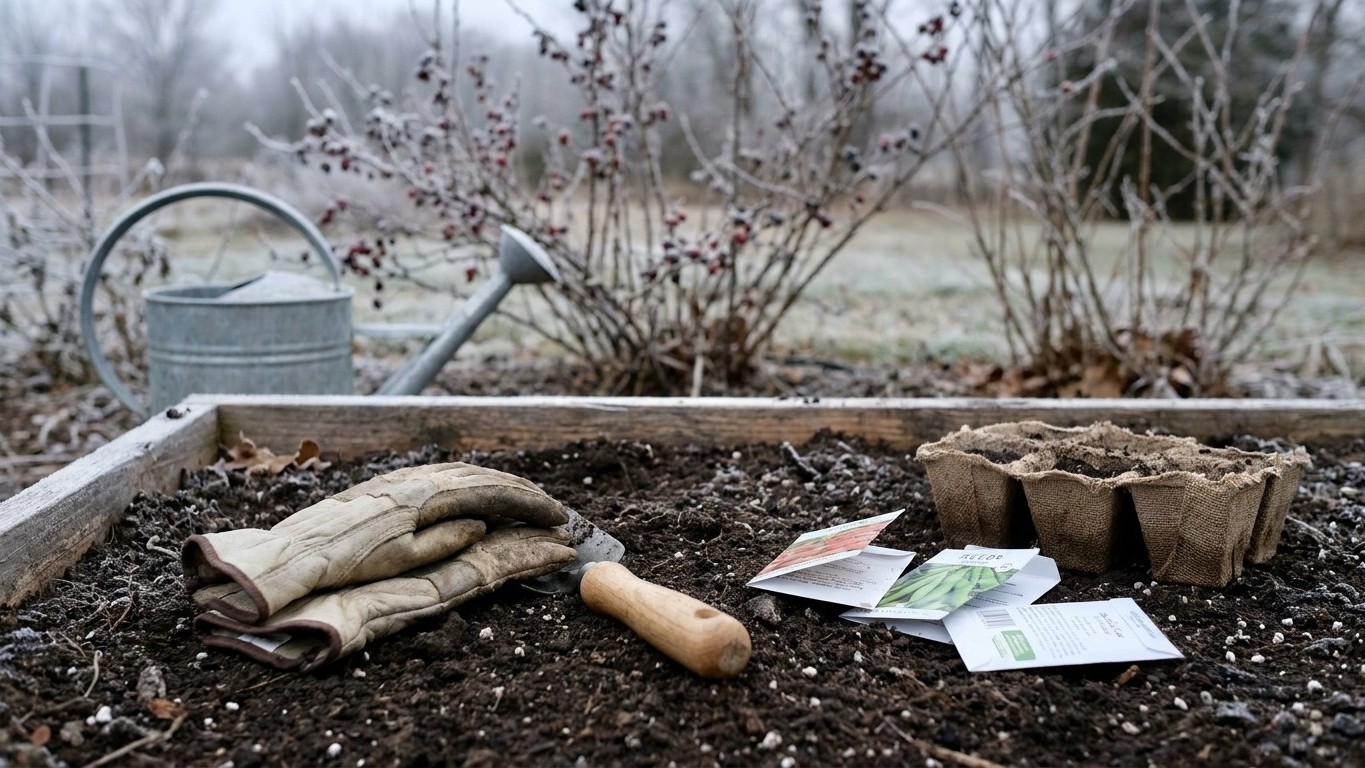

In February in Wisconsin, nothing goes into open ground. Soil across the state’s 3b-6a hardiness range sits frozen solid, and the earliest last-frost date on record for the state’s climate normals doesn’t arrive until April 16 at the soonest. What the month actually offers is indoor seed starting counted backward from that frost window, dormant pruning, bare-root planning, and the kind of soil and tool prep that determines how fast the garden moves once the ground finally opens.
What goes in the ground in February
The decision here isn’t the calendar. It’s soil temperature, and in February that temperature in Wisconsin is somewhere below freezing from Superior to Beloit. NOAA’s 1991-2020 climate normals put the last spring frost between April 16 and April 29, depending on where in the state you’re standing, which means the soil won’t be workable, let alone warm enough for germination, for at least eight to ten more weeks after February ends. There’s no gambling to be done here. The answer is flatly no.
That includes garlic. In most of the country a February gap in ground-freeze lets stragglers get garlic cloves in late. Not in Wisconsin: garlic here goes in during fall, usually October, so it can already be sitting dormant under mulch through the winter. There’s nothing new to plant alongside it now. Shallots follow the same fall-planting logic and aren’t a February option either.
What’s genuinely useful this month is anything that happens under cover or below ground level, not in open beds. Cold frames and low tunnels can hold overwintered greens and give you a head start on hardening off transplants once March arrives, but they’re not for sowing new seed into frozen native soil underneath them. Bare-root fruit trees, canes and roses ordered for spring delivery should be kept dormant, either heeled into a trench of loose mulch in an unheated garage or refrigerated in slightly damp packing material, until the ground actually thaws. And if you dug rhubarb crowns or chicory roots last fall, February is prime time to force them indoors in a dark, cool spot for an early, tender harvest that has nothing to do with outdoor planting at all.
What to start under cover
The math for indoor seed starting runs backward from the frost window, not forward from today’s date. With the last frost falling between April 16 and April 29 depending on location, the slowest growers need to go under lights first. Onions and leeks, which typically want 10 to 12 weeks of indoor growth before transplanting, should already be started or go in during the first half of February for gardeners in the earlier-frost southern counties. Celery, nearly as slow, follows the same early track.
Peppers come next, needing roughly 8 to 10 weeks before they’re ready for the ground, which points to a mid-to-late February start for most of the state. Cabbage-family transplants (broccoli, cabbage, kale started for transplant rather than direct seeding) generally want 6 to 8 weeks and can go out into the garden two to three weeks before the last frost since they tolerate a light freeze, so a late-February to early-March start indoors lines up well.
Tomatoes are the crop most gardeners rush, and February is too early almost everywhere in Wisconsin. At 6 to 8 weeks to transplant size and a frost window that doesn’t clear until mid-to-late April, starting tomatoes now means six or more weeks of extra growth indoors under inadequate light, producing the classic leggy, rootbound seedling that never really recovers once it’s in the ground. The opposite failure shows up with slow growers like onions: start them too late and they never bulk up before the season’s heat sets in. Counting backward from your local frost date, not from boredom with winter, is what keeps both mistakes off the table.
What is ready to pick
Outdoors, the honest answer is nothing. No bed in Wisconsin is producing fresh growth in February. But “nothing to pick” doesn’t mean an empty kitchen if the fall garden was planned with this month in mind.
Kale and leeks left in the ground under a heavy mulch or a blanket of snow can often still be harvested, snow acting as surprisingly effective insulation, though a leek bed that’s frozen solid for weeks straight may need a thaw window to actually dig. Cold frames holding spinach, mâche or claytonia sown back in fall can keep producing small pickings right through the coldest stretch, since these greens tolerate temperatures that would kill nearly everything else. Indoors, sprouts and microgreens are the closest thing to a fresh, fast harvest this time of year, ready in days rather than weeks and needing nothing more than a countertop and a tray.
The other job this month is inspection, not harvest. Stored squash should get a hand-check for soft spots or a sweetish smell, both signs it’s turning and needs to be used immediately rather than left for later. Potatoes sprouting eyes or going soft, and onions gone papery-soft at the neck, are telling you the same thing: pull them from storage now before they take neighboring produce down with them.
The jobs that matter this month
Dormant pruning of fruit trees and berry canes belongs squarely in February. With no leaves to hide the branch structure and the plant fully dormant, cuts made now heal cleanly before spring growth resumes, and there’s far less risk of triggering a burst of tender new wood that a late freeze could kill, the way pruning in a warm spell later in spring sometimes does. Apple and pear trees, raspberry and blackberry canes, and grapevines are all fair game this month if the wood isn’t frozen brittle on the coldest days.
Seed ordering has a real deadline too, even if it isn’t printed on the packet. Popular varieties, especially anything that made a splash the previous season, sell out from seed companies well before planting time, and gardeners who wait until March are often choosing from what’s left rather than what they wanted.
Soil testing can happen anytime the ground isn’t actively frozen at sample depth, but sending a sample off now through the University of Wisconsin’s soil testing services means results and amendment recommendations are back in hand well before spring planting, rather than arriving after the window to till in lime or compost has already tightened.
Beyond that, February is when the unglamorous maintenance gets done: turning the compost pile if it hasn’t frozen into a solid block, cleaning and sharpening pruners and hoes so they’re not doing double duty as rust removers in April, and walking the fence line and raised beds to find the boards that rotted or the post that heaved out of the frozen ground, so repairs happen while there’s time rather than while seedlings are waiting to go in.
What not to do in February
The most common mistake is starting tomatoes, peppers, or other warm-season transplants weeks earlier than the frost math supports, usually driven by cabin fever rather than any change in the actual planting window. A tomato seedling started in early February for an April transplant date that’s really eight to twelve weeks away turns leggy, pale and stressed long before it ever sees the outdoors, and often never fully recovers even after hardening off.
A second trap: treating a warm afternoon as a green light. A 45-degree thaw in February doesn’t mean the soil six inches down has warmed at all, and gardeners who uncover mulched beds or pull row cover during that thaw, thinking spring has arrived, often expose crowns and dormant perennials to a hard refreeze days later that does more damage than the winter cold ever would.
Feeding nitrogen this month is also backward. Dormant plants aren’t taking up nutrients, and a nitrogen application now either washes away with snowmelt before roots are active or, worse, pushes a flush of tender growth right before a freeze can hit it. Hold fertilizer until active growth actually resumes. And pruning during a deep cold snap, rather than a merely cold but stable stretch, can crack brittle wood at the cut rather than making a clean cut at all, so timing dormant pruning around the coldest days matters as much as doing it this month in the first place.
Checking this against your own county
A statewide frost window is a starting point, not an instruction specific to your yard. The April 16-29 last-frost range and October 17-29 first-frost range both shift by weeks depending on where you garden: Lake Michigan pushes fall’s first freeze later along the shoreline while inland southern counties typically freeze by early October and the north freezes earlier still. Elevation and local low-lying frost pockets move things further. For a planting calendar tuned to your specific county, the University of Wisconsin-Madison Division of Extension is the reliable next stop.
Common questions
Can I plant anything outdoors in Wisconsin in February?
No. Soil across the state’s hardiness range of 3b-6a is frozen in February, and the earliest recorded last-frost date doesn’t arrive until April 16. Outdoor planting, including garlic, isn’t an option this month anywhere in the state.
When should I start seeds indoors for Wisconsin’s frost date?
Count backward from your local last-frost date, which falls between April 16 and April 29 depending on location. Onions and leeks need 10 to 12 weeks indoors, peppers need 8 to 10, and tomatoes need only 6 to 8, meaning tomatoes started in February are typically too early.
What USDA hardiness zone is Wisconsin?
Wisconsin spans USDA Plant Hardiness Zones 3b through 6a, based on the 2023 map built on 1991-2020 average extreme minimum winter temperatures. That’s a statewide range, and the zone at any specific address depends on local elevation and microclimate.
Is it too early to prune fruit trees in February in Wisconsin?
No, February is a good window for dormant pruning of fruit trees and berry canes, as long as the wood isn’t frozen brittle on the coldest days. Pruning while the plant is fully dormant reduces the risk of triggering new growth that a later freeze could damage.