
By November, most of Wisconsin has already had its first fall freeze, so the open garden is closing rather than opening. What’s left to plant is narrow: garlic and shallots where soil is still workable, bare-root trees and shrubs while dormant, and anything you can tuck under a cold frame or low tunnel. The bigger work this month happens indoors and in planning, not in the dirt.
What goes in the ground in November
The calendar says November, but the soil doesn’t care about the calendar. It cares about temperature, and in Wisconsin that temperature has usually already crossed the freezing line once before this month even starts. NOAA’s 1991-2020 climate normals put the first fall freeze for the state’s reference station between October 17 and October 29, so by the time November arrives, the ground has typically had at least one hard frost, sometimes several. What decides whether you can still plant is not the date on the wall but whether the soil is still workable with a shovel.
That workability varies enormously across the state. Wisconsin spans USDA hardiness zones 3b through 6a, a range built on the average extreme minimum winter temperature, and that spread means a gardener near Madison, in the warmer southern tier, may still have loose, diggable soil into mid-November, while a grower up near Lake Superior could already be looking at frozen ground and snow cover by the first week. Lake Michigan complicates this further along the eastern shoreline, where the lake’s stored heat pushes the first freeze later than it hits inland areas just a few miles west.
What’s actually safe to plant
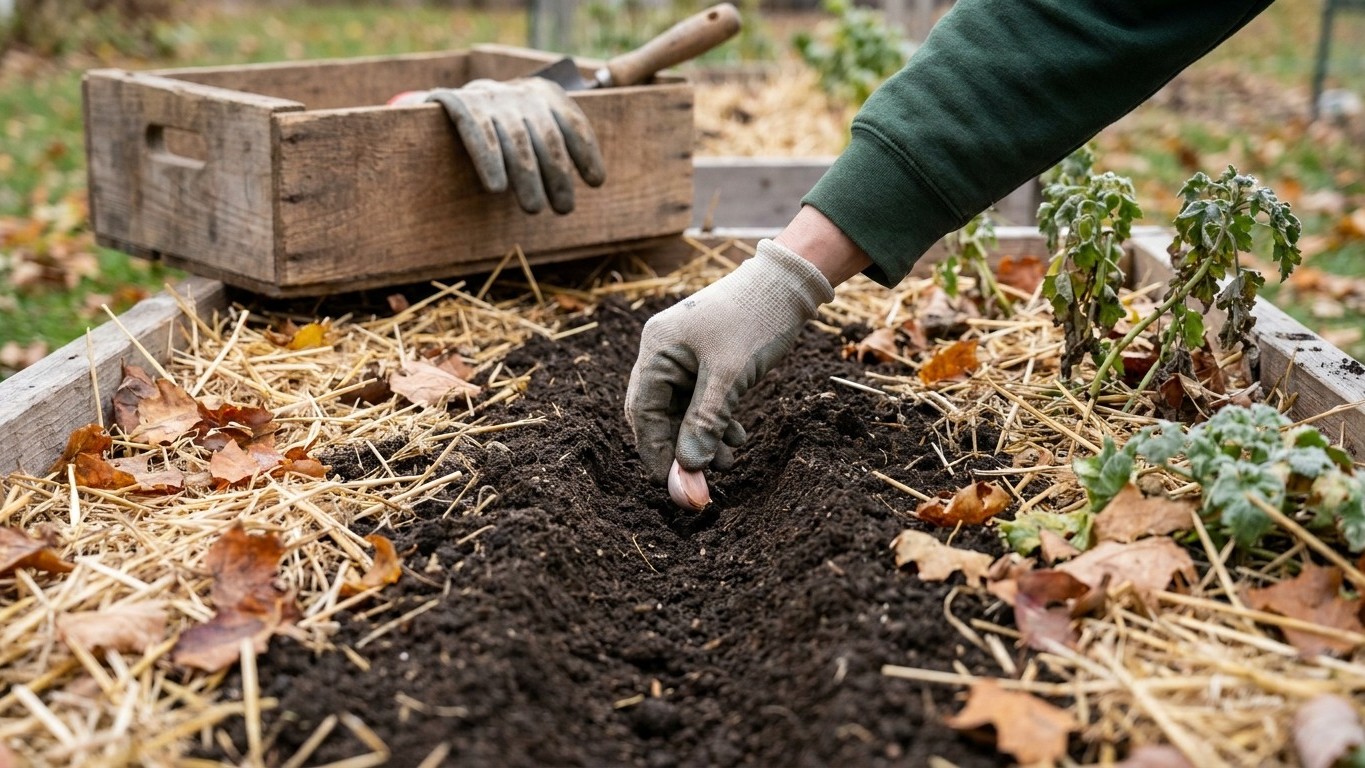
Where the soil is still open, garlic and shallots are the classic November planting. Both go in as individual cloves or bulbs pushed a couple of inches deep, and both need the cold months ahead to trigger the bulb division that gives you a full head come summer. Beyond alliums, this is the window for bare-root and dormant plantings: fruit trees, roses, and shrubs sold dormant can go into the ground as long as it isn’t frozen solid, since the plant isn’t trying to grow, just to root in before winter locks everything up. Cold frames and low tunnels extend the window a little further, letting you tuck in hardy greens for a late crop or an early spring head start. Forcing rhubarb or chicory indoors, in a dark, cool spot, is another option that has nothing to do with outdoor soil at all.
What to start under cover
Sowing under cover in November isn’t governed by the spring frost window the way an April planting would be, since the last spring frost for the state’s reference station falls between April 16 and April 29, months away. Instead, what matters here is a shorter, more immediate clock: how much cool-but-not-frozen soil time is left before winter shuts things down completely. If you’re direct-sowing something like spinach, mache, or claytonia into a cold frame, you’re racing the last stretch of soil that’s still workable enough for germination, not the return of frost.
Run the arithmetic backward from your local ground-freeze point rather than from a fixed date. Ask how many weeks of germination and light top growth a crop needs, then count back from when your soil typically locks up solid. In the state’s southern counties that might allow a few more weeks of cold-frame sowing than in the north, where the ground can be frozen well before the calendar turns the page.
Two mistakes show up here every season. Sow too early relative to what you can actually use, and you end up with leggy, rootbound seedlings sitting in trays with nowhere to go, since outdoor transplanting is still months off. Sow too late, or trust a mild afternoon instead of the soil, and the seed sits ungerminated when the ground hardens, wasting the packet and the effort. Indoors, sprouts and microgreens sidestep this problem entirely. They don’t touch outdoor soil or frost timing at all, just a tray, water, and a countertop, which makes them the most reliable “planting” available this month regardless of where you live in the state.
What is ready to pick
Outdoors, the harvest has largely wound down. Most tender crops are long gone after the first fall freeze, and what’s left standing is whatever tolerated a hard frost or was deliberately covered against one. Kale and leeks are the two workhorses here: both improve in flavor after cold exposure and can often be pulled from under a light snow cover well into the month, especially in the milder southern counties. If you mulched brassicas heavily before the ground froze, check under that mulch periodically rather than assuming everything’s gone.
Cold frames, if you have one running, may still be producing small amounts of spinach, mache, or lettuce, though growth slows dramatically as daylight shortens. Indoors, sprouts and microgreens fill the gap for households wanting something fresh and green on a weekly rhythm.
The bulk of this month’s “harvest,” though, comes from the root cellar or pantry, not the garden bed. Squash, potatoes, and onions stored from earlier in the season need a regular check now. Squash that’s developing a soft spot or a sweet, fermenting smell needs to be used immediately, not stored further. Potatoes that have gone soft, sprouted heavily, or turned green near the skin should be pulled from the batch before they affect the rest. Onions with a wet neck or visible mold at the top are done and shouldn’t sit next to sound bulbs. A five-minute check of stored crops once a week catches problems before they spread through the whole bin.
The jobs that matter this month
This is the month where the real work shifts from planting to maintenance, and skipping it costs you results next season, not this one. Dormant pruning tops the list for fruit trees and cane berries: once leaves have dropped and the plant is fully dormant, you can remove damaged, crossing, or diseased wood without the stress a mid-season cut would cause, and the bare branches make structural problems easy to see.
Ordering, planning, and soil work
Seed catalogs move fast, and popular varieties, particularly regionally adapted ones bred for a shorter season, sell out well before spring planting begins. Ordering now, while the full catalog is still available, beats settling for whatever’s left in February. This is also the natural point to sketch next season’s rotation, since the current season’s results, what struggled, what thrived, what pest showed up where, are still fresh enough to plan around intelligently.
Soil testing and amending both benefit from a slow season. Amendments like lime or compost need months to break down and adjust pH before planting, so working them in now gives them a head start rather than asking them to act instantly in spring. Turning the compost pile keeps it active through the cold months instead of stalling into a frozen brick. Cleaning and sharpening tools, an easy task to defer indefinitely, actually matters here: a dull pruning blade tears wood rather than cutting it cleanly, leaving a wound that heals poorly. Finally, walk the beds and fencing now. Repairing a sagging trellis or a gap in the fence line is a five-minute fix in November and a spring emergency if a hungry animal finds it first.
What not to do in November
The most common mistake this month is trusting the air instead of the ground. A stretch of unusually mild afternoons can feel like an invitation to leave frost-tender bulbs, dahlias and gladiolus among them, in the soil a little longer. But an air temperature reading tells you nothing about what’s happening a few inches down, and a sudden cold snap can catch those bulbs before they’re dug and stored, losing the whole clump.
Newly planted garlic is vulnerable to the same misjudgment in reverse. Skipping a mulch layer because the weather still feels manageable leaves cloves exposed to the freeze-thaw cycling that heaves them out of the ground over winter. A few inches of straw or shredded leaves, applied once the soil has cooled but before it locks up, solves this cheaply.
Cold frames create their own version of the same error. Opening the lid on a warm afternoon to vent excess heat is correct, but forgetting to close it before evening lets the frame lose all its stored warmth right when the plants inside need it most. Check cold frames at dusk, not just at midday.
Fertilizing is the last trap. Nitrogen applied to perennials, lawns, or overwintering beds late in the season pushes soft new growth that has no time to harden off before hard cold arrives, and that new growth is usually the first thing to die back. If a bed needs feeding, slow-release compost worked in now serves the soil over winter without forcing fresh growth on anything still standing.
Checking this against your own county
Everything above describes Wisconsin as a whole, and a state this size doesn’t behave as one climate. Elevation, distance from Lake Michigan, and simple north-south position can shift these frost windows by weeks, not days. A county near the Illinois border and one near Lake Superior are effectively gardening in different seasons by November, even though they share a state line.
Treat everything here as a starting point, then confirm it locally. The University of Wisconsin-Madison Division of Extension publishes county-level guidance and planting calendars that account for these regional differences directly, and that’s the better reference once you’re deciding an actual planting date for your own yard.
Common questions
Is it too late to plant garlic in November in Wisconsin?
It depends on whether your soil is still workable. In the state’s southern counties, soil often stays diggable into mid-November, which is late but still viable for garlic. Farther north, the ground may already be frozen by then, so check with a trowel rather than the calendar.
Can I still transplant trees or shrubs in November?
Yes, if they’re sold dormant and the ground isn’t frozen solid. Dormant bare-root stock is actually well suited to this window since the plant isn’t putting energy into top growth, just establishing roots before winter.
What’s the point of pruning fruit trees this month if they’re already dormant?
Dormancy is exactly why November works well for this. With no leaves and no active growth, you can see the branch structure clearly and make cuts without stressing a plant that’s actively growing, reducing disease risk compared to a mid-season prune.
Why does the same “November” advice not work the same across Wisconsin?
The state covers USDA hardiness zones 3b through 6a, and Lake Michigan delays freezing along the shoreline compared to inland areas. A single statewide date can be off by weeks depending on where in the state you’re gardening, which is why local extension data matters more than a general calendar.