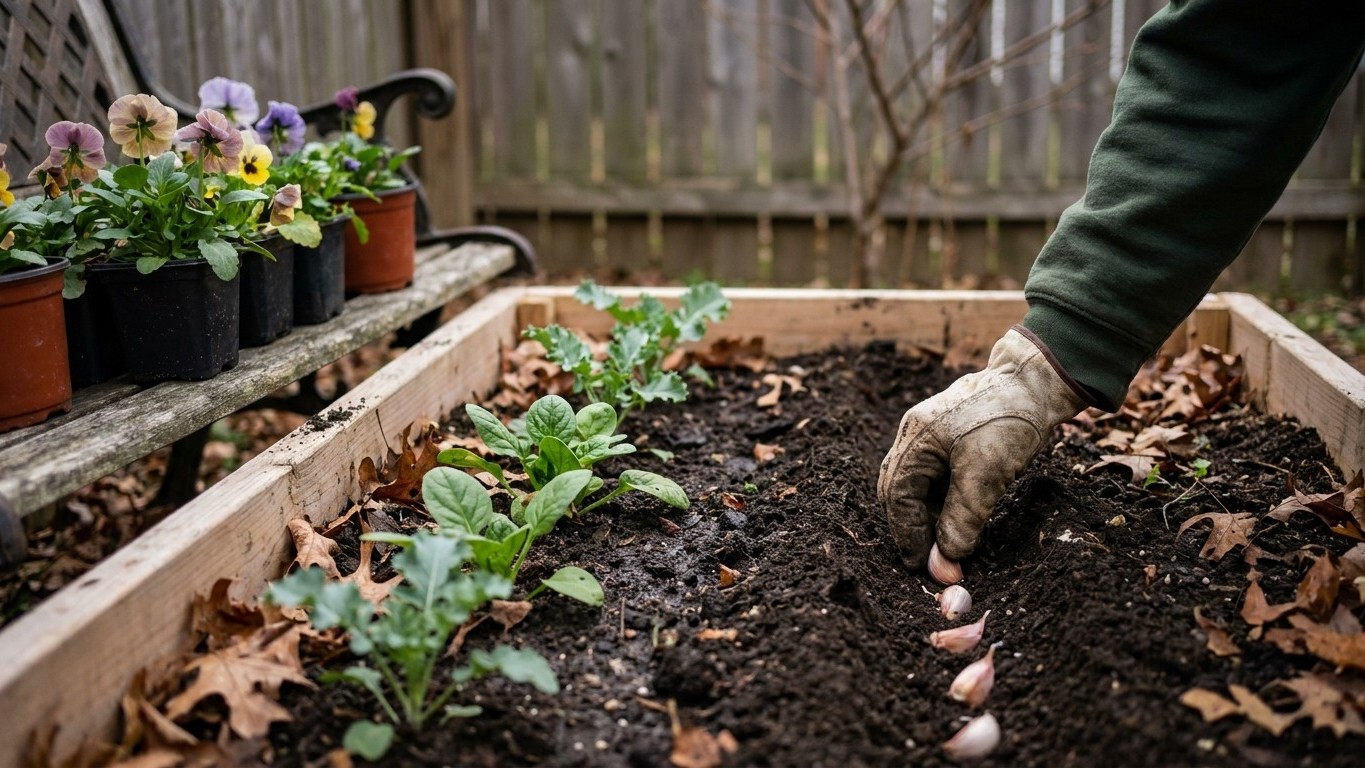

By October, most of Yukon is already weeks past its average first fall frost, and the ground in many yards is either freezing or already frozen solid. The honest answer for this month is that almost nothing goes into open soil. What’s left is protected growing, dormant planting in the rare mild pocket, and the work that sets up next season rather than this one.
What goes in the ground in October
Environment and Climate Change Canada’s 1981-2010 climate normals for the Whitehorse A station put the average first fall frost at August 25. That’s a mean date, not a guarantee, so in some years the real freeze lands later. But by the time October arrives, most of Yukon is running five to six weeks past that average marker, which means for the majority of the territory, soil has already locked up or is well on its way. Air temperature during a mild spell can feel deceptively soft, but soil at planting depth cools and freezes on its own schedule, lagging behind the daytime warmth overhead.
That makes October a poor month for direct-sown or transplanted crops across nearly all of Yukon. If you’re reading this from a sheltered, south-facing yard in the Whitehorse area where the ground hasn’t frozen yet, a very late planting of garlic or shallots is still worth trying, pressed in before the soil locks for good. Beyond that narrow window, don’t gamble on anything tender.
What still makes sense this month:
- Garlic and shallots, but only where soil remains workable, not frozen at the surface.
- Cold frames and low tunnels over greens already established from late summer, buying a few more weeks of harvest.
- Bare-root and dormant stock, planted only if the ground hasn’t yet closed up, then mulched heavily.
- Forced rhubarb or chicory, using roots lifted before the ground froze and brought into a dark, cool indoor space.
Everything else, from lettuce to peas to any warm-season crop, has no realistic path to survival planted outdoors this month in Yukon’s zone.
What to start under cover
Working backward from spring rather than forward from October makes this month’s limits clearer. The Whitehorse A station’s average last spring frost lands around June 5, and it’s a midpoint, not a safe date. Many seed packets call for starting tomatoes six to eight weeks before the last frost and peppers eight to ten weeks before. Counted back from June 5, that puts realistic start dates somewhere in mid-March to early April, months away from October.
Starting those seeds now would run straight into the two failure modes that catch gardeners every year: seedlings started too early get leggy and rootbound long before it’s safe to move them outside, while seeds sown too late miss the short growing window entirely. October sits well on the “too early” side for spring transplants, so resist the urge to get a jump on next season by filling trays now.
What protected space is actually good for this month is shorter-cycle food, not long-season transplants. Microgreens and sprouts on a windowsill or under a grow light deliver fresh greens in one to two weeks without any risk of legginess, since they’re harvested young rather than grown to transplant size. Potted herbs brought indoors before hard frost can keep producing for weeks. If you dug dahlia, canna, or other tender bulbs before the ground froze, October is also the month to check them over in storage, since rot caught now is easier to manage than rot discovered in January.
What is ready to pick
Outdoors, there’s little to nothing left to harvest across most of Yukon by October. Any crop still in open ground has almost certainly been hit by the season’s first hard freeze, and root vegetables left in unprotected soil risk freezing in place if the ground has locked up around them.
Cold frames tell a different story. Hardy greens like spinach, mâche, and some kales can keep cropping under cover well past the point when open beds are done, especially if the frame catches afternoon sun. Leeks and kale planted with winter hardiness in mind can sometimes be pulled from beneath early snow cover, though this depends heavily on how deep the freeze has gone and how much insulating snow has fallen.
Indoors, sprouts and microgreens are the most reliable fresh crop this month, ready in days rather than weeks. The bigger job indoors is checking what’s already in storage. Go through squash, potatoes, and onions by hand, looking for soft spots, mold, or a sweetish smell that signals early rot. One bad squash left in a bin can spread trouble to its neighbors within days, so pull anything questionable and use it immediately rather than letting it sit.
The jobs that matter this month
October carries real deadlines even though nothing is going into the garden. Dormant pruning of fruit trees and berry canes is one of the biggest: cutting back while the plant is fully dormant reduces stress and disease risk compared to pruning during active growth, and it’s far easier to see branch structure without leaves in the way. Get this done before the coldest stretch sets in, since pruning cuts in extreme cold can invite dieback at the wound.
Seed ordering belongs on this month’s list too. Popular short-season varieties bred for northern gardens tend to sell out early in catalog season, and waiting until late winter often means settling for whatever’s left. Pair that with planning next year’s rotation while the current season’s successes and failures are still fresh in mind, rather than trying to reconstruct it from memory in spring.
Soil work pays off now as well. Testing and amending beds, working in compost or aged manure, and turning the compost pile all give amendments time to break down and integrate before spring planting resumes. Cleaning and sharpening tools before they’re stored for winter means they’re ready to go the moment soil opens up again, instead of costing a frustrating afternoon of maintenance in the middle of spring rush. Walk the property to check raised beds, fencing, and any structure that took a beating over the growing season, patching now while repairs are simple rather than after a heavy snow load has made things worse.
What not to do in October
The most common mistake this month is trusting the air. A stretch of mild, sunny days can feel like an invitation to plant something tender, but soil temperature moves slowly and stays cold at depth long after the surface warms in the sun. Direct-sowing anything warm-season based on how the afternoon feels is a near-guaranteed loss.
Uncovering cold frames or pulling back mulch after a mild spell is another trap. It’s tempting to give plants more light and air on a warm day, but Yukon’s fall weather swings hard, and a sudden overnight freeze on newly exposed soil or crowns can undo weeks of protection in a single night. Once mulch and covers go on for the season, leave them, checking only briefly and re-covering promptly.
Feeding nitrogen this month is also poor timing. Nitrogen pushes soft new growth, and soft growth is exactly what gets damaged first when a hard freeze arrives. Any fertilizing that’s still useful now should lean toward phosphorus and potassium to support root and stem hardiness, not lush top growth that has nowhere safe to go before winter closes in.
Finally, don’t assume there’s more time for garlic than there is. Waiting for a calendar cue rather than checking the actual soil condition means many gardeners miss the workable window entirely and end up trying to force cloves into ground that’s already frozen at the surface.
Checking this against your own county
Yukon’s frost dates and hardiness zone come from a single reference point, the Whitehorse A weather station, and a territory this size is not one climate. Elevation, valley cold pockets, and the real distance between southern communities and the far north can shift both frost windows by weeks in either direction. A garden near Whitehorse and one near Dawson or further north are not working from the same calendar, even though both fall under the same territory-wide averages.
Before making a final call on any planting decision this month, check current conditions against Canada’s federal agriculture resources at agriculture.canada.ca, and weigh local knowledge from your own soil and microclimate over any single station’s historical average.
Common questions
Can I still plant garlic in Yukon in October?
Only where soil remains workable and hasn’t frozen at the surface. Given that the average first fall frost at the Whitehorse A station lands around August 25, most of the territory is well past a safe planting window by October, though sheltered, south-facing yards may still have a brief opening.
What hardiness zone is Yukon in?
Natural Resources Canada lists the reference city’s hardiness zone as 1b in the Canadian system, based on 1991-2020 normals. That’s a Canadian zone, built from seven climate variables, and it does not convert directly to a USDA zone used elsewhere in the United States.
Is it too late to start seeds indoors this month?
For spring transplants like tomatoes or peppers, yes. Counting back six to ten weeks from the average last spring frost of June 5 puts realistic start dates in mid-March to early April, so seeds started in October would be leggy and rootbound long before it’s safe to move them outside.
What can I still harvest in October in Yukon?
Very little from open ground, since most areas are already past the average first fall frost. Cold frames may still be producing hardy greens, and indoors, sprouts and microgreens remain a reliable fresh option while stored squash, potatoes, and onions should be checked regularly for early rot.