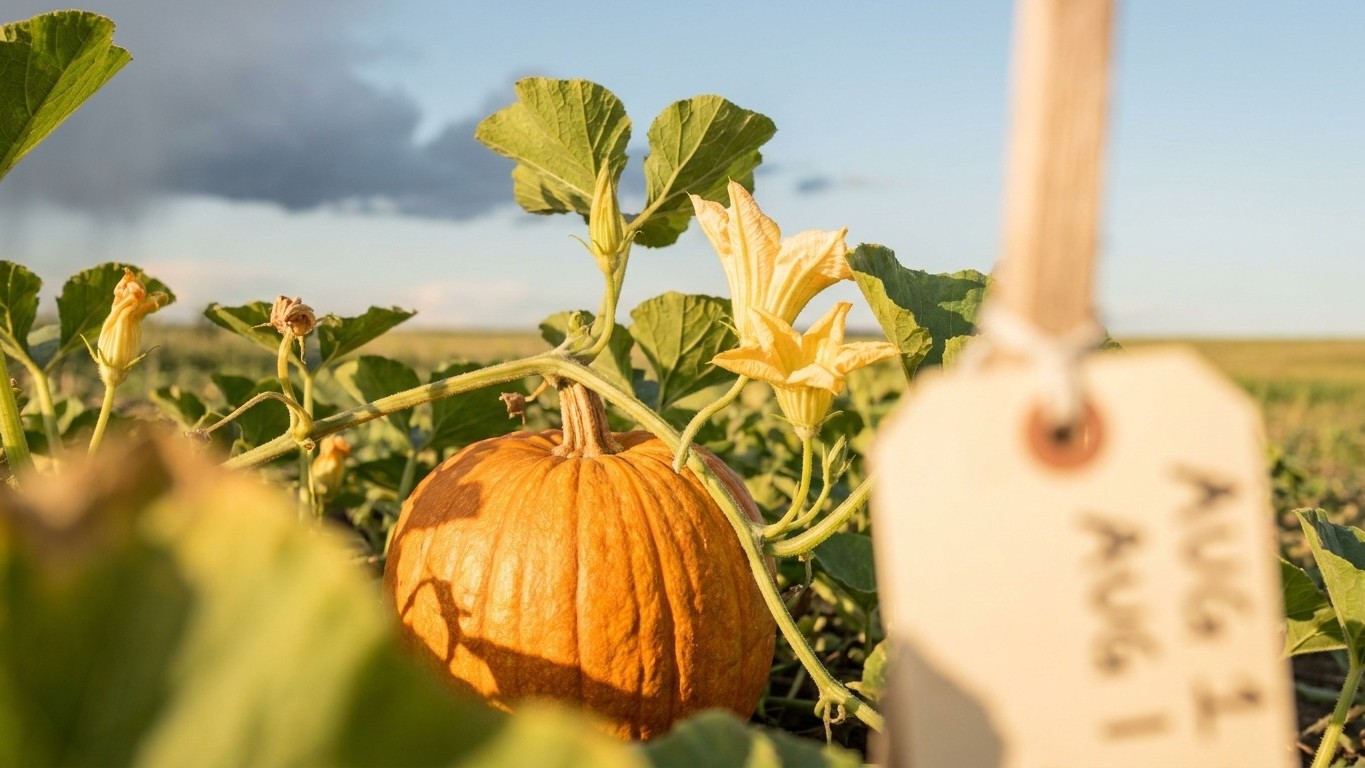

If you’re in Alberta, the honest answer to Will Pumpkins Ripen Before Frost in Alberta? is: only if your flowers open by early August. Work backward from the average first fall frost, subtract the 45 to 55 days a pumpkin needs after flowering (not from seeding), and the math leaves a narrow window. Miss it and you’re picking green fruit off a dying vine.
The short answer
Start with the frost. At Calgary Int’l A, the average first fall frost lands on September 16, based on the 1981-2010 Canadian Climate Normals. That’s a mean, not a promise: in roughly one year out of two, frost actually arrives later than that date, and in the other half it arrives earlier. Treat September 16 as the midpoint of a window, not a line you can plan against with confidence.
Now do the subtraction. A pumpkin needs 45 to 55 days from the moment a female flower opens to reach a ripe, hardened fruit, according to Utah State University Extension. Count back 45 days from September 16 and you land on August 2. Count back 55 days and you land on July 23. That gives a flowering window of roughly late July to the first days of August. Any flower that opens after that stretch is racing a frost it’s likely to lose.
This is the detail that trips people up: the clock starts at flowering, not at the day you drop seed in the ground. A vine can look enormous by mid-July, covered in leaves and runners, and still not have set a single female flower. Pumpkins are monoecious, meaning they carry male and female blossoms on the same plant, and the female flowers (the ones with a small swelling behind the petals) are the ones that matter for this calculation. Male flowers open first and don’t start any countdown at all.
So the real question for an Alberta gardener isn’t “when do I plant” but “when will my vines actually flower.” A short, cool spring that delays flowering by even two weeks can push the ripening deadline past the average frost date entirely. Because the September 16 figure is a mean rather than a safe cutoff, a gardener who’s counting on an average year has, by definition, only about even odds of frost holding off long enough. That’s not a comfortable margin for a crop that needs 45 to 55 days after the flower opens, no exceptions built into the plant’s biology.
None of this means pumpkins are a lost cause here. It means the sowing decision, covered in When to Sow Pumpkins in Alberta, has to be aimed squarely at getting flowers open before the first days of August, with as much cushion as the season allows.
When to sow here
The seed doesn’t care about the calendar. It cares about soil temperature, and pumpkins won’t germinate reliably until the soil holds at 65 F, a figure that has nothing to do with the last spring frost date. Air and soil warm at different speeds, and soil lags the air by weeks. That gap is the whole reason sowing decisions in Alberta take more than checking a frost date off a chart.
- Mark the average last spring frost. At Calgary Int’l A that’s May 21, again a mean figure: in about half the years, frost shows up after that date, sometimes well after.
- Don’t sow the moment that date passes. The air clearing frost risk says nothing about what the soil a few inches down is doing. Soil that sat under snow or cold, wet ground through April typically needs additional weeks of sun and drainage before it holds steady warmth.
- Test the soil directly rather than guessing from the air temperature. A simple soil thermometer pushed a few inches into the bed, checked over several consecutive days, is the only way to confirm the ground has actually reached 65 F rather than just having a warm afternoon.
- Use row covers to close part of the gap. Row covers trap solar heat against the soil and can bring that 65 F threshold forward by about two weeks compared with bare, exposed ground. In a season this tight, two weeks is not a small thing, it’s the difference between flowers opening in late July and flowers opening in mid-August.
- Sow once the soil holds 65 F for several days running, not just one warm spike. A single hot afternoon can trick a thermometer reading without meaning the soil has genuinely turned the corner into steady warmth.
Put the arithmetic together and the sequence looks like this: the average last frost clears around May 21, the soil then needs additional weeks beyond that to reach 65 F on its own, and row covers can pull that date back by roughly two weeks. Sow into soil that’s actually warm, not soil that’s merely frost-free, and count forward to see whether flowering has any realistic chance of landing before early August. If the sowing date keeps sliding toward mid-June with no cover in use, the flowering window starts to butt right up against, or beyond, the deadline calculated above.
What goes wrong here
- A late flower that never colours. When flowering slips into mid-August because sowing was delayed or the season ran cool, the fruit is still green and small when frost threatens. There’s no fix once the flower has opened that late, only prevention: get soil warm early with row covers, and choose a sowing date that puts flowering ahead of the late-July to early-August cutoff rather than after it.
- A fruit caught by frost before it hardens. Even a fruit that set on time can be sitting at 40 or 50 days into its 45-to-55-day clock when the first cold night arrives. Utah State University Extension recommends harvesting with the stem attached and moving fruit somewhere it will not freeze, rather than leaving it in the field gambling on a few extra days of ripening. A pumpkin picked slightly under isn’t lost the way a frozen one is.
- A vine that dies back before the skin hardens. Vine decline that arrives early, before the fruit has had its full run of days, is often driven by insect pressure rather than weather. If leaves are collapsing and the vine is thinning out weeks ahead of frost, check for squash bugs or cucumber beetles rather than assuming it’s simply the season ending on schedule. A vine lost to pests in July steals weeks the plant never gets back.
Checking this against your own county
Everything above is anchored to one weather station, Calgary Int’l A, and a province this size doesn’t run on one climate. Higher ground, land north of Calgary, and pockets tucked against the foothills can all see frost land days or weeks earlier than the average used here. Before locking in a sowing date, check local conditions through Alberta Agriculture and Irrigation, the province’s own agriculture service, at alberta.ca/agriculture-and-irrigation. Local frost records and season-length guidance for your specific district will tell you whether the late-July flowering deadline calculated here needs to move earlier for your particular ground.
Common questions
Can gardeners north of Calgary use the same window?
Not without adjusting it. The September 16 and May 21 figures come from a single station in the Calgary area. Districts farther north or at higher elevation typically see frost arrive earlier in fall and linger later in spring, which shrinks the flowering window further rather than leaving it unchanged.
What happens if my flowers open after the early-August window closes?
The fruit is working against the odds from that point on. Some gardeners still let the plant try, since the September 16 date is only an average and frost sometimes holds off later than that, but there’s no published figure here to promise how much extra time, if any, that gamble buys.
Should pumpkins be picked green before frost hits?
Utah State University Extension’s guidance is to harvest with the stem attached and store the fruit somewhere it will not freeze, rather than leaving it exposed to a hard frost. No storage temperature or keeping time is published beyond that, so treat “somewhere it will not freeze” as the operating rule.
Does this same flowering math apply to squash and other cucurbits?
The 45-to-55-day, post-flowering clock referenced here is specific to pumpkins, as published by Utah State University Extension. Other cucurbits carry their own maturity windows, and this page doesn’t extend that figure to any crop beyond pumpkins.