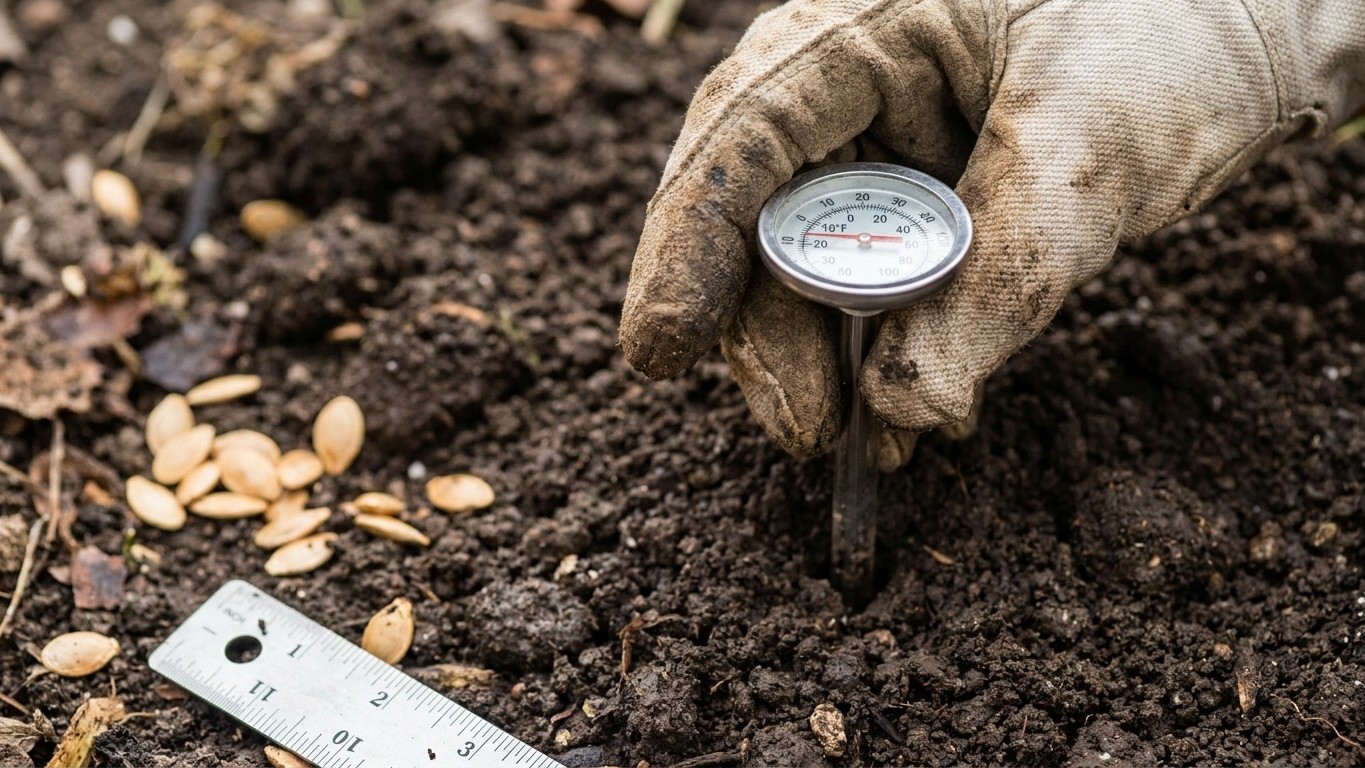

The direct answer: don’t sow by the calendar, sow by a thermometer. Utah State University Extension puts the threshold at 65 F soil, checked with a soil thermometer a few inches down, not the air temperature on the porch. Push seed into cold ground and it sits there rotting instead of sprouting, no matter how sunny the forecast looks.
The short answer
Utah State University Extension is blunt about it: pumpkin seed goes into the ground once soils are 65 F, not before. That’s a soil reading, not an air reading, and it’s not the same as your region’s last frost date either. Soil warms slower than air, sometimes by weeks, because it holds moisture and shade the way a sponge holds water. A calendar says spring arrived; the dirt hasn’t gotten the memo yet.
Once the ground clears that mark, the university’s guidance is specific: drop four to six seeds per mound, 1 to 2 inches deep, with mounds spaced 4 feet apart. That spacing isn’t arbitrary filler in a spec sheet. Pumpkin vines sprawl hard, and 4 feet between mounds gives the plants room to run before they start competing for the same patch of sun and soil moisture.
Here’s where the real planning question hides, and it’s the one most gardeners skip. Utah State University Extension states that pumpkins need 45 to 55 days to mature after flowering, not after the seed goes into the ground. That distinction matters more than almost anything else on this page. A seed sown in warm soil still has to germinate, grow leaves, put out vines, and finally open a female flower before that 45-to-55-day clock even starts ticking. Skip past that detail and you’ll count from the wrong starting line, and your harvest math will be off by weeks.
So the short answer has two layers. Layer one: wait for 65 F soil before you sow, don’t guess based on the air. Layer two: once you see a flower, count 45 to 55 days from that point, not from planting day, to estimate when a pumpkin might be ripe. Confuse the two and you’ll either plant too early into cold, seed-rotting dirt, or you’ll assume your patch is running late when it’s actually right on schedule, just measured from the wrong milestone.
What actually decides it
Two separate clocks govern a pumpkin crop, and they answer two different questions. The soil temperature clock decides when you’re allowed to plant at all. The flowering-to-harvest clock decides whether a pumpkin will ripen before frost ends the season. Mixing them up is the single most common planning mistake with this crop, and it’s an easy one to make because both numbers involve counting days.
The soil clock is the gatekeeper. Below 65 F, pumpkin seed simply doesn’t perform reliably. Cold, damp soil invites rot before germination can even begin, and seed that does sprout in marginal conditions tends to emerge weak and stunted. There’s no shortcut here. Utah State University Extension’s guidance ties the sowing decision to that soil reading, not to a date on a wall calendar, precisely because soil temperature varies by location, mulch, sun exposure, and how wet the ground has been.
The flowering clock is the one that determines your realistic harvest window. Once flowers appear, and once fruit is set, that pumpkin needs 45 to 55 days from flowering to reach maturity. This is the number that should drive your decision about how late in the season you can still expect a full-sized, cured pumpkin rather than a green one caught by cold weather. If you know roughly when your region’s first fall frost tends to arrive, you can work backward from that date, subtract the 45-to-55-day flowering window, and get a sense of the latest point at which a flower needs to open for that fruit to have a real shot at ripening.
What settles the whole timeline, more than either number alone, is how quickly the soil clock starts after your particular spring turns warm. A slow-to-warm spring pushes back the sowing date, which pushes back when the first flowers open, which pushes the maturity window closer to frost. That’s the chain reaction worth tracking, more than fixating on a single date. Row covers and plastic mulch, discussed below, exist specifically to shorten that chain by warming the soil faster than open air would on its own.
How to do it
- Check soil temperature before touching a seed packet. Push a soil thermometer a couple of inches into the planting area and take readings over several days, not just once. Utah State University Extension’s threshold is 65 F; readings that bounce around that number mean you’re on the edge and should wait a bit longer for consistency.
- Warm the soil early with plastic mulch or row covers, if you want a head start. Utah State University Extension notes that these two tools let you plant as much as two weeks before the last frost date, because they trap heat and protect emerging seedlings from a cold snap. This doesn’t override the 65 F soil rule; it’s a way to reach that soil temperature sooner.
- Build mounds spaced 4 feet apart. Mounding improves drainage around the seed and gives roots a slightly warmer, looser pocket of soil to start in, which matters when soil temperature is still hovering near the minimum.
- Sow four to six seeds per mound, 1 to 2 inches deep. Planting several seeds per mound accounts for uneven germination; not every seed will come up, especially close to the temperature threshold.
- Water after planting and keep the soil consistently moist while seeds germinate. Inconsistent moisture at this stage is one of the more common reasons for patchy, uneven stands.
- Watch for flowering, not for a fixed date on the calendar. Once flowers open, start counting. That’s your real countdown to maturity: 45 to 55 days from that point, according to Utah State University Extension.
- Plan your latest safe flowering date around your region’s typical fall frost timing. Work backward from frost using the 45-to-55-day flowering window to judge whether late-set fruit still has enough season left to mature fully.
What goes wrong
- Sowing by the calendar instead of the thermometer. Seed goes into soil that’s still below 65 F because the date “felt right.” The fix: check actual soil temperature over several days before planting, and don’t plant until readings are consistently at or above that mark.
- Confusing the last frost date with the 65 F soil threshold. These are not the same moment, and soil often lags well behind air temperature. The fix: measure soil directly rather than assuming that once frost risk has passed, the ground is automatically warm enough.
- Counting the 45-to-55-day maturity window from the planting date instead of from flowering. This throws off harvest expectations by weeks, since germination and vegetative growth all happen before the first flower even opens. The fix: mark the date of first flowering in the garden and count forward from there, not from the sowing date.
- Crowding mounds closer than 4 feet apart. Vines that don’t have room to spread compete for light and moisture, and dense foliage traps humidity that favors disease. The fix: respect the spacing and thin aggressively if seedlings crowd each other early on.
- Skipping row covers or plastic mulch in a short-season area, then running out of days before frost. Utah State University Extension notes these tools allow planting up to two weeks earlier than otherwise possible. The fix: use them deliberately if your growing season is tight, rather than treating them as optional.
- Ignoring pest pressure early, when seedlings are most vulnerable. Young pumpkin plants can be set back hard by squash bugs and cucumber beetles, both of which have their own detailed control guidance elsewhere on this site. The fix: scout mounds regularly from the seedling stage onward rather than waiting until damage is obvious.
- Assuming a specific storage temperature or humidity target after harvest. Utah State University Extension’s guidance only specifies keeping harvested pumpkins somewhere they will not freeze; no storage temperature, humidity level, or keeping-time figure is published. The fix: don’t borrow numbers from other crops and present them as pumpkin-specific storage guidance.
Common questions
Is 65 F soil the same as my region’s last frost date?
No. Soil temperature and the last frost date are two different measurements, and soil typically warms more slowly than air. Check actual soil temperature rather than assuming it matches frost-date timing.
Do the 45 to 55 days start when I plant the seed?
No. Utah State University Extension specifies that the 45-to-55-day maturity window runs from flowering, not from sowing or transplanting. Track the date flowers first appear, then count forward from there.
Can I plant earlier than 65 F soil if I use row covers?
Plastic mulch and row covers can let you plant up to two weeks before the last frost date by warming the soil faster, according to Utah State University Extension. The goal is still to reach that 65 F threshold, just sooner than open soil would manage on its own.
How far apart should pumpkin mounds be?
Utah State University Extension recommends spacing mounds 4 feet apart, with four to six seeds sown per mound at a depth of 1 to 2 inches.
The Moon calendar is a separate, older custom: see when to plant pumpkins by the moon, written as tradition rather than fact.