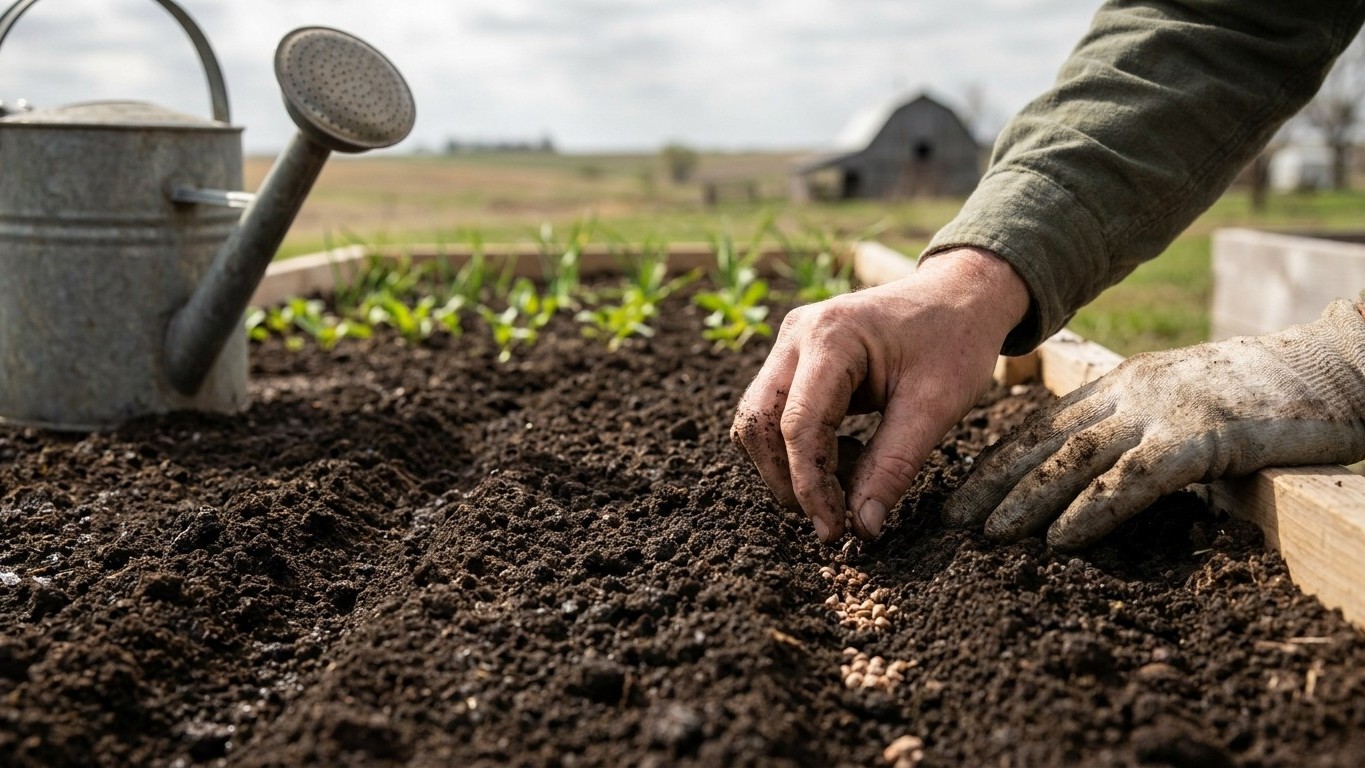

Kansas gardeners get one real shot at beets before summer heat turns the root woody: sow in place two to three weeks before the last spring frost, keep the soil evenly moist through germination and the first true leaves, and pull the crop before the run of 90-degree days settles in for good. Everything else on this page is about protecting that window.
The short answer
Kansas’s official state soil is the Harney series, a Mollisol, the deep, dark prairie soil that built the Corn Belt and, further west, the wheat belt that follows it. The surface horizon runs close to neutral, about pH 6.7, and texturally it sits as a silt loam: roughly 9 percent sand, 24 percent clay, and 67 percent silt, with organic matter around 2.0 percent. It’s classified well drained. Kansas named it the state soil by law, and USDA NRCS keeps it as the representative profile for the state soils program.
For a beet, that mix is a mixed blessing. The silt fraction holds moisture well between waterings, which matters because beets are unforgiving about consistent water in their first six weeks. But a soil that’s two-thirds silt with almost no sand can also crust hard after a rain, and a crusted surface is exactly what stalls beet germination, since the seed corky cluster needs to push through, not around, whatever cap has formed. The 24 percent clay adds structure and nutrient-holding capacity, which is good for a root crop, but it also means this soil compacts under foot traffic or heavy equipment faster than a sandier profile would.
On heat, the honest answer is that this page doesn’t have a published day-count of how many days the reference city spends above 90 degrees Fahrenheit; that figure isn’t part of the verified data behind this page, so it isn’t stated here as a number. What is documented is the mechanism: beet roots turn woody once temperatures push past 85 degrees Fahrenheit while the plant is also short on water. Kansas summers reliably deliver stretches above that threshold, which is the practical reason the crop needs to be sized and out of the ground before the hottest weeks arrive, rather than left in as a “just in case” reserve the way a gardener might leave carrots.
None of this is a diagnosis of any one backyard. Kansas spans hundreds of mapped soil series, and the Harney profile describes a representative agricultural surface, not a worked, amended, raised, or fill-graded garden bed. A yard on a river terrace, a subdivision built on scraped and re-graded fill, or a hillside plot can carry none of these numbers. Treat the Harney figures as a regional tendency, and confirm your own bed with a soil test, since Beet Soil in Kansas can vary widely from one property to the next, before you decide how much sand, compost, or lime it actually needs.
The six weeks that decide it here
Knowing When to Sow Beets in Kansas means sowing beets two to three weeks ahead of the last frost is standard practice, and in the reference city that Kansas climate data is drawn from, the last spring freeze typically falls somewhere between April 4 and April 18. That puts a realistic direct-seeding window in mid-to-late March for most of the state, with the caveat that this 32-degree freeze-probability figure comes from an airport weather station, and suburban and rural gardens usually see their own last frost run one to two weeks later than the station number, more at higher elevation. Check your own county before you commit seed to the ground.
Once seed goes in, the clock that matters isn’t the calendar, it’s the first six weeks after germination. That stretch is what determines whether a beet plant bolts, meaning it shoots up a flower stalk instead of investing in the root, and Utah State University Extension is direct about the cause: water stress in those first six weeks is what triggers premature flowering. It has nothing to do with heat yet. It’s about the seedling running dry while it’s still establishing.
Kansas spring is the wrinkle. A mid-March to April planting window in this state doesn’t land in a calm, predictable stretch of weather; it lands in one of the more variable seasons the state gets, prone to swinging between dry spells and heavy rain events within the same month, sometimes within the same week. That variability is exactly what makes the six-week bolting window harder to manage here than in a region with a steadier, gentler spring. A dry March followed by a cold, wet April doesn’t cancel the risk, it just moves where the stress hits: a week of dry wind on young seedlings can do the damage even if the month as a whole ends up wetter than normal.
The practical response isn’t complicated, it’s just easy to skip. Check soil moisture at seedling depth every few days through that six-week stretch rather than trusting a rain gauge total for the month, since a soaking rain followed by two weeks of dry wind still leaves the plant thirsty for most of that window. Consistency, not total rainfall, is what the beet is responding to.
What goes wrong here
- Bolting from a dry spring establishment period. A gardener sows on schedule, gets a fine germination, then a dry, windy two-week stretch in April hits right as the seedlings are putting on true leaves. The plants respond by bolting rather than sizing a root. The fix is scheduled watering through the entire six-week establishment window, not just watering in response to visibly wilting soil, since the trigger is cumulative water stress rather than a single dry-out event.
- Woody roots from summer heat arriving before harvest. This is a separate failure from bolting, caused later in the season, when temperatures climb past 85 degrees Fahrenheit and the plant is also under water stress. The result is a root that’s fibrous and unpleasant rather than tender. The remedy is timing the harvest to the plant’s seed-to-maturity days, generally in the 60- to 80-day range from direct seeding, so the crop is out of the ground before the worst of the heat lands, rather than treating the root as storage-safe in the soil once it’s technically mature.
- Surface crusting on the silt-heavy soil that typifies much of Kansas. A hard rain on a silt loam like the Harney profile can seal the surface into a crust that beet seedlings, with their short hypocotyl push, struggle to break through. A light mulch or a raked, loosened surface layer after any heavy rain and before emergence reduces this risk.
- Over-amending with organic matter on soil that’s already reasonably fertile. Utah State University Extension caps organic matter amendment at no more than 1 inch of composted material per 100 square feet. On a soil that already carries roughly 2.0 percent organic matter at the surface, piling on more compost than that recommendation doesn’t help the root size up, and can actually push nitrogen availability in a direction that favors leafy top growth over the root itself.
- Compaction from working clay-bearing soil wet. At 24 percent clay, this soil compacts if it’s tilled or walked on while still damp from a spring rain. Compacted ground restricts the straight, even root development beets need. Wait until the bed is workable, not just accessible, before tilling in spring.
Checking this against your own county
Everything above describes a representative state soil and a single reference city’s frost dates, not your particular yard. Kansas State University’s own extension network is the right next step: K-State Research and Extension maintains county offices that can run or interpret a soil test, confirm local frost-date norms that may run later than the reference-city figures cited here, and speak to conditions specific to your county’s soil series rather than the statewide representative one. A phone call or a soil sample dropped at the county office will tell you more about your actual planting window than any statewide average can.
Common questions
How many days does it take to grow a beet from seed in Kansas?
Beets are direct-seeded, not transplanted, and the days-to-maturity count runs from that seeding date, generally landing in the 60- to 80-day range depending on variety. In Kansas, that timeline needs to be planned backward from the point summer heat sets in, since a beet still sizing up once temperatures push past 85 degrees Fahrenheit with any water stress is at risk of turning woody.
Is Kansas soil naturally good for beets?
The state’s representative soil, the Harney series, is well drained and close to neutral in pH, both favorable traits, but it’s also a silt loam that can crust after heavy rain and compacts if worked wet. It’s a reasonable starting point, not a guarantee, and it describes a mapped agricultural surface rather than any individual garden bed.
What causes beets to bolt in Kansas gardens?
Water stress in the first six weeks after germination, according to Utah State University Extension. In Kansas, that six-week window typically falls in a variable spring stretch prone to dry, windy spells even in years with normal or above-normal total rainfall, which is what makes consistent watering through establishment more important than the monthly rain total.
When should I plant beets in Kansas?
The general rule is two to three weeks before the last spring frost. In the reference city used for Kansas climate normals, that last frost date falls between April 4 and April 18, though rural and suburban gardens often see their own last frost run one to two weeks later. Confirm the timing with your local K-State Research and Extension office rather than relying on the reference-city date alone.