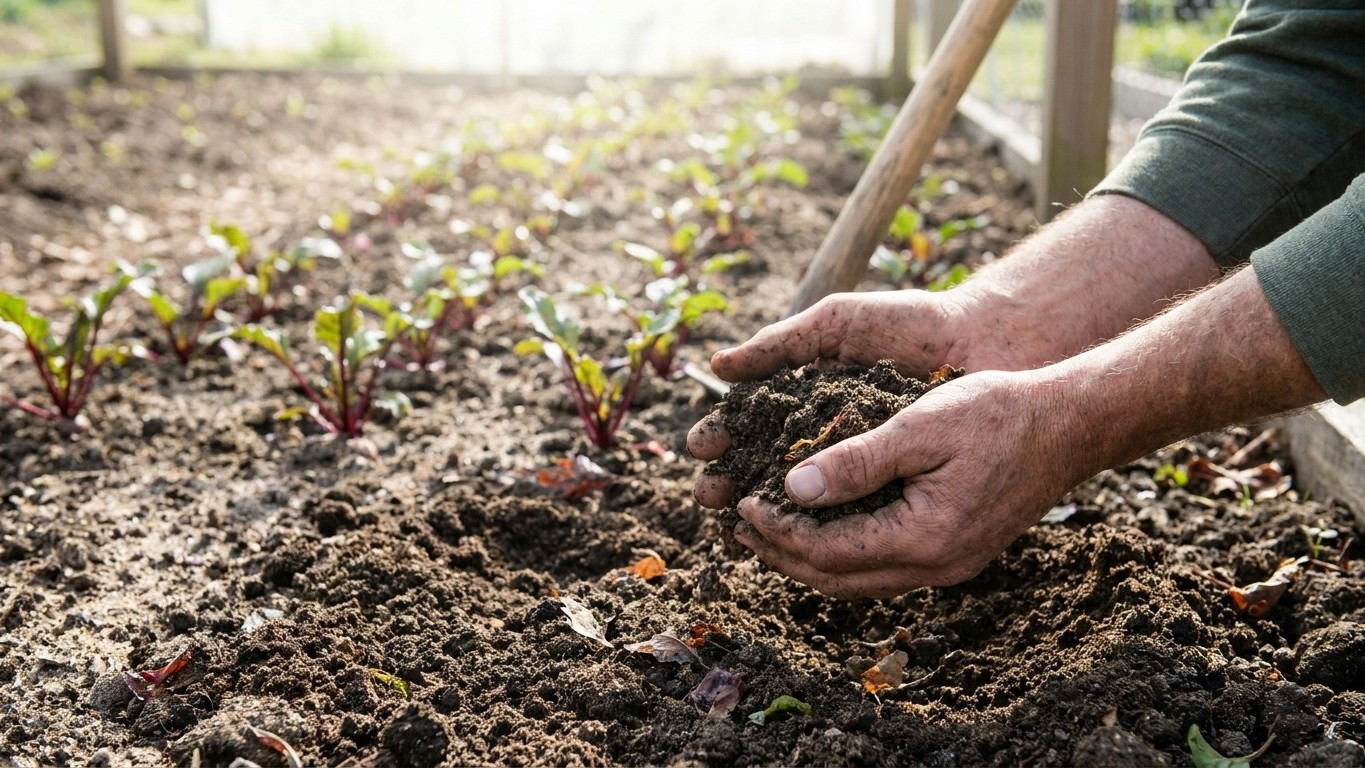

Kentucky’s official state soil, the Crider series, is a well-drained silt loam with a mildly acid pH near 6.2, plenty of clay and almost no sand. That’s a reasonable starting point for beets, but not a perfect one: the crop wants a sandier, deeper profile, and Kentucky’s swinging spring weather puts the first six weeks of growth right in the window where dry stretches trigger bolting before summer heat can make the root woody — which is why knowing When to Sow Beets in Kentucky matters as much as the soil itself.
The short answer
The Crider series carries the surface texture 5 percent sand, 19 percent clay, 76 percent silt, according to USDA NRCS Soil Survey Geographic Database records for the surface horizon of the series’ major components. That’s a silt loam, not the sandy loam beets actually prefer. Utah State University Extension describes the ideal beet bed as deep, sandy and well-drained, rich in organic matter. Crider hits two of those marks and misses one: it’s well drained, and its organic matter runs about 3.0 percent, but that figure is below what “rich in organic matter” implies for a root crop that’s picky about texture around its swelling bulb. The state’s surface pH of about 6.2 sits inside the range most vegetable crops tolerate, so acidity isn’t the issue here. Silt is.
Silt loam compacts and crusts more readily than sand does, especially after a heavy spring rain followed by a dry snap, exactly the kind of surface seal that can strangle a beet seedling before it gets its first true leaves. The fix Utah State names is straightforward: work in composted organic matter, capped at 1 inch per 100 square feet, before sowing. That amount loosens the surface without overfeeding the bed, since excess nitrogen pushes leafy top growth at the root’s expense.
On the heat side, Utah State’s threshold is specific: air above 85 F combined with water stress is what turns a beet root woody and fibrous. This page doesn’t have a published count of how many days the reference Kentucky city spends above 90 F each year, so that figure isn’t stated here rather than guessed at. What can be said is that Kentucky summers routinely clear 85 F for extended stretches, which means the woodiness risk is real for any planting that’s still sizing up a root once true summer heat arrives, regardless of the exact day count.
None of this describes any one backyard. Kentucky spans hundreds of mapped soil series, and the Crider profile represents the state, not a specific garden. A river-bottom plot, a hillside clearing, or any yard a builder graded and refilled can carry a completely different texture, pH and organic-matter level than the numbers above. Treat the Crider data as a baseline for what Kentucky ground tends to do, then confirm your own plot with an actual soil test — see this guide to Beet Soil in Kentucky for a deeper breakdown.
The six weeks that decide it here
Beets are conventionally sown in place 2 to 3 weeks before the last frost date, never started as transplants. In this region, NOAA’s 1991-2020 Climate Normals put the last spring freeze probability window for the reference Louisville station at March 24 to April 4. Sowing on that schedule lands germination and the first six weeks of growth somewhere in the stretch from mid-March through mid-May, depending on how early or late a given spring runs.
That window matters because Utah State University Extension is specific about timing: water stress during the first six weeks after sowing is what causes premature flowering, meaning the plant bolts and sends up a seed stalk instead of building a root worth harvesting. Six weeks of dry soil early on does the damage regardless of what happens later in the season. A beet that bolts in May because of a dry April doesn’t get a second chance once the rain returns.
Kentucky’s early spring has a reputation for swinging conditions, a mild wet stretch followed abruptly by a dry, breezy week, sometimes within the same month. That variability is exactly what makes the first six weeks risky here. A gardener who sows right at the recommended 2-to-3-week mark before the last frost, then assumes spring rain will handle watering, is gambling on a season that doesn’t reliably deliver steady moisture. The safer approach treats those first six weeks as a period requiring active monitoring rather than passive faith in typical spring rainfall.
One more wrinkle: NWS Louisville has noted that the reference station used for these normals runs its urban climate slightly later into spring and slightly earlier into fall than the surrounding rural county. Gardeners outside the city core, particularly in more rural stretches of Jefferson County or beyond, should expect a tighter frost-free window than the March 24 to April 4 range suggests, not a wider one.
What goes wrong here
- Bolting from a dry early spring. Beets sown per the recommended 2-to-3-week window before last frost hit their critical first six weeks right as Kentucky spring can swing dry. Utah State University Extension ties water stress in that window directly to premature flowering. Remedy: check soil moisture at planting depth twice a week through the first six weeks, and water deeply rather than lightly whenever the top inch dries out.
- Woody roots from summer heat. This is a separate failure from bolting, caused later in the season. Utah State’s threshold pairs air above 85 F with water stress to produce a fibrous, tough root. Remedy: keep watering consistent once temperatures climb, and plan harvest before a prolonged heat stretch rather than letting roots sit in the ground through it.
- Surface crusting on silty ground. The state’s representative soil runs 76 percent silt and only 5 percent sand, a texture prone to sealing over after rain and then baking hard. A crusted surface can trap beet seedlings before they emerge. Remedy: work in composted organic matter at up to 1 inch per 100 square feet ahead of sowing, and avoid walking or working the bed while it’s wet.
- Organic matter running short of what beets want. At roughly 3.0 percent organic matter, the state’s reference soil falls under the “rich in organic matter” standard Utah State sets for beet beds. Remedy: the same compost amendment addresses this and the crusting problem together, since both trace back to a soil that’s heavier in silt and clay than beets prefer.
- Assuming one soil test applies to the whole yard. Kentucky’s mapped soil series number in the hundreds, and a single reference profile like Crider can’t stand in for a specific lot, especially one with fill dirt, a graded slope, or a low spot that holds water. Remedy: pull an actual soil sample from the bed in question before relying on any state-level figure.
Checking this against your own county
Everything above describes Kentucky’s official reference soil and regional frost timing, not any individual garden. The most reliable next step is a soil test through the University of Kentucky Cooperative Extension, accessible at extension.ca.uky.edu. County extension offices can confirm actual texture, pH and organic matter for a specific plot, along with local frost timing that may run tighter than the regional normals if the garden sits outside an urban core. That local number, not the state soil series, should guide amendment and sowing decisions.
Common questions
How long do beets take to mature in Kentucky?
Beets are sown directly in the garden, never transplanted, and the maturity clock starts at seeding. Utah State University Extension’s general guidance for the crop puts most varieties in the 60 to 80 day range from that sowing date to harvest.
Can I use the state soil’s pH of 6.2 as my own garden’s pH?
No. That figure represents the surface horizon of the Crider series as mapped across the state, not a measurement of any worked garden bed. A cultivated plot, especially one that’s been limed, fertilized or amended over time, can read differently. A soil test through the local extension office gives the actual number for a specific bed.
Is bolting the same problem as a woody root?
No, and treating them as one issue leads to the wrong fix. Bolting happens early, tied to water stress in the first six weeks after sowing, and it ends the crop by sending the plant to seed. Woodiness happens later, when heat above 85 F combines with water stress on a root that’s already sizing up. Both call for consistent watering, but they strike at different points in the season and for different reasons.
Does Kentucky’s silty state soil need amending before planting beets?
Based on Utah State University Extension’s standard for beet beds, deep, sandy, well-drained and rich in organic matter, the state’s reference silt loam falls short on sand content and organic matter. Working in composted organic matter, capped at 1 inch per 100 square feet, addresses both gaps without overloading the bed with nitrogen.