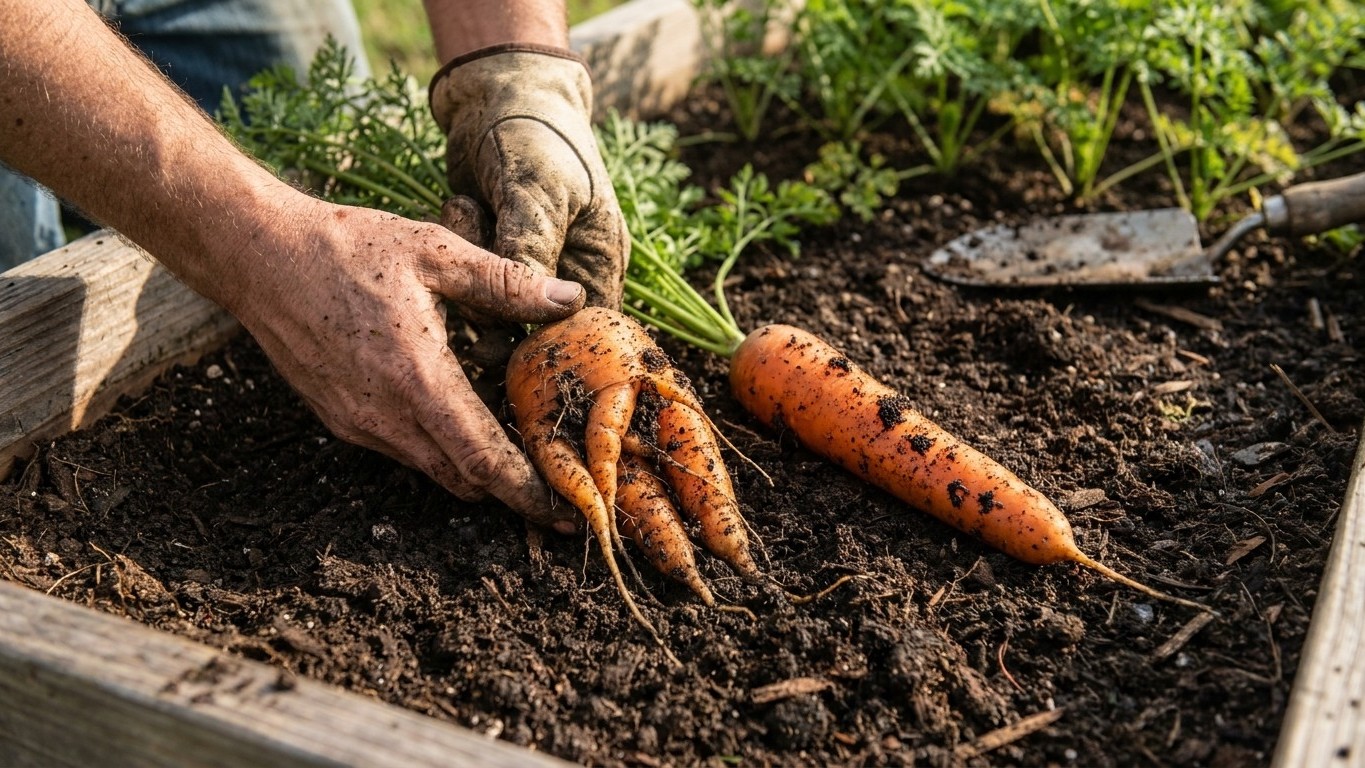

Mississippi’s official state soil, the Natchez series, is mostly silt (82 percent) with just 13 percent clay and barely any sand. That texture drains well, but it isn’t the deep, loose ground carrots crave everywhere in the state. Whether your carrots fork or grow straight comes down to the dirt in your own bed, not the map.
The short answer
The soil that Mississippi law named as representative of the state is the Natchez series, an Inceptisol, which is a term for a young soil that hasn’t had time to build up the strong, distinct layers older soils show. Sampled at the surface, it runs about 5 percent sand, 13 percent clay and 82 percent silt, which puts it solidly in the silt loam camp. Surface pH sits around 6.2, just on the acid side of neutral. Organic matter measures about 1.8 percent, and drainage is classed as well drained.
That combination is mixed news for a carrot. The silt-heavy texture and the good drainage rating both work in the root’s favor: silty ground tends to be finer and less obstructive than a clay-heavy soil, and standing water is one of the fastest ways to rot a taproot before it ever forms. The 13 percent clay figure isn’t high enough on its own to guarantee forking, but silt loam can still compact into a crust or a dense layer a few inches down, especially in a bed that’s been walked on or left untilled. Carrots want soil that’s deep, loose and rich in organic matter all the way down, according to Utah State University Extension, and any obstruction, whether it’s a stone, a clay lens or a compacted band, forces the root to split or fork around it. So will carrots fork in Mississippi soil? It depends less on the state average and more on what’s compacted beneath your own rows.
At 1.8 percent organic matter, the state soil is on the lean side. Utah State University Extension is specific that heavy or rocky ground needs plenty of compost worked in, along with double digging to break up compaction below the reach of a hoe or a light till. If your garden mirrors the state soil’s texture, that’s the fix: dig a bed 12 to 15 inches deep, mix in a generous layer of compost, and break up any dense layer you hit rather than working around it. If digging that deep isn’t realistic, because of a shallow topsoil layer, buried construction debris, or a yard that’s mostly fill dirt, a raised bed filled with a loose, compost-rich mix sidesteps the problem entirely and gives the root nowhere to hit resistance.
None of this is a diagnosis of your yard. Mississippi spans hundreds of mapped soil series, from Delta bottomland to Piney Woods sand to red clay hill country, and the Natchez series is one representative sample chosen to stand for the whole state, not a description of what’s under your carrots. Think of it as a starting point for the kind of ground your region tends to produce, then confirm what you actually have with a look and a feel of your own dirt.
The test that settles it in your own garden
A state soil profile tells you what USDA mapped for a representative site. It says nothing about the topsoil a previous owner scraped off, the truckload of fill a builder brought in, or the layer of river sand two counties over that ended up under your lawn. The only way to know what your carrots will hit is to look yourself.
- Dig a hole where you plan to plant. Go down at least 12 inches with a spade or a garden fork, straight through the layer where roots will actually grow.
- Check the depth of loose soil and note any stones. Carrots need open ground the full length of the root; a rock, a brick fragment, or a hardpan layer partway down is exactly what causes forking.
- Feel the texture in your hand. Grab a moist handful and rub it between your fingers. Gritty means sand, slick and sticky means clay, silky and smooth means silt. Most gardens are some blend of the three.
- Watch how water drains. Fill the hole with water and time how long it takes to disappear. Water that lingers for hours points to a compacted or clay-heavy layer that will need breaking up or bypassing with a raised bed.
Run through those four steps and you’ll know more about your bed than any state-level soil figure can tell you. If the hole reveals loose, stone-free ground that drains at a reasonable pace, you’re closer to what carrots want than the raw texture numbers might suggest. If it reveals a dense layer, standing water, or a scattering of rocks and construction debris, that’s your answer on whether to double dig, amend heavily with compost, or skip the in-ground bed altogether and build up instead.
When to sow here
Carrots are direct-sown. There’s no transplanting step to count from, no seedling tray to harden off first, the seed goes straight into the ground where the root will grow, and every date below counts from that seeding day.
- Start with the frost window. NOAA’s 1991-2020 climate normals put the last spring frost, based on 32°F freeze probabilities, somewhere between March 6 and March 22 for the reference station used in that dataset.
- Sow two to three weeks before that last frost date. Carrot seed tolerates cool soil far better than most garden crops, so working backward from March 6 lands you in the second half of February, and working backward from March 22 lands you in the first days of March, depending on where in that window your last frost typically falls.
- Confirm the soil has warmed to at least 40°F before seeding. That’s the floor for germination at all. Below it, seed can sit for weeks without sprouting, or rot before it ever does.
- Aim for the 55 to 65°F range for the best, most even germination. Seed sown in that band comes up faster and more uniformly than seed sown at the bare 40°F minimum.
The arithmetic matters more than the calendar. If your soil is still cold and heavy in mid-February, sowing on schedule from the calendar alone can leave seed sitting in ground that hasn’t reached 40°F, and nothing will happen until it does. A soil thermometer pushed a couple of inches down costs little and settles the question faster than guessing from air temperature. And remember that the frost dates above come from a single reference weather station. NOAA’s own guidance on these figures notes that suburban and rural gardens commonly see their last spring frost run later, and their first fall frost arrive earlier, by a week or two, sometimes more at higher elevation. If your property sits in a low-lying spot that collects cold air, or well outside town, push your sowing window later rather than earlier and check the soil before you trust the calendar.
What goes wrong here
- Forked roots in heavy or compacted ground. Silt-heavy soils like the state’s representative Natchez series can still crust or compact below the surface, and any dense layer, stone, or clay lens forces the taproot to split around it. Double dig the bed 12 to 15 inches deep and work in compost to open it up, or move to a raised bed filled with loose soil if digging that deep isn’t practical.
- Poor or patchy germination during a hot spell. Carrot seed germinates best between 55 and 65°F, and a stretch of unseasonably warm weather right after sowing can push soil temperature well past that range, slowing sprouting or knocking germination rates down. Water the seed row lightly and frequently to keep the top inch cool and moist until seedlings emerge, and consider a light mulch or shade cloth over the row during a heat spike.
- Splitting from uneven watering. A root that grows steadily and then gets hit with a heavy soak after a dry stretch tends to crack from the inside as it swells too fast. Keep watering consistent through the growing season rather than letting the bed dry out and then flooding it, especially in soil like the state’s lean, 1.8 percent organic matter profile, which holds less moisture reserve than a bed built up with compost.
- Slow growth in low-organic-matter soil. At around 1.8 percent organic matter, the state’s representative soil is thinner in nutrients and moisture-holding capacity than carrots prefer. Work in compost before sowing, not after, since carrots don’t respond well to being disturbed once the taproot has started forming.
Checking this against your own county
Everything above is a regional starting point, built from one representative soil series and one reference weather station. Your county’s frost dates, soil survey, and planting calendar can all differ from those numbers, sometimes by a meaningful margin. Mississippi State University Extension, at extension.msstate.edu, is the land-grant service for the state and the right place to confirm local frost timing, get a soil test read by someone familiar with your county’s mapped series, and get variety and spacing guidance suited to where you actually garden. A five-minute call or a soil sample sent in beats guessing from a state average every time.
Common questions
Do I need to test my soil’s pH before planting carrots?
The state’s representative soil runs about 6.2, slightly acid, but that figure describes one mapped series, not your yard. A basic soil test through your local extension office will give you your own number rather than a statewide estimate.
Can I fix forked carrots by switching varieties?
Utah State University Extension attributes forking to heavy or rocky soil, not to variety choice. Changing seed won’t solve a compaction or debris problem; double digging, adding compost, or building a raised bed will.
How long after sowing should I expect to harvest?
Carrots typically take somewhere in the range Utah State University Extension outlines for the crop, counted entirely from the seeding date since carrots are never transplanted. Exact timing varies by variety, so check the specific seed you’re planting.
What if my soil test comes back very different from the state soil figures on this page?
That’s expected. The Natchez series figures describe one representative site chosen to stand for the whole state; a state spans hundreds of mapped soil series, and river bottoms, hill country, and disturbed yards can all differ completely. Treat your own test result as the number that counts.