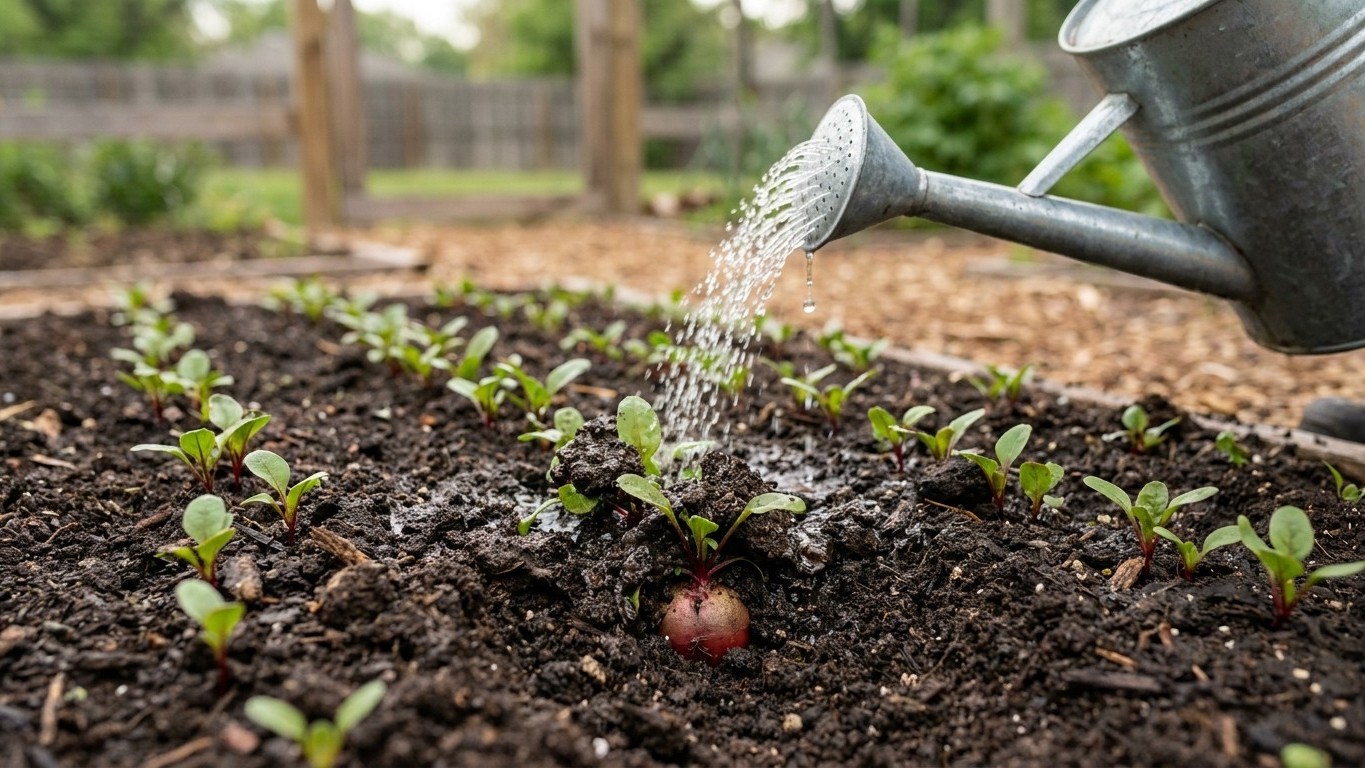

Beets grow well across Missouri once you match the sowing date to your local frost window and keep the soil moisture even for the first six weeks after seeding. When to Sow Beets in Missouri depends heavily on this timing, since the state’s dominant garden soils drain reasonably well but carry enough silt to crust over young seedlings, and summer heat turns root quality toward woody rather than tender if watering lapses. Get the timing and moisture right, and a 60 to 80 day root crop fits comfortably into a Missouri garden calendar.
The short answer
What the Menfro numbers mean for a beet bed
Missouri’s representative garden soil, mapped by USDA NRCS as the Menfro series, is an Alfisol, a forest-derived soil of moderate natural fertility with a surface pH near 6.2, slightly on the acid side of neutral. Texturally it’s a silt loam: about 4 percent sand, 19 percent clay and a full 77 percent silt, with roughly 2.0 percent organic matter in the surface horizon. It’s classified well drained, and understanding Beet Soil in Missouri starts with these baseline numbers.
For a beet, that mix is a reasonable starting point but not a perfect one. Beets want deep, sandy, well-drained ground loaded with organic matter, according to Utah State University Extension guidance on the crop. Menfro’s well-drained rating checks that box, and 77 percent silt behaves more like a loose, workable seedbed than sticky clay would. What it doesn’t offer on its own is the organic-matter load beets prefer: 2.0 percent is moderate, not rich, so most Missouri gardens benefit from working in compost, capped at no more than 1 inch of composted material per 100 square feet, per the same Extension guidance. Overdo that amendment and the risk shifts toward lush tops at the expense of the root.
Where heat changes the picture
Heat works on a different clock than the sowing date does. Extension research ties root woodiness to a specific combination: air temperatures above 85 F arriving while the plant is also short on water. Missouri summers routinely push past that mark for extended stretches, though the exact count of 90-degree days for any one Missouri location isn’t tracked on this page. What matters for the beet bed is simpler: once daytime heat settles in above 85 F, irrigation stops being optional. Skip a week of watering during a hot stretch, and the root that comes out of the ground will be more fibrous than the one that got steady moisture.
None of this is a diagnosis for one particular backyard. Missouri spans hundreds of mapped soil series, and the Menfro series is simply the one USDA lists as representative of the state as a whole under its State Soils program. A garden dug into a river bottom, a hillside, or ground a builder graded and filled a few years back can differ from these numbers substantially, in texture, in drainage, and in pH. Treat the figures above as a sense of what the region’s soil tends to do, then pull a real soil test for the bed in question before amending anything.
The six weeks that decide it here
Setting the sowing date
Beets are sown directly into the ground, never transplanted, and the clock for both maturity and risk starts at that seeding date. Extension guidance ties root maturity to 60 to 80 days from seeding, and the same first stretch after the seed goes in, roughly the first six weeks, is when water stress does its damage: not by killing the plant, but by pushing it to bolt, sending up a flower stalk instead of building a root worth harvesting.
In Missouri, the timing for that window is set by the last spring frost, which NOAA’s 1991-2020 climate normals place between April 6 and April 20 for the Kansas City area, with beets going into the ground 2 to 3 weeks ahead of that date. That puts the seeding date somewhere in the second half of March across much of the region, though the normals data point specifically to the Kansas City International Airport station; downtown Kansas City tends to clear its last frost about five days earlier, and southern Missouri gardens run milder again.
What Missouri spring does to that window
Whatever the exact week, the six weeks that follow sowing land squarely in a Missouri spring, and that’s a season known for swinging rather than settling: a mild stretch can give way to a late cold snap, and a wet week can be followed by a hot, dry one before the calendar even reaches May. That swing is exactly the setup that puts bolting risk on the table. A beet seedling that dries out during one of those sudden warm, dry stretches in its first six weeks reads the stress as a cue to reproduce rather than to keep building a root, and once that flower stalk starts, there’s no walking it back for that plant. The practical takeaway isn’t complicated: whatever the weather does in a given spring, the beet bed needs even, unbroken moisture through that early stretch, checked by hand rather than assumed from the last time it rained.
What goes wrong here
- A crusted seedbed that never comes up. Menfro’s surface is heavy on silt, and silt-rich ground caps over into a hard crust after a rain followed by sun, which can trap small beet seedlings before they break the surface. Keep the top inch loose with a light scratch of mulch or fine compost rather than letting bare silt dry into a shell.
- Bolting after a warm, dry snap in the first six weeks. This is the early-season failure, driven by water stress right after seeding, not by heat. Even watering through that specific six-week window is the fix, since a plant that has already bolted won’t build a usable root afterward no matter how much water it gets later.
- Woody, fibrous roots later in the season. This is a separate failure from bolting, showing up once summer heat climbs past 85 F while the soil runs dry. It comes from a different cause and needs a different response: consistent irrigation and a mulch layer through the hot months, rather than anything done at sowing time.
- Forked or hairy roots from over-amending. Menfro’s organic matter runs moderate at about 2.0 percent, which tempts gardeners to pile on compost. Extension guidance caps that at 1 inch of composted material per 100 square feet; go past it and the extra nitrogen tends to push leafy top growth and a misshapen root rather than a clean one.
- A garden that doesn’t match the state soil at all. Menfro is well drained and moderately fertile, but plenty of Missouri yards sit on river-bottom clay, compacted fill, or thin hillside ground that holds water or sheds it very differently. A bed that stays soggy after rain needs raised rows or added drainage before any of the timing advice above will help.
Checking this against your own county
Everything above starts from a statewide representative soil and a Kansas City area frost record, and Missouri is too large and too varied for either to stand in for one specific yard. The Bootheel, the Ozark hill country, and the northern plains counties all handle spring frost and summer heat on their own schedule, and the soil under a raised bed in one county can have almost nothing in common with the Menfro numbers above.
University of Missouri Extension keeps county-level offices that can pull a local soil test, confirm a more precise last-frost date for that specific location, and flag whether the local ground needs anything the statewide figures don’t cover. That office, reachable through University of Missouri Extension, is the more reliable next stop before finalizing a sowing date or an amendment plan, especially for anyone gardening well north or south of the Kansas City reference point used here.
Common questions
How long do beets take to mature in Missouri?
Beets typically reach maturity 60 to 80 days from the seeding date, since beets are sown directly in the garden rather than started as transplants. That window runs from the day seed goes into the ground, not from any later stage.
When is the right time to sow beets in Missouri?
Aim for 2 to 3 weeks before the last spring frost. For the Kansas City area, NOAA’s climate normals place that frost date between April 6 and April 20, with the airport station running slightly later than downtown and southern Missouri trending milder still.
Why did my beets bolt instead of forming a root?
Bolting comes from water stress in the first six weeks after sowing, when a young beet reads dry conditions as a cue to send up a flower stalk instead of building a root. It’s an early-season problem tied to moisture, not to later heat.
Why are my beet roots tough and woody?
Woodiness is a separate, later-season failure, caused by air temperatures above 85 F combined with water stress once the root is already developing. Consistent watering and mulch through the hottest stretches of summer are the main defense.