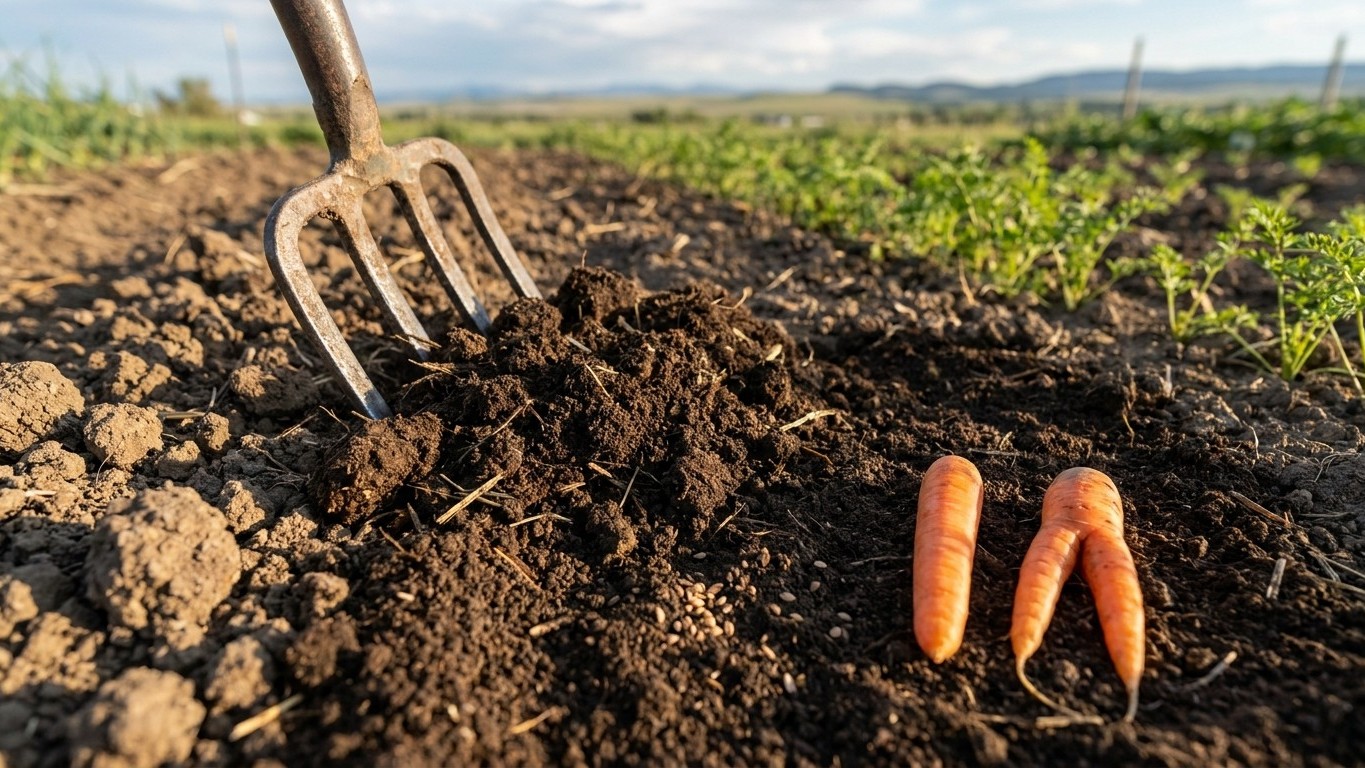

Montana’s dirt leans heavy and clay-rich across much of the state, and that single fact decides whether your carrots grow straight or twist into a knot. When to Sow Carrots in Montana comes down to timing it two to three weeks before your local last frost, once soil warms to at least 40°F, and expect forking unless you break up that clay first. Here’s the arithmetic and the soil chemistry behind it, plus a way to check your own patch before you drop a single seed.
The short answer
Montana’s official state soil is the Scobey series, a Mollisol, the deep, dark prairie soil that also built the Corn Belt further east. Where it’s mapped, the surface horizon runs close to neutral, about pH 7.0, and it’s clayey: 35 percent sand, 31 percent clay, 34 percent silt, with organic matter around 2.0 percent. Drainage is classed as well drained, which sounds reassuring, but “well drained” describes how water moves through the profile over time, not how easily a taproot can push through it. The state legislature named Scobey the official state soil in 2015, part of the USDA NRCS State Soils program that gives every state a signature series.
Put a carrot seed in ground with that much clay and silt, and the odds of a fork rise fast. Utah State University Extension is blunt about this: carrots want deep, sandy, well-drained soil rich in organic matter, and heavy or rocky ground makes the root fork rather than run straight. Thirty-one percent clay is enough to compact under a hoe, crust after a hard rain, and resist a taproot trying to drive six or eight inches down. So Will Carrots Fork in Montana Soil? often comes down to this clay content, and the fix Utah State names isn’t a different variety, it’s mechanical: work in plenty of compost and double dig the bed, breaking and loosening the soil a full spade deep, sometimes two, before you sow.
None of this means every Montana garden fights this exact fight. Scobey is one soil series among hundreds mapped across the state, and it’s a snapshot of one representative location, not a survey of your yard. River-bottom ground along the Yellowstone or Missouri drains and warms differently than a bench above it. A lot filled or graded during construction bears no resemblance to any native series on the map. Mountain valleys carry their own thin, rocky soils that never resembled the eastern Montana plains where Scobey is most common. Treat this section as a starting point that tells you what the region’s ground tends to do, hold clay, run close to neutral, resist a taproot, and then go find out what’s actually under your own carrot bed. If you already know your soil is loose and sandy, skip the double digging. If you’ve never dug past six inches, the next section will tell you what to look for.
The test that settles it in your own garden
- Dig a hole where you plan to sow, at least a foot deep. If you hit a hardpan, a dense layer that resists the shovel, or you can’t get past six or eight inches without hitting rock, that depth is your ceiling for a straight carrot root unless you loosen it or build up.
- Pull soil from that hole and look for stones. Any that are bigger than a pea and sitting in the top foot will deflect a growing root and cause forking, no matter how good the texture is otherwise.
- Grab a handful of moist soil and squeeze it. If it holds a tight ribbon shape and feels slick, that’s clay-heavy ground, closer to the Scobey profile described above. If it falls apart and feels gritty, you’re working with sandier soil that drains faster and resists compaction, better carrot conditions from the start.
- Fill the hole with water and time how long it takes to drain. Standing water after an hour or more points to poor drainage, a setup for rot and uneven growth. Water that vanishes almost immediately suggests very sandy or loose soil, which drains well but may need more frequent watering to avoid split roots later in the season.
- Repeat the dig-and-squeeze test in two or three spots in the same bed. Soil can change texture within a few feet, especially near a foundation, a driveway, or wherever fill dirt was brought in.
When to sow here
- Start from your local last spring frost window. Around Billings, NOAA’s 1991-2020 climate normals put that window between April 29 and May 10, based on the 30 to 70 percent probability band for a 32°F freeze. Mountain valleys elsewhere in the state can see frost in any month, so this window is a milder-valley reference, not a statewide guarantee.
- Count backward two to three weeks from that window. That puts a realistic outdoor sowing date somewhere in the second half of April for areas with a similar frost pattern to Billings, earlier or later depending on how your own valley compares.
- Check soil temperature before you sow, not just the calendar. Carrot seed needs the ground at 40°F minimum to have any shot at germinating, and germination happens best between 55°F and 65°F. A cold snap after sowing won’t kill the seed outright, but it will stall it, sometimes for weeks.
- Remember every one of these dates counts from the day you sow seed, not from a transplant. Carrots don’t transplant, the taproot forks or snaps if you try moving a seedling, so the entire 70- to 100-day maturity window on a seed packet runs from the seed going into the ground, start to finish.
- If a late cold spell arrives after sowing, resist replanting immediately. Carrot seed can sit in cool, damp soil longer than most vegetables before it either germinates or fails, so give it a week or two before assuming a bed needs redoing.
What goes wrong here
- Forking in heavy ground. Clay-heavy soil close to the Scobey profile, 31 percent clay, resists a straight taproot and splits it around stones or compacted layers. The remedy is the one Utah State names directly: work in compost and double dig the bed a full spade or two deep before sowing, or switch to a raised bed filled with looser, amended soil.
- Poor germination in a hot spell. Carrot seed germinates best between 55°F and 65°F. A stretch of hot, dry weather right after sowing can push surface soil well past that range and crust it over, and thin, weak stands are the result. Shading the row lightly and keeping the surface consistently moist during germination helps keep soil temperature in range.
- Splitting from uneven water. Roots that dry out and then get soaked, a hard rain after a dry stretch, or an irrigation schedule that skips a week then floods, expand unevenly and split along the root. Even, regular watering through the growing season prevents this far more reliably than trying to fix it once it starts.
- Crusted soil blocking emergence. That same clay content can bake into a hard crust after rain on bare, sown ground, physically trapping seedlings before they break the surface. A light mulch or a thin layer of compost over the seed row keeps the surface soft enough for emergence.
Checking this against your own county
Everything above is a regional starting point built from one representative soil series and one set of frost normals from a single monitoring station. Your county’s actual frost dates, soil map units, and elevation can shift that picture considerably, especially anywhere away from the milder river valleys. Montana State University Extension keeps county-level offices with staff who can pull the actual soil survey for your address and talk through local frost timing based on years of on-the-ground observation, not just a single station’s normals. Find your local office through Montana State University Extension before you finalize a sowing date or decide whether your bed needs a double dig.
Common questions
Can I sow carrots directly in clay soil without amending it?
You can, but expect forked, stubby roots. Utah State University Extension identifies heavy or rocky soil as a direct cause of forking, and the fix is compost plus deep loosening, not a different sowing technique.
How do I know if my soil temperature has reached 40°F?
A basic soil thermometer pushed a few inches into the bed, checked in the morning before the sun warms the surface, gives the most reliable reading. Waiting for a stretch of consistent readings above 40°F is safer than judging by air temperature alone.
Does a raised bed solve the forking problem completely?
A raised bed filled with loose, amended soil removes the native clay layer from the root’s path entirely, which is often the most reliable fix where digging down isn’t practical, though it does require enough depth, at least a foot, to accommodate a full-length carrot root.
Why do my carrots split even when the soil is loose?
Splitting usually traces back to uneven watering rather than soil texture. Roots that swell after inconsistent moisture crack along their length even in good, loose soil, so a steady watering schedule matters as much as the soil itself.