
Most Maryland gardeners should start pepper seed indoors somewhere between mid-January and late February, counting back 8 to 10 weeks from transplant day. Transplant happens after the last frost and once soil hits 60 F, which in Maryland’s reference data falls between April 3 and April 16. The exact week depends on your county, your soil, and how much heat risk you’re willing to carry into July.
The short answer
Baltimore’s reference station averages 24.6 days a year at or above 90 F, based on NOAA NCEI Climate Normals for 1991-2020. That’s not a curiosity number. It’s the figure that tells you how much heat load your pepper plants will absorb between flowering and harvest, and it’s the number that decides whether a July heat wave costs you a fruit set or two.
Pepper flowers are fussy. Utah State University Extension notes that fruit set fails at both ends of the temperature scale: nights below 55 F stall pollen viability just as surely as days above 90 F do. Maryland’s near-25-day stretch of 90-degree-plus afternoons means that somewhere in mid-summer, probably late July into August, your plants will hit a run of days where blossoms open, drop, and never turn into peppers. That’s not a disease or a nutrient problem. It’s the plant protecting itself from heat it can’t use.
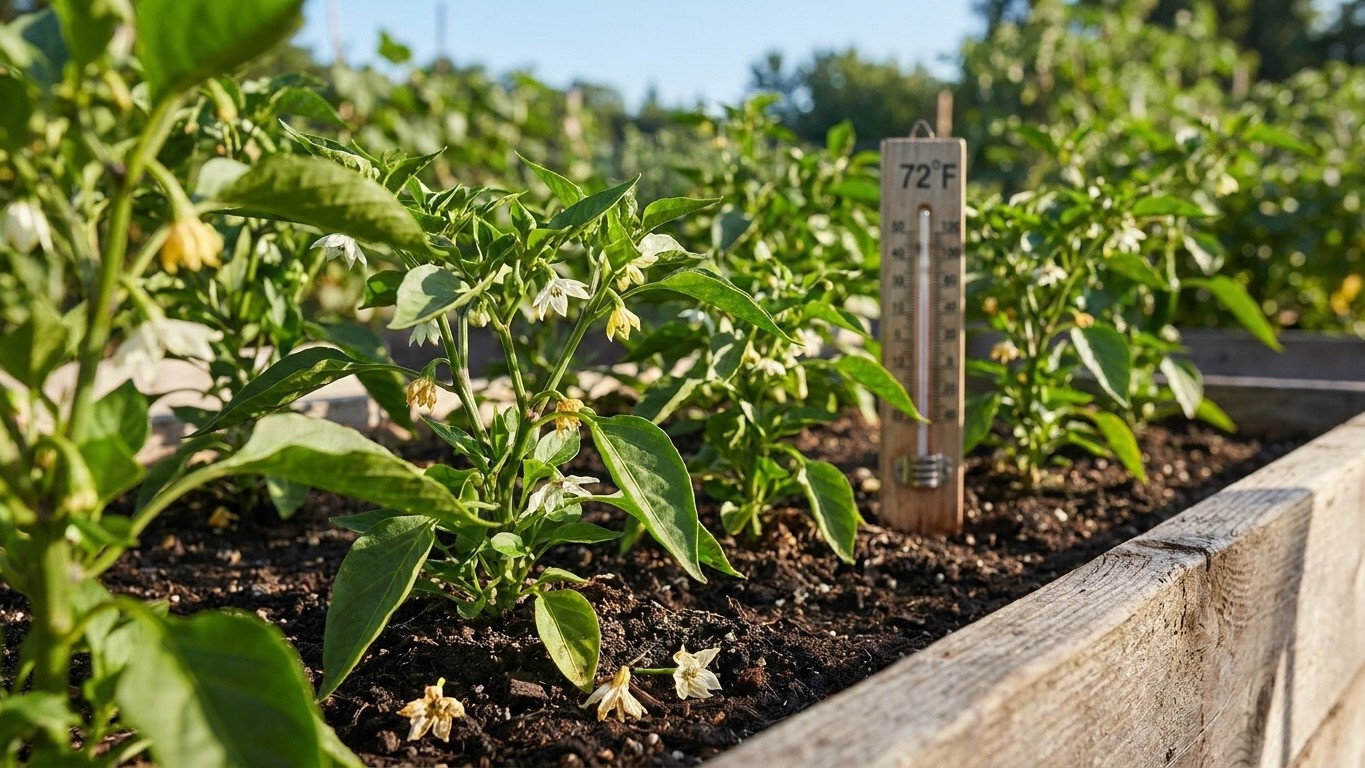
The cold end of that equation is where this data gets thinner. This site tracks days above 90 F for Maryland, but it does not carry summer night minimum temperatures, and that’s a real gap you need to fill yourself. A 55 F night threshold sounds abstract until you remember that early-season nights in a shaded backyard, a low-lying garden bed near a creek, or a spot that catches cold air draining off a hillside can sit several degrees below what a regional average would suggest. Don’t guess at this from latitude, and don’t assume that because you’re south of Pennsylvania your nights automatically clear 55 F by late May. They might not. A cheap min-max thermometer left in the garden for two weeks in late spring tells you more than any state-level average ever will.
So the short answer has two halves. The heat half is measurable and it’s already working against you for about three and a half weeks a year on average, concentrated in mid-summer. The cold half is real, it fails fruit set just as completely, and it’s the one you have to measure yourself, at your own site, in your own soil.
When to start seed here
The math behind a pepper-seeding date isn’t complicated once you separate the two things that actually matter: when your last frost happens and when your soil warms enough to accept a transplant. Everything else is subtraction.
- Find your local last-frost window. NOAA NCEI’s 1991-2020 climate normals put the 32 F freeze-probability window for the Maryland reference station between April 3 and April 16. That’s a statewide anchor, not a guarantee for your yard. Western Maryland, meaning Garrett and Allegany counties, runs weeks later than that window because of elevation. The Eastern Shore tends to run milder and can sometimes push earlier within that band.
- Add the soil-temperature condition. A frost-free calendar date doesn’t mean the soil is ready. Peppers need soil at 60 F before transplant, and cold, wet Maryland clay in early April often lags behind the air temperature by a week or more. If your last frost falls on April 10, don’t assume your soil hits 60 F on April 11. Check it with a soil thermometer pushed 4 inches deep, taken in the morning, over several consecutive days.
- Subtract 8 to 10 weeks for indoor growing time. Utah State University Extension recommends starting pepper seed 8 to 10 weeks before that transplant date. Counting back 8 weeks from April 3 lands you around February 6. Counting back a full 10 weeks from April 16 lands you closer to February 3. Split the difference and most of the state is looking at a seed-starting window from late January through the third week of February.
- Adjust for your specific county. If you garden in Garrett or Allegany County, push your transplant date later to match your true frost timing, then subtract your 8 to 10 weeks from that later date, which moves your indoor seeding into February proper rather than late January. If you’re on the Eastern Shore with a milder microclimate, you may be able to start slightly earlier and transplant on the front edge of the statewide window.
- Hold transplants back if soil hasn’t caught up. A pepper seedling started on schedule but held at proper indoor temperature and light for an extra one to two weeks rarely suffers for it. A pepper transplanted into 52 F soil because the calendar said April, on the other hand, often sits and sulks for a month before it grows at all.
Redo this arithmetic with your own numbers rather than trusting a single statewide date. A gardener in Oakland, in Garrett County, and a gardener in Salisbury, on the Eastern Shore, are working from meaningfully different last-frost windows even though they’re both in Maryland.
What goes wrong here
- Blossom drop during a hot spell. When daytime highs push past 90 F, which happens roughly 24.6 days a year at Maryland’s reference station, open flowers abort rather than set fruit. There’s no cure for the heat itself, but shade cloth rated around 30 to 40 percent, hung over plants during the worst afternoon stretch, can knock a few degrees off the flower’s immediate environment and buy you a better set rate. Watering deeply in the morning, rather than a light daily sprinkle, also helps the plant handle heat stress without shedding blooms out of self-preservation.
- Blossom drop from a cool night. The other side of the same failure. If nights near you drop below 55 F, whether that’s a late-spring cold snap or an early-fall chill, flowers can abort just as they do in heat. Since this site doesn’t track summer night lows for Maryland, put a thermometer in your own garden bed for a couple of weeks each spring and fall to know where you actually stand, rather than assuming your nights track the state average.
- Sunscald on exposed fruit. Maryland summers deliver strong, direct sun for long stretches, and a pepper plant that’s lost leaves to disease, wind, or over-aggressive pruning can expose its fruit directly to that sun. The result is a pale, sometimes leathery, sunken patch on the fruit’s shoulder. Keep foliage full and intact through the season rather than stripping lower leaves, and consider light shade cloth on the hottest, most exposed rows.
- Blossom-end rot. This shows up as a dark, sunken patch on the bottom of the fruit and it’s a calcium-uptake problem tied almost always to inconsistent watering rather than a true calcium deficiency in the soil. Maryland’s mix of clay-heavy soils and uneven summer rainfall, where a plant gets a soaking thunderstorm followed by a dry week, is a near-perfect recipe for it. Even, consistent watering on a schedule, plus a couple of inches of mulch to hold soil moisture steady, addresses it more reliably than any calcium amendment.
Common questions
Can I start pepper seed earlier than late January to get a bigger head start?
You can, but an oversized, root-bound seedling sitting under grow lights for 12 or 14 weeks rarely outperforms one started on the recommended 8-to-10-week schedule. Extra indoor weeks mostly add stress, not size, once the plant outgrows its starter pot.
What if my county’s last frost date doesn’t match the statewide April 3 to April 16 window?
Use your own local record. The statewide figure comes from NOAA NCEI’s 1991-2020 climate normals at a single reference station, and Maryland’s terrain varies enough, mountainous in the west, milder on the Eastern Shore, that your actual last-frost date can sit well outside that band.
Does soil temperature or air temperature matter more for transplanting?
Soil temperature is the harder requirement. Peppers need soil at 60 F to root and grow normally after transplant, and an early frost-free date with cold soil underneath will still stall the plant even if the air feels warm enough.
Is there a published hard-freeze or light-frost threshold specific to Maryland I should also watch for?
Not in the data behind this article. The only frost figure available here is the 32 F freeze-probability window from NOAA NCEI’s 1991-2020 climate normals. No separate light-frost or hard-freeze threshold is published in these sources, so don’t rely on a second number you may have seen elsewhere without checking it against your own local record.