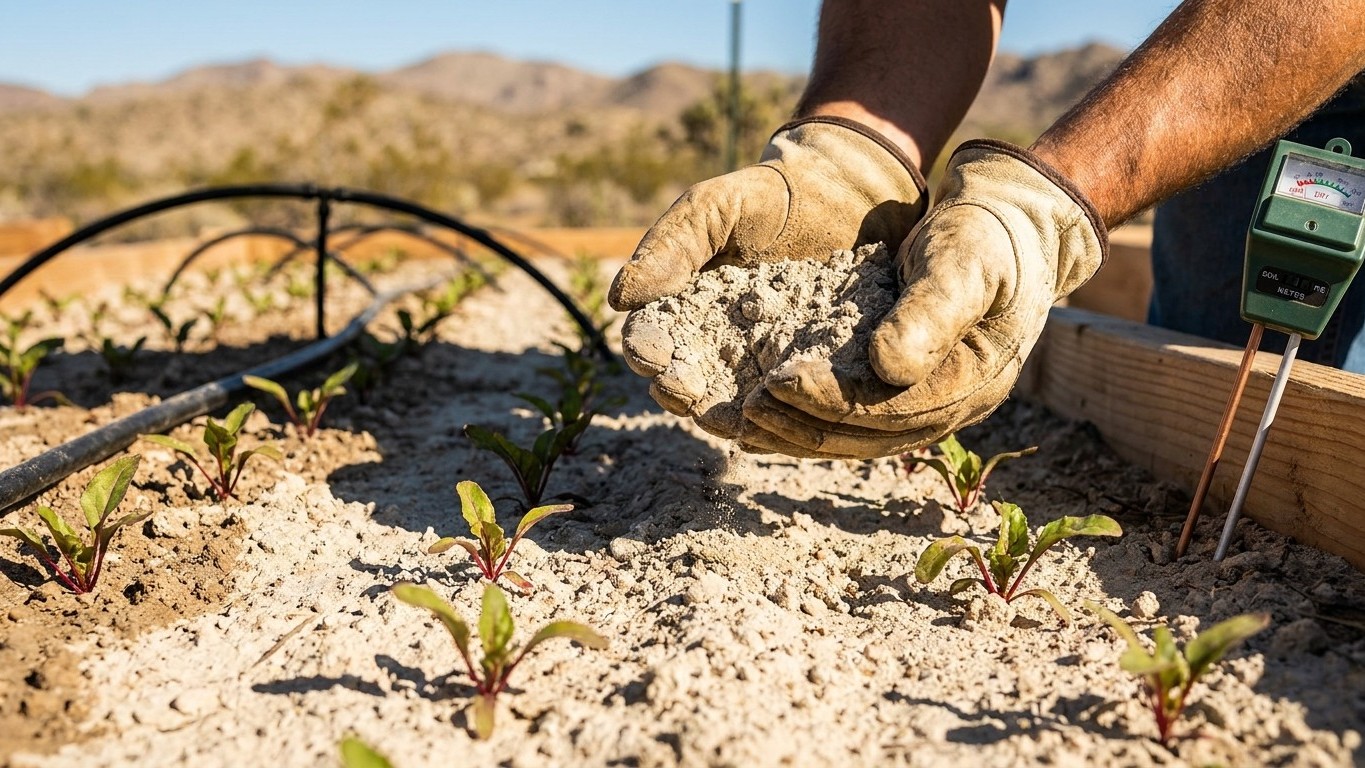

Nevada’s official state soil, the Orovada series, is 66 percent sand and only 8 percent clay, alkaline at the surface, and well drained. That combination sheds water fast, which sets the real fight for a beet grower here: keeping the root zone consistently moist for the first six weeks after sowing, before heat and dryness turn a fine crop into a bolted or woody one.
The short answer
The Orovada series is an Aridisol, the soil order that forms under dry climates and tends toward alkalinity and salt accumulation. Its surface horizon runs about pH 7.5, with 66 percent sand, 8 percent clay, and 26 percent silt, and organic matter sits around 1.4 percent. It drains well. Nevada made Orovada its official state soil by state law, and USDA NRCS records these figures as representative values across 223 sampled components of the series.
None of that is a diagnosis of your yard. Nevada spans hundreds of mapped soil series, and a state soil is a snapshot of what’s typical across the landscape, not a measurement anyone took in a particular garden bed. River bottoms hold silt the Orovada series doesn’t have. Hillside ground compacts differently. Anywhere a house pad got graded or filled, the native profile is gone entirely. Treat the Orovada numbers as a description of the region’s tendency, sandy, alkaline, low in organic matter, fast draining, and then pull an actual soil test for the bed you’re planting, since understanding Beet Soil in Nevada conditions locally will matter more than the statewide average.
That said, the tendency matters for beets specifically. Utah State University Extension describes the crop as wanting deep, sandy, well-drained soil rich in organic matter. Nevada’s representative soil hits two of those three targets on its own: it’s sandy and it drains well. The organic matter figure, at roughly 1.4 percent, falls short of “rich,” which is exactly why USU Extension’s guidance to work in no more than 1 inch of composted organic matter per 100 square feet matters here. Too little compost and the sandy profile won’t hold enough moisture between waterings. Too much, and you risk forking roots and excess leaf growth at the expense of the root itself.
On heat, the specific count of days above 90 F for a Nevada reference city isn’t part of the sourced climate data used for this page, so no number is given here. What is established, again from USU Extension, is the threshold that matters agronomically: air temperatures above 85 F combined with water stress make beet roots woody. Nevada’s low-elevation valleys clear that 85 F mark for extended stretches most summers, which means the sandy, fast-draining soil and the heat compound each other unless irrigation stays consistent through the growing season, not just at planting, making the question of When to Sow Beets in Nevada just as critical as soil prep.
The six weeks that decide it here
USU Extension’s guidance to sow beets 2 to 3 weeks before the last expected frost puts the crop’s most sensitive stretch, the first six weeks after seeding, squarely inside a state’s early spring. That’s the window where water stress does its damage: beets that dry out during this stage tend to bolt, sending up a flower stalk instead of building a root, and there’s no walking that back once it starts.
Nevada’s spring behavior varies enormously depending on where in the state you’re standing. NOAA’s 1991-2020 climate normals for the Las Vegas airport put the range for a 32 F freeze probability between January 7 and February 1, but that reading comes from a desert location with a strong urban heat-island effect around the airport itself, and it should not be used as a planting guide anywhere else in Nevada. Reno, Carson City, and any elevated ground in between freeze months later in spring and start freezing again months earlier in fall than the Las Vegas figure suggests. A gardener in the Truckee Meadows working off a Las Vegas frost date would be sowing into ground that’s still going to freeze again.
What that means practically: the six weeks after sowing land in a very different kind of spring depending on elevation. In the low desert, that window can already be warming toward the kind of dry heat that stresses shallow-rooted seedlings before they’ve built enough root mass to buffer it. At higher elevation, the same six weeks may still carry frost risk on one end and a fast swing into dry wind on the other. Either way, the risk sits in the same place: inconsistent soil moisture during establishment. Nevada’s sandy, well-drained state soil profile doesn’t hold water on its own, so whatever the spring pattern looks like locally, the irrigation schedule has to compensate for a soil that lets moisture through quickly rather than storing it.
What goes wrong here
- Seedlings bolt before they’ve sized up. Sandy, fast-draining soil like Nevada’s Orovada series lets the root zone dry out between waterings during that critical first six weeks, and USU Extension is direct that water stress at this stage triggers premature flowering. The fix is a watering schedule that doesn’t wait for the surface to look dry, since sandy soil looks dry well before the root zone actually is, paired with a couple inches of mulch to slow evaporation.
- Roots turn woody in midsummer. This is a separate failure from bolting, driven by heat above 85 F layered on top of water stress later in the season, after the plant has already set a root. Deep, less frequent watering that reaches below the sandy surface layer, rather than light frequent sprinkling, keeps the root zone from drying at the depth that matters once summer heat sets in.
- Low organic matter starves the soil’s moisture-holding capacity. At roughly 1.4 percent organic matter, Nevada’s representative soil doesn’t hold water the way a beet bed ideally would. Working in up to 1 inch of composted organic matter per 100 square feet, per USU Extension’s guidance, closes some of that gap without overloading the bed.
- Frost timing gets misjudged because Nevada’s range is so wide. A gardener using a low-desert frost date in a high-elevation county risks sowing into ground that freezes again weeks later, right into the sensitive early root stage. There’s no single statewide sowing date; local frost timing has to come from a source that reflects the specific county’s elevation.
- Alkaline surface soil limits some nutrient uptake. A surface pH around 7.5 can tie up certain micronutrients that plants need in available form. A soil test for the specific bed, not just knowledge of the state soil’s typical pH, is what tells a gardener whether an amendment is actually needed.
Checking this against your own county
Everything above describes tendencies for Nevada’s representative soil and its general climate range, not a specific garden. The next step is a soil test and a local frost date for the actual county where the beets are going in the ground. University of Nevada, Reno Extension, at extension.unr.edu, is the state’s land-grant extension service and the right place to get both: county-specific frost timing and guidance on testing and amending soil that may look nothing like the Orovada series once it’s been worked as a garden bed for a few seasons.
Common questions
How many days do beets take from seeding to harvest in Nevada?
USU Extension’s guidance runs 60 to 80 days, and that count starts from seeding in place, not from a transplant date, since beets are a direct-sow crop.
Can I use the Las Vegas frost date for the rest of Nevada?
No. That figure reflects a desert airport with a strong urban heat-island effect and applies narrowly to that location. Reno, Carson City, and higher-elevation areas freeze later in spring and earlier in fall, so a local frost date from your own county extension office is the only reliable number.
Is Nevada’s state soil the same as what’s in my backyard?
Probably not exactly. The Orovada series describes a representative Aridisol across the state, but Nevada maps hundreds of soil series, and disturbed, filled, or river-bottom ground can differ completely. Use it as a general picture of regional tendencies, then test your own bed.
What’s the difference between bolting and woody roots?
Bolting happens early, when water stress during the first six weeks after seeding pushes the plant to flower instead of building a root. Woodiness happens later, when heat above 85 F combines with water stress after the root has already started forming. They’re two separate failures with the same underlying cause, inconsistent moisture, but they show up at different growth stages and need to be diagnosed separately.