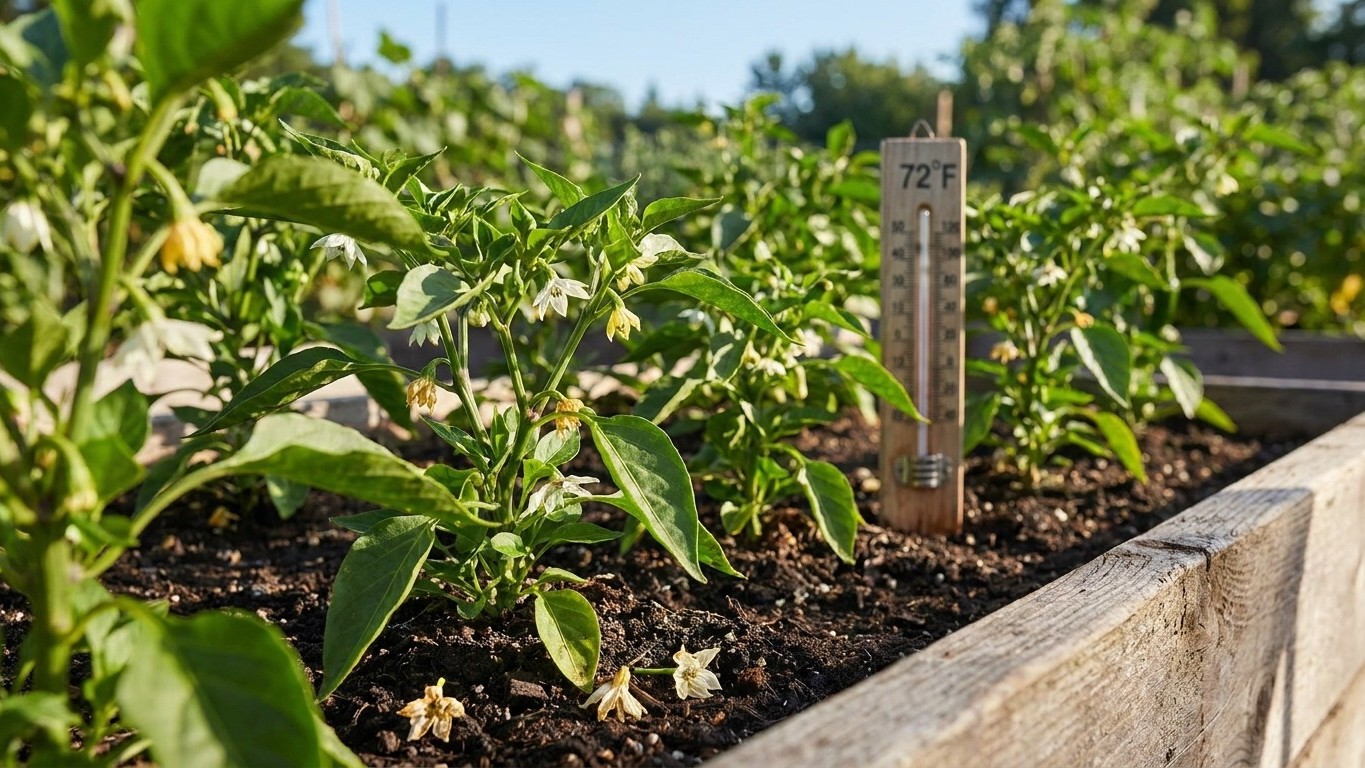

Start pepper seed indoors in British Columbia between mid-January and early February for most Lower Mainland and coastal gardens, counting back 8 to 10 weeks from a transplant date around mid-May, once soil has warmed to 60°F and frost risk has passed. Gardeners in the Interior, the Okanagan, or higher elevations need to shift that window later based on their own local frost pattern, not the coastal one.
The short answer
British Columbia’s reference climate station, Vancouver, records an average of 0.0 days a year at or above 90°F, according to Environment and Climate Change Canada’s 1981-2010 Climate Normals. That’s not a typo and not a rounding error. It means the coastal and Lower Mainland growing belt essentially never sees the kind of extreme daytime heat that stalls pepper fruit set elsewhere on the continent. For a plant that Utah State University Extension flags as failing to set fruit once days climb past 90°F, that half of the risk is close to a non-issue in this part of the province.
Why zero heat days still doesn’t mean easy peppers
Pepper fruit set fails at both ends of the thermometer, not just the hot one. Utah State University Extension is specific on this: flowers drop or fail to set when nights fall below 55°F just as readily as when days push above 90°F. With the hot threshold almost never in play at the coast, the entire risk in a typical BC pepper season shifts to the cool side of that equation, cool nights, not scorching afternoons, are what actually costs a gardener here their pepper harvest.
The number this site can’t give you
This is where the data runs out, on purpose. This site tracks days at or above 90°F by station, because that figure is measured and published. It does not carry summer night minimum temperatures, and there’s no reliable way to back into them from latitude, from a coastal location, or from how cold a January gets. A garden three miles from the water can run several degrees warmer at 2 a.m. than one tucked into a low-lying valley a short drive inland, and BC’s terrain, mountains, valleys, ocean influence, makes that kind of local variation the rule rather than the exception. Watch your own nighttime lows through late spring and early summer with an actual thermometer or a nearby weather station before you assume your peppers are past the cool-night risk. Don’t let a mild afternoon fool you into thinking the night matched it.
When to start seed here
The math behind a pepper start date is the same everywhere Utah State University Extension’s guidance applies: figure out your transplant date first, then count backward. In British Columbia, the piece that changes county to county, sometimes garden to garden, is the frost date and how fast the soil warms in spring.
Working the calendar backward
- Start with the frost date, treated as a midpoint, not a guarantee. Environment and Climate Change Canada’s Climate Normals put the average last spring frost at the Vancouver Int’l A station at March 18. That’s a mean date drawn from 1981-2010 records, which means in roughly half of those years frost arrived later than March 18, not earlier. Treat it as the center of a window, never as a safe planting date.
- Wait for 60°F soil, not just for the calendar. Utah State University Extension is clear that transplanting happens after frost and once soil has reached 60°F, whichever comes later. Coastal BC soil often lags air temperature in early spring because of cool ocean influence and heavy spring rain, so check soil temperature directly with a soil thermometer a few inches down rather than assuming the date alone tells you enough.
- Pick a realistic transplant date for your own site. For much of the Lower Mainland, that tends to land somewhere in mid-to-late May once both the frost risk and the soil-temperature condition are comfortably behind you. Interior and higher-elevation gardens should push this later, based on their own frost history, not on the coastal figure.
- Count back 8 to 10 weeks for the indoor start. If your realistic transplant target is mid-May, an 8-week head start lands seed-starting in mid-March; a 10-week head start lands it in early March. Gardeners who prefer more margin, or whose soil warms slower than average, can start at the 10-week mark; those confident in an earlier soil-warm date can lean toward 8.
- Rerun the math for your own county. Anyone outside the immediate Lower Mainland should swap in their own local frost record where it exists, or at minimum add extra buffer weeks for inland and upland districts where spring runs later than the coastal station used here.
What goes wrong here
The specific ways a BC pepper crop underperforms tend to trace back to the same two temperature extremes Utah State University Extension names, plus one watering-related problem that shows up almost everywhere peppers are grown.
The three failures worth watching for
- Blossom drop during a hot spell. Even though 90°F days are rare at the coast, BC’s Interior and Okanagan gardens can run hotter, and even the Lower Mainland gets the occasional heat spike. When daytime temperatures climb into that range during flowering, blossoms can drop before they set fruit. The remedy is timing and shade: avoid heavy pruning that strips leaf cover right before a forecast hot stretch, and use light shade cloth over plants during the worst afternoon heat rather than leaving them fully exposed.
- Blossom drop from a cool night. This is the flip side, and in most of coastal BC it’s the more likely culprit. A run of nights under 55°F during flowering can cause the same blossom drop as heat does. Since this site doesn’t track night minimums, the fix starts with your own observation: if overnight lows are dipping into the low 50s during bloom, delay transplanting outdoors, or protect young plants with row cover or cloches until nights stabilize warmer.
- Sunscald on fruit. In gardens with strong, direct sun, particularly Interior valleys with less cloud cover than the coast, exposed pepper fruit can develop pale, blistered patches where sunlight hits directly for extended periods. Keeping a fuller leaf canopy around developing fruit, rather than pruning plants into an open, exposed shape, is the straightforward fix.
- Blossom-end rot. This shows up as a dark, sunken patch at the bottom of the fruit and is tied to inconsistent watering interfering with calcium uptake, rather than to a calcium shortage in the soil itself. Even, regular watering through fruit development, especially during any dry spell, is the most reliable way to avoid it.
Common questions
Does British Columbia ever get hot enough to hurt pepper fruit set?
At the Vancouver reference station, the average is 0.0 days a year at or above 90°F, so the coastal and Lower Mainland belt rarely faces that risk. Interior and Okanagan gardens can run considerably warmer in summer, and gardeners there should watch their own local heat pattern rather than assume the coastal figure applies to them.
Is March 18 a safe date to transplant peppers outdoors in BC?
No. March 18 is the average last spring frost date at the Vancouver Int’l A station over the 1981-2010 record, which means frost arrives later than that in roughly half of all years. Peppers also need soil at 60°F, which is rarely the case that early in spring, so the realistic transplant window sits well past mid-March for most gardens.
How do I know if my nights are too cold for pepper flowers to set fruit?
Utah State University Extension puts the cool-end threshold at nights below 55°F. This site doesn’t publish summer night minimums, and there’s no dependable way to guess them from latitude or from how cold your winters run. Track your own overnight lows with a thermometer through the flowering period instead of assuming.
Should I start pepper seed 8 weeks or 10 weeks before transplanting?
Utah State University Extension’s range is 8 to 10 weeks indoors before transplant. Gardeners with slower-warming soil, or those who want more margin against a late frost, should lean toward the 10-week end; gardeners confident their soil and frost timing run close to average can use 8 weeks.