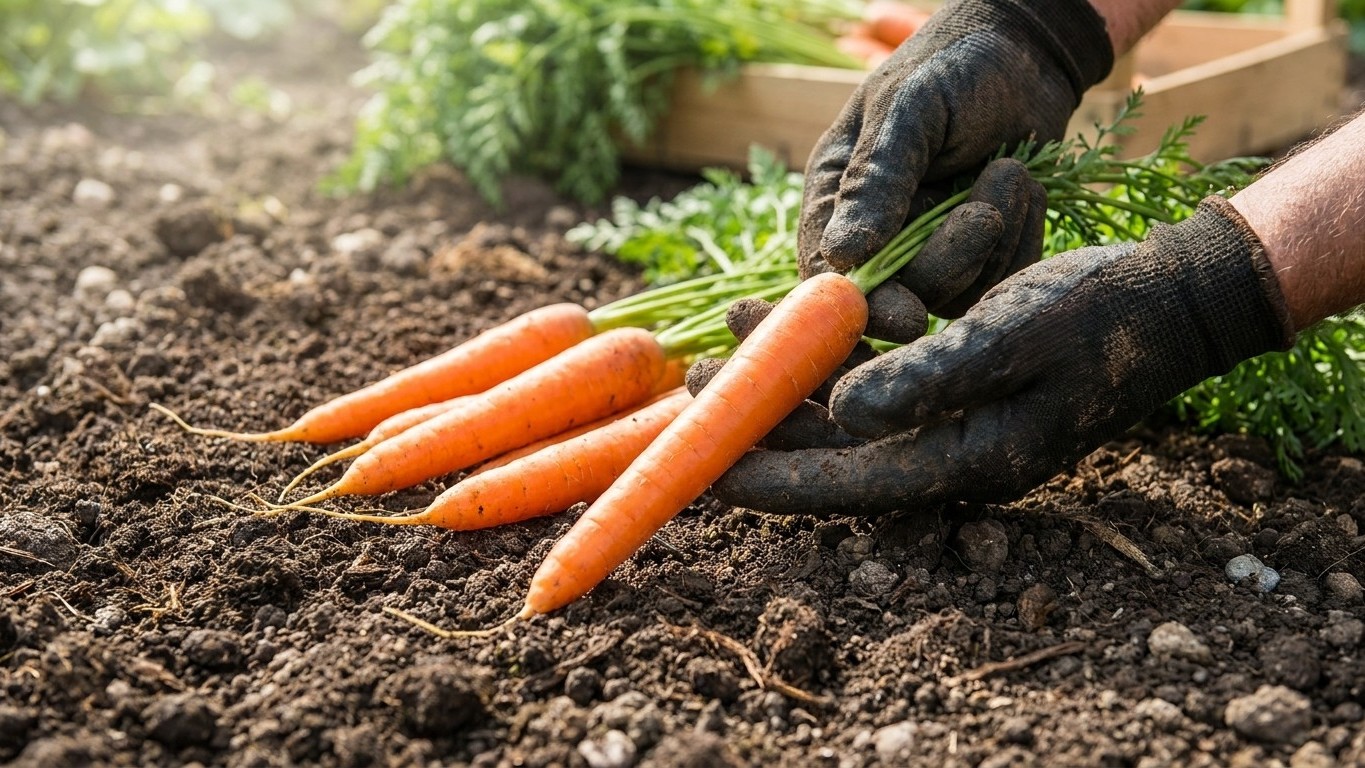

Will Carrots Fork in North Dakota Soil? North Dakota’s representative topsoil is a well-drained loam, not the heavy clay that typically forks a carrot. That’s good news for straight roots, but the real work here isn’t the ground, it’s the calendar. Cold soil and a short frost-free window matter more to this crop than what state you’re standing in.
The short answer
The soil USDA lists as representative of North Dakota is the Williams series, a Mollisol, the deep, dark prairie soil that built the Corn Belt. Its surface horizon runs 38 percent sand, 22 percent clay and 40 percent silt, a loam to silt loam blend, with organic matter around 4.0 percent and a surface pH near 7.2, essentially neutral. It’s classed as well drained.
Carrots want exactly this kind of ground: deep, loose, well-drained soil rich in organic matter. Utah State University Extension is blunt about the alternative, heavy or rocky soil makes the root fork, splitting into two or three legs as it hits resistance and grows around it instead of straight down. On paper, the Williams series clears that bar. Twenty-two percent clay is on the low side, and 40 percent silt with well-drained status means water moves through instead of pooling around a growing taproot.
That does not mean every North Dakota garden bed will produce a clean, single-root carrot. A state spans hundreds of soil series, and the Williams series is simply the one USDA records as most representative of North Dakota as a whole, not a survey of every backyard in it. River bottoms tend to run heavier and wetter. Hilltops can be thinner and stonier. And any yard where a builder graded, filled or compacted the topsoil, which describes a large share of newer subdivisions, will behave nothing like the undisturbed prairie soil this figure describes.
If your ground turns out to lean heavier than this, sandier, or shallower than it looks, the fix Utah State gives is the same regardless of which state you’re in: work in plenty of compost and double dig the bed, turning and loosening the soil to a full spade’s depth or more so the root has nothing to deflect off of. Where that’s impractical, because the ground is compacted clay or full of rock, a raised bed filled with a looser mix sidesteps the problem entirely rather than fighting it season after season. Neither fix depends on picking a different carrot variety; the fork is a soil problem, not a seed problem.
The test that settles it in your own garden
State averages tell you what to expect, not what you have. The only way to know if your bed will fork a carrot is to look at it directly, with a shovel, before you sow anything.
- Dig a hole at least a foot deep where you plan to sow. Carrots need loose ground for their full length, so check that the soil isn’t blocked by a hardpan layer, a buried layer of construction fill, or bedrock partway down.
- Look at what comes out. Note any rocks, gravel or chunks of clay in the spoil pile. Utah State University Extension is clear that rocky or heavy soil is exactly what forks a root, so stones the size of a marble or bigger in the top foot are a warning sign.
- Rub a handful between your fingers. Soil that forms a slick, sticky ribbon when wet is high in clay. Soil that won’t hold any shape at all and runs through your fingers is mostly sand. Something in between, that holds a loose shape but crumbles easily, is closer to the loam carrots prefer.
- Watch how water drains. Pour a bucket of water into the hole and time how long it takes to disappear. Water that sits for hours signals poor drainage and a soil that will need amending or a raised bed; water that vanishes quickly points toward the sandier, well-drained profile carrots do best in.
None of these steps need lab equipment. What they give you is a direct read on the two things that actually determine whether a carrot grows straight in your soil: how deep it’s loose, and how fast water moves through it.
When to sow here
Carrots are sown directly into the ground as seed. There’s no transplanting step, no seedling tray to harden off, which means every date that matters here counts from the day the seed goes into the soil, not from any later planting.
- Start with the last spring frost. NOAA’s Climate Normals for the reference weather station put North Dakota’s last spring freeze in the May 4 to May 15 window. That’s the airport-station figure; a suburban or rural garden nearby, especially at higher elevation or in a low-lying frost pocket, often sees frost linger one to two weeks longer, so treat this as a starting reference, not a guarantee for your yard.
- Check the soil, not just the calendar. Carrot seed germinates poorly in cold ground. Soil temperature needs to reach a minimum of 40 F before sowing makes sense at all, and a simple soil thermometer pushed a couple inches down tells you that faster than guessing from air temperature.
- Sow 2 to 3 weeks before that last frost date. Carrots tolerate cool soil better than heat, so working backward from the May 4 to May 15 window puts a typical sowing window in mid to late April for most of the state, adjusted earlier or later based on how your own soil is running that year.
- Aim for 55-65 F for germination. That’s the range where carrot seed sprouts fastest and most evenly. Soil that’s only just crossed 40 F will still germinate seed, just more slowly and less uniformly than soil that’s warmed further into that ideal band.
- Count 70 to 100 days from seeding, not from any later date. Because carrots have no transplant step, the entire maturity window runs from the day seed goes into the ground, which is worth marking on a calendar since carrot tops give little visual signal of how close the root is to full size.
What goes wrong here
- Forking in heavy or compacted ground. Even where the state’s representative soil is loam, individual yards with clay pockets, subsoil fill, or compaction from foot traffic will fork a root exactly as Utah State University Extension describes. The remedy is working in compost and double digging the bed to a full spade’s depth before sowing, or switching to a raised bed filled with looser soil if the native ground is too heavy to rework.
- Poor germination during a hot spell. If a warm stretch pushes soil well past the 55-65 F ideal germination range right after sowing, seedlings can emerge unevenly or fail to come up at all. Shading the seedbed lightly or timing sowing for a cooler stretch within the recommended window helps keep soil temperature closer to that band.
- Splitting from uneven watering. Carrot roots that go through a dry stretch and then get a heavy soak can split along their length as the interior swells faster than the outer skin can stretch. Keeping the bed evenly moist with a consistent watering schedule, rather than letting it dry out and then drenching it, keeps growth steady instead of erratic.
- Sowing before soil has actually warmed. Going by the calendar alone, rather than checking that the ground has cleared the 40 F minimum, leaves seed sitting in cold soil where it germinates slowly or rots before sprouting. A soil thermometer settles this faster than any date on a chart.
Checking this against your own county
Everything above is a starting point built from a representative soil series and a single reference weather station. Your own county’s frost dates, and the specific soil series mapped under your address, can differ from both. The North Dakota State University Extension service maintains county-level offices across the state and can point you to local frost data and soil survey information specific to where you garden. That local check is worth doing before you commit a full bed to a sowing date pulled from a statewide average.
Common questions
Do I need to test my soil’s pH before growing carrots in North Dakota?
The representative Williams series runs near neutral at about pH 7.2, which is a workable range for carrots, but that figure describes one mapped soil series, not your specific bed. A soil test through your local extension office gives you the actual number for your garden rather than a statewide estimate.
Can I sow carrots earlier than the last frost date to get a head start?
Only if the soil itself has reached at least 40 F. Sowing based on the calendar alone, before checking soil temperature with a thermometer, risks seed sitting in cold, wet ground where it germinates slowly or fails.
Why did my carrots come up thin and patchy this year?
Uneven germination is often a soil temperature problem, sowing happened either too cold, below the 40 F minimum, or during a spell well above the 55-65 F ideal range, rather than a seed quality issue.
Is a raised bed necessary, or is double digging enough?
Either works, according to Utah State University Extension, provided the fix matches the problem. Double digging loosens existing soil in place and works fine where the ground itself is workable but compacted. A raised bed makes more sense where the native soil is too rocky, too heavy, or too shallow over a hardpan to rework economically.