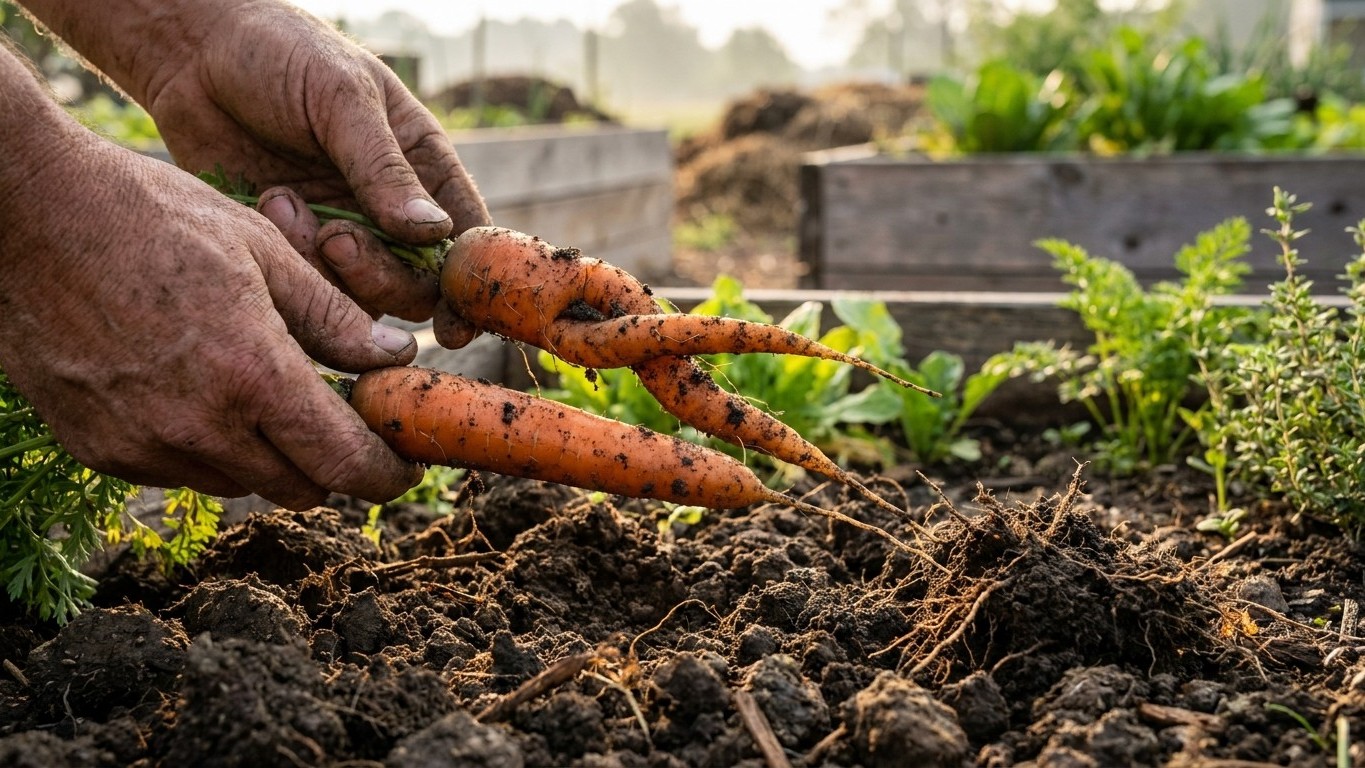

Ohio carrots need loose, deep soil and a sowing date pinned to the frost calendar, not the promise on the seed packet. The state’s representative soil runs heavier than carrots prefer, which means many home gardens will produce forked or stubby roots unless the bed gets amended or raised first. Sow seed directly in the ground two to three weeks before the last frost, and test your own dirt before assuming the state average applies to your yard.
The short answer
The soil USDA lists as representative of Ohio is the Miamian series, an Alfisol, which is the technical way of saying it’s a forest soil of moderate fertility that holds nutrients reasonably well. The surface horizon runs 26 percent sand, 20 percent clay and 53 percent silt, a loam-to-silt mix with organic matter around 2.0 percent and a surface pH near 6.5, slightly acid. Drainage is classed as well drained, which is the one piece of good news in this profile.
That 20 percent clay figure matters more than it looks. Carrots, according to Utah State University Extension, want deep, sandy, well-drained soil rich in organic matter, and they punish heavy or rocky ground by forking the root instead of growing straight. Miamian soil isn’t the heaviest clay you’ll find, but it’s silty and clay-laden enough that a carrot pushing down through it can meet resistance, split around a stone, or hit a compacted layer and branch sideways looking for an easier path, which raises the question Will Carrots Fork in Ohio Soil? in beds that haven’t been amended. The fix Utah State names for heavy soil is plenty of compost worked in, combined with double digging to loosen the ground well below the depth the root will travel. In practice that means turning the bed a full spade deep, sometimes two, and mixing in compost as you go rather than just topdressing it.
If your ground is truly stubborn (a hardpan a few inches down, or clay that turns to brick in August), double digging every bed every season stops being practical, and a raised bed filled with a loose, sandy mix becomes the more honest answer. Raised beds also sidestep the compaction problem entirely, since you’re not fighting the native subsoil at all.
None of this is a diagnosis of your particular garden. Ohio spans hundreds of mapped soil series, and the Miamian profile above describes what USDA considers representative of the state as a whole, not what’s sitting under your tomatoes. A subdivision built on scraped and regraded fill, a bottomland plot near a creek, or a hillside garden a few miles away can all differ from this profile completely. Treat these numbers as a starting point for what the region’s ground tends to do, not as a substitute for checking your own dirt.
The test that settles it in your own garden
- Dig a hole at least a foot deep where you plan to sow. Carrots need clear room to grow straight, so you’re checking whether the soil stays loose and diggable at that depth or turns into dense, unbroken clay partway down.
- Look at what comes out of the hole. Note any change in color or texture as you go deeper, and pull out any stones, rubble, or roots you hit. A carrot forks around anything solid in its path, so a hole full of gravel or buried construction debris is a strong clue why past roots came out twisted.
- Feel the texture between your fingers. Grab a handful of moist soil and rub it. Gritty means sand, slick and sticky means clay, smooth and silky means silt. Most garden soil is some blend, and the more clay you feel, the more compost and loosening the bed will need before carrots go in.
- Squeeze it into a ball. Soil high in clay holds a tight ball that barely crumbles when you poke it. Sandy soil falls apart almost immediately. Loam holds a loose shape and breaks with light pressure, which is closer to what carrots want.
- Watch how water drains. Fill the same hole with water and time how long it takes to disappear. Water sitting for hours signals poor drainage and a raised bed is worth considering; water gone within a reasonable stretch suggests the ground can support a properly amended in-ground bed.
When to sow here
Carrots are sown directly into the ground, seed to soil, with no transplanting step at any point. That matters for timing, because every day counted toward maturity starts at the moment the seed goes into the dirt, not at some later planting-out date. Getting the sowing window right in Ohio means working backward from the last spring frost and forward from soil temperature.
- Find your last frost window. Ohio State University Extension’s gardening calendar puts the last spring frost, for the state’s zone 6a areas, between May 5 and May 15.
- Count back two to three weeks from that date. Carrot seed tolerates cool soil far better than most garden crops, so sowing goes in ahead of the frost date rather than after it. Working from a May 5 frost, that lands sowing in the last third of April; from a May 15 frost, it lands in the middle of April.
- Check soil temperature before trusting the calendar alone. The ground needs to have warmed to at least 40 F for carrot seed to have any real chance of sprouting. A cold, wet spring can push that threshold back later than the calendar math suggests, so a simple soil thermometer pushed a couple inches down is worth more than a fixed date.
- Aim for the real sweet spot once the soil is workable. Germination performs best in soil between 55 and 65 F. Sowing the moment the ground crosses 40 F may work, but seed sown once the soil sits closer to that 55 to 65 F band will come up faster and more evenly.
- Count maturity from that sowing date, not from any later step. Since there’s no transplant involved, the full run to harvest is measured from the day seed hit the soil.
What goes wrong here
- Forked or branched roots in heavy ground. Ohio’s representative soil carries enough clay and silt that a carrot root can meet resistance and split around it. The remedy is working in generous compost and double digging the bed a full spade deep or more before sowing, or moving to a raised bed filled with a looser mix if the native soil never loosens enough.
- Poor or patchy germination during a hot stretch. Carrot seed germinates best between 55 and 65 F, and a sudden warm spell can push soil temperature well past that band, especially in a bed with dark, bare soil catching full sun. Sowing a bit earlier in the window, watering lightly to keep the top inch cool, or covering the row briefly during a heat spike all help keep germination on track.
- Splitting from uneven watering. Carrots that dry out and then get soaked, whether from a missed week of watering followed by a heavy rain or an inconsistent hose schedule, tend to split along the root as it swells too fast after a dry stretch. Steady, even moisture from sowing through harvest, rather than occasional deep soaks, keeps the root growing at one steady rate.
- Stubby roots that stop short. This is usually the same underlying problem as forking, just less dramatic: a compacted layer or dense clay a few inches down stops the root cold instead of splitting it. The same double-digging and compost approach that prevents forking also prevents this.
Checking this against your own county
The soil figures and frost dates on this page describe Ohio broadly, and broadly is exactly where their usefulness ends. Your county’s actual frost pattern, soil survey data for your specific parcel, and locally tested variety recommendations all live with your county’s extension office, and that’s the resource worth calling before you commit a whole bed to carrots.
Ohio State University Extension runs that local network statewide, county by county, with staff who can pull the soil survey for your address and confirm the frost dates your particular area actually sees. Start at extension.osu.edu and look up your county’s office directly. A five-minute phone call there will tell you more about your specific ground than any state-level average ever could.
Common questions
Can I fix forking carrots without digging up the whole bed?
Not reliably. Forking happens where the root meets resistance below the surface, so a shallow fix on top won’t reach the problem. Utah State University Extension points to compost worked in along with double digging as the remedy for heavy soil, and that means loosening the ground to real depth, not just the top few inches.
How early is too early to sow carrot seed in Ohio?
Soil below 40 F won’t support germination no matter how close you are to the frost date, so soil temperature should override the calendar. Check the ground directly rather than sowing on a fixed date regardless of conditions.
Does Ohio’s state soil mean my garden has 20 percent clay?
Not necessarily. The Miamian series figures describe what USDA lists as representative for the state, drawn from mapped surface horizons across hundreds of components, not a measurement of any individual backyard. Your soil could be sandier, heavier, or something else entirely depending on your specific location and its history.
Do carrots need a different sowing date if I’m using a raised bed?
The frost and soil-temperature guidance still applies, since raised beds warm slightly faster than ground-level soil but aren’t immune to a late cold snap. Check soil temperature in the raised bed itself rather than assuming it matches ground-level readings nearby.