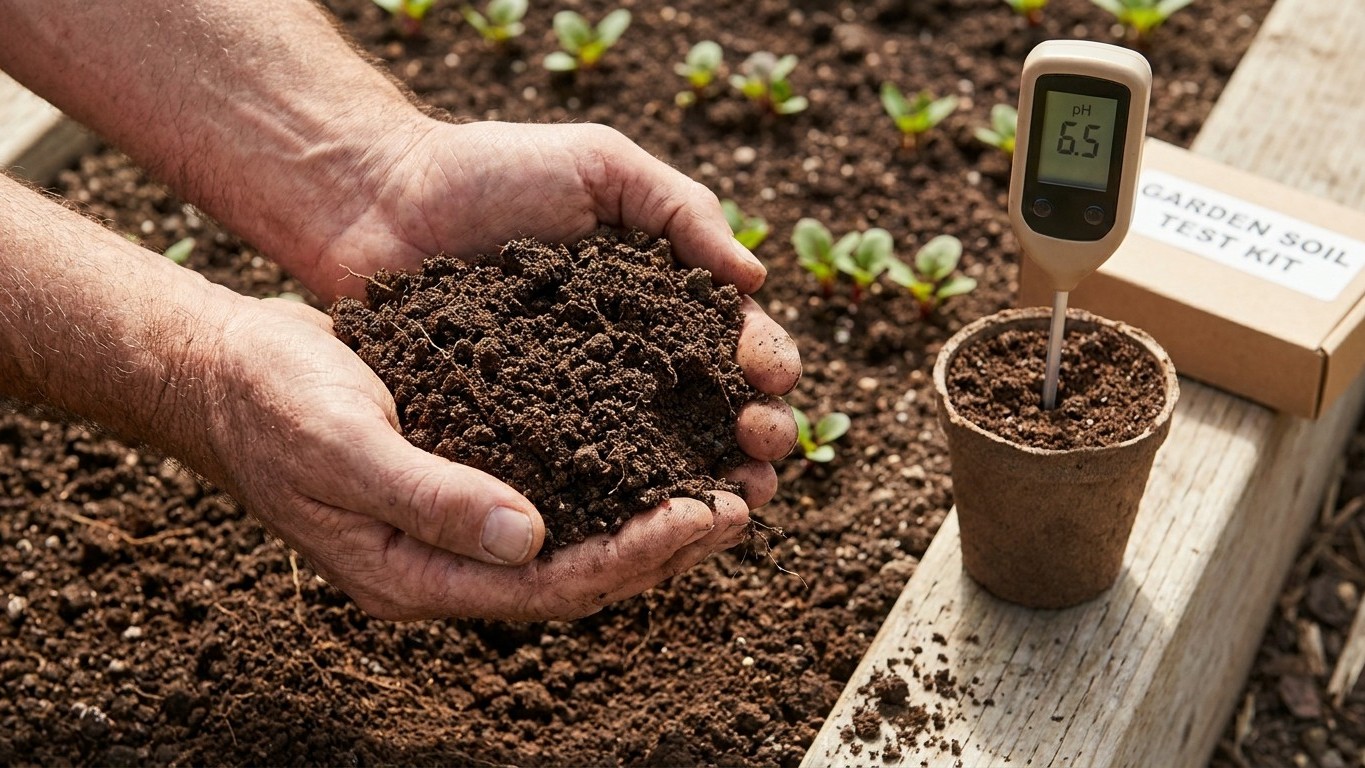

Washington’s official state soil, the Tokul series, is a volcanic-ash Andisol: light, porous, and unusually good at holding both water and phosphorus, but strongly acid at the surface (pH about 4.5) and mapped as moderately well drained. For a beet crop, that combination cuts two ways, and understanding Beet Soil in Washington conditions helps set expectations before you plant. For specifics on timing, see When to Sow Beets in Washington: sow direct, 2 to 3 weeks before your local last frost, keep the row evenly moist through the first six weeks, and treat the state’s mapped soil as a reference point, not your garden’s actual number.
The short answer
Start with the texture. The Tokul series runs roughly 45 percent sand, 10 percent clay, and 45 percent silt in its surface horizon, a loam-to-silt mix that USDA NRCS Soil Data Access lists from measurements of 19 mapped components. That’s a workable structure for beets, which want deep, loose ground rather than the dense clay that deforms a taproot. The drainage class, moderately well drained, is a middle grade: better than a swampy bottomland, not as free-draining as a true sandy loam. Combined with an Andisol’s odd talent for gripping onto moisture, a bed built on this kind of ground won’t dry out fast, which matters directly for bolting risk in young beets.
The acidity is the bigger flag. A surface pH near 4.5 sits deep in the strongly acid range, well outside where most root vegetables do their best work, and it’s also the kind of pH that locks phosphorus into forms plants struggle to use, even on a soil this good at holding onto that nutrient in the first place. A soil test, and very likely a dose of lime, is the practical response before beet seed goes in the ground.
One more caution belongs here. USDA NRCS records an organic matter figure near 75 percent for this series’ surface horizon. That’s not a garden-bed number, it’s the signature of a natural organic surface layer, peat, muck, or undecomposed forest litter, sitting on top of the mineral soil as originally mapped. No cultivated backyard bed carries anything close to that after tilling, composting, and a few seasons of cropping. Treat it as a description of the untouched landscape, not a target to hit with your own compost pile.
Heat is the other half of the equation, and here the record for the reference station doesn’t publish a day-count above 90 F. What can be said plainly: Washington west of the Cascades runs a mild, maritime summer, which tends to keep sustained heat spikes less frequent than in the state’s dry interior. Utah State University Extension’s guidance still applies regardless of location: heat above 85 F paired with water stress is what turns a beet root woody, a separate failure from bolting. None of this replaces a local check. Washington spans hundreds of distinct soil series, and this state soil is a starting point for the conversation, not a verdict on any one yard.
The six weeks that decide it here
Sowing 2 to 3 weeks ahead of the last frost puts the seedling’s critical early window squarely inside the region’s spring pattern, and in western Washington that pattern is defined by the frost-date record itself. NOAA NCEI’s 1991-2020 Climate Normals, drawn from station USW00024233, put the last spring freeze probability window between February 27 and March 18. That’s a mild date on paper, but a mild frost date is not the same thing as an early planting date. Cold, waterlogged soil and short daylight routinely hold spring crops back well past the point when the freeze risk has actually passed, and beet seed sitting in cold, saturated ground germinates slowly no matter what the calendar says.
This is where the soil profile from the section above becomes relevant again. A moderately well drained, silt-heavy bed on the west side of the state tends to run wet rather than dry through late winter and early spring, the opposite problem from the one Utah State University Extension warns about. Their guidance is specific: water stress in the first six weeks after sowing is what pushes a beet toward premature flowering, or bolting. On soil that’s naturally holding onto moisture in a wet maritime spring, that particular trigger is less likely to come from drought and more likely to come from an unusual dry stretch inside an otherwise damp season, exactly the kind of week a gardener might skip watering because the ground still looks wet on top while the root zone has actually dried out.
None of this applies statewide. East of the Cascades, Washington shifts to high desert, with a shorter, drier, more temperature-swingy spring that this frost-date record, tied to a western Washington station, doesn’t describe. A gardener in that half of the state is working with a different six weeks entirely, and needs a local frost record rather than this one to time sowing.
What goes wrong here
- A dry week inside a wet spring triggers bolting. Even on moisture-retentive Andisol ground, a single stretch of sun and wind in the first six weeks after sowing can dry the surface enough to stress a young beet. Utah State University Extension ties this directly to premature flowering. The fix is a consistent watering schedule through that window rather than watering only when the topsoil looks dry.
- Strongly acid soil locks up phosphorus. At a surface pH near 4.5, phosphorus becomes chemically bound and harder for roots to reach, regardless of how much the soil naturally holds onto it. A soil test followed by lime, applied ahead of sowing so it has time to adjust the root zone, is the standard correction.
- Over-amending a naturally organic-rich landscape. Because the mapped series shows very high surface organic matter, it’s tempting to pile on extra compost. Utah State University Extension caps composted organic matter at no more than 1 inch per 100 square feet; more than that can smother drainage in an already moisture-holding bed.
- Late-season heat on top of missed watering makes roots woody. This is a separate failure from bolting; it shows up after the root has already set, when temperatures climb above 85 F while soil moisture drops. Deep, regular watering through summer and timely harvest before an extended hot stretch are the remedies, and they don’t double as a fix for early bolting or vice versa.
- Slow, patchy germination in cold, wet early spring. A silt-heavy, moderately well drained bed can stay cold and saturated even after the last freeze date has technically passed. Waiting for the soil itself to warm and drain, rather than sowing strictly by the frost calendar, avoids uneven stands.
Checking this against your own county
The Tokul series and the western Washington frost window above describe a reference point, not a guarantee about any single garden. Actual soil texture, pH, and drainage shift block by block, especially anywhere a builder has cut, filled, or graded the ground, and the frost record used here comes from one station that represents the mild, maritime side of the state, not the interior. Washington State University Extension, at extension.wsu.edu, runs county-level offices that can point to a local soil test and a frost record closer to a specific address. That’s the next step before finalizing a sowing date or deciding how much lime a bed actually needs.
Common questions
How long do beets take from seed to harvest in Washington?
Utah State University Extension’s guidance runs 60 to 80 days, counted from the seed going into the ground, not from a transplant, since beets are sown in place. Local temperature and daylight can push that window in either direction, but the count always starts at sowing.
Do I need to lime my soil before planting beets?
If your ground resembles the mapped Tokul series, with a surface pH near 4.5, a lime application ahead of sowing is the standard response to strongly acid soil. But that pH describes the state’s representative soil series, not your yard specifically; a soil test is the only way to know your actual number before treating it.
Is the last-frost date the same across Washington?
No. The February 27 to March 18 window comes from a station representing western Washington’s mild, maritime climate. Eastern Washington, beyond the Cascades, is high desert with a shorter, different season, and that frost record doesn’t apply there.
What’s the difference between a bolted beet and a woody beet?
They come from different problems at different points in the season. Bolting happens early, triggered by water stress in the first six weeks after sowing, and the plant switches to flowering instead of building a root. Woodiness happens later, when heat above 85 F combines with water stress on a root that’s already formed. Watering consistently addresses both, but they’re not the same failure and don’t share a single fix.