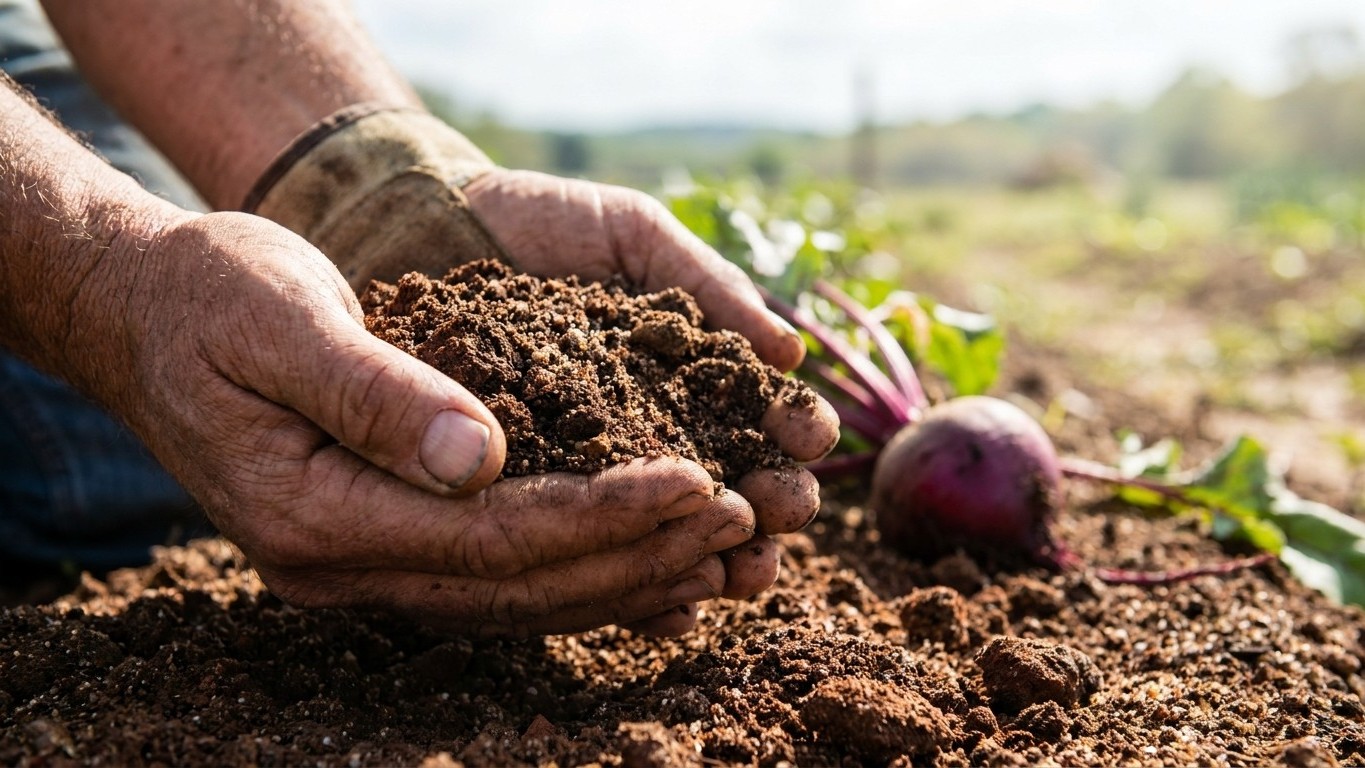

Alabama’s official state soil, the Bama series, is sandy, acidic and short on organic matter, which drains fast enough to suit a beet root but starves it of the nutrients and moisture that root needs to size up without turning fibrous. The state’s spring-to-summer turn is quick, so the six-week window after seeding matters more here than the calendar does. None of this is a verdict on any one yard; it’s a place to start before a soil test tells you what’s actually under your boots.
The short answer
Start with the numbers behind the name. The Bama series runs 67 percent sand, 14 percent clay and 19 percent silt in its surface layer, classified as well drained, with organic matter sitting around just 0.8 percent and a surface pH near 5.3, which USDA calls strongly acid. That combination reads two ways for a beet. The sand-heavy texture and good drainage are exactly what beet roots want; a beet grown in tight, waterlogged clay tends to fork and stall. But the same texture that drains well also drains fast, meaning it holds neither water nor nutrients for long between rains or waterings. And 0.8 percent organic matter is thin. Beets want soil rich in organic matter, and this series, as mapped, isn’t naturally there. That’s not a flaw so much as a starting condition: it means the gap between what the ground offers and what the crop needs has to be closed with compost, not assumed away.
The acidity carries its own cost. At pH 5.3, several of the nutrients a beet root needs to bulk up become less available to the plant, even when they’re technically present in the soil. This is the kind of problem a bag of fertilizer alone won’t fix, because the issue isn’t the nutrient supply, it’s the chemistry blocking uptake. A lime application based on an actual soil test, not a guess, is the tool for that job.
On the heat side, there’s no published day count here for how often the reference station clears 90 F, so that specific figure isn’t something to state as fact. What is established is the threshold that matters for beet quality: heat above 85 F combined with water stress is what turns a beet root woody. Alabama’s growing season runs warm and long enough that gardeners should assume that 85 F threshold gets crossed with some regularity as the season advances, which puts a premium on getting beets to size before the hottest stretch lands, not during it.
A state spans hundreds of soil series, and Bama is one representative sample, not a survey of every garden bed in Alabama. River bottoms run differently than upland fields, and any lot a builder has graded or filled will bear little resemblance to either. Treat these figures as a description of what the region’s ground tends to do, not a stand-in for your own soil test.
The six weeks that decide it here
Beets are sown directly in the ground, never transplanted, and the standard advice is to get seed in 2 to 3 weeks ahead of the last spring frost. At the NOAA reference station used for this page, that last spring freeze falls somewhere between March 19 and April 3, based on 1991-2020 climate normals. Count back from there and the first six weeks of a beet’s life in much of Alabama land somewhere in late winter sliding into early spring, the stretch when the weather is least settled and most prone to swinging hard in either direction within the same week.
That instability is the actual risk, more than any single average. Alabama spring doesn’t run as a clean dry season or a clean wet one; it swings, with soaking stretches followed by dry snaps that can pull moisture out of a sandy, low-organic-matter bed fast. And the first six weeks are exactly the window in which water stress does its worst damage to a beet: interrupted moisture during that early stage is what triggers premature flowering, known as bolting, and a bolted beet stops building root and starts building seed stalk instead. That’s a different failure than the woody root that shows up later from summer heat, and treating them as the same problem, solved by “just keep it watered,” misses what’s actually going on at each stage.
Given Bama’s fast drainage and thin organic matter, a dry week during that early window empties the root zone quicker than it would in a heavier soil that holds moisture longer between rains. That doesn’t mean watering constantly from day one; it means watching that specific six-week stretch closely and not letting a dry spell run past a few days once true leaves are up. The last-frost window itself is a station figure, not a county guarantee. Gardens outside city limits often see frost run later in spring and earlier in fall than the airport station shows, sometimes by one to two weeks, more at elevation, so local timing should shift the sowing date, not just the general season.
What goes wrong here
- Bolting from an early dry spell. Sandy, low-organic-matter soil like Bama loses moisture fast, and a dry stretch in the first six weeks after seeding is the single most common trigger for premature flowering. The fix is steady, even moisture through that early window specifically, not just “regular watering” for the whole season, plus a mulch layer to slow evaporation between rains.
- Woody roots from summer heat plus thirst. Once temperatures climb past 85 F, any water stress at that point turns root tissue fibrous and tough. This is a separate failure from bolting, tied to the back half of the growing cycle rather than the start, and it means timing sowing so the 60 to 80 days from seed to harvest lands before the hottest weeks close in, with deep watering maintained if heat arrives early.
- Nutrient lockup from low soil pH. A surface pH near 5.3 keeps several nutrients less available to beet roots regardless of what’s in the soil. A soil test followed by a lime application, sized to the actual test result, addresses this directly; fertilizer alone won’t.
- Thin organic matter failing to hold nutrients or water. At roughly 0.8 percent organic matter, Bama’s surface layer has little buffering capacity. Working in compost, capped at 1 inch per 100 square feet, brings the bed closer to what beets actually want without overdoing it.
- Fast leaching in sandy ground. The same drainage that prevents rot also washes soluble nutrients below the root zone after heavy rain. Splitting fertilizer applications across the growing season, rather than applying it all at planting, keeps more of it in reach of the root as it develops.
Common questions
Is Alabama soil good for beets?
The state’s representative soil, the Bama series, drains well, which suits beets, but it’s sandy, acidic and low in organic matter, none of which suits them without amendment. It’s a workable starting point, not soil that’s ready for beets straight out of the ground.
How do I fix acidic soil for beets in Alabama?
Test the soil first rather than assuming the state average pH of about 5.3 applies to your bed. If the test confirms strongly acid soil, a lime application sized to that result raises pH into a range where nutrients become more available to the root.
When should I plant beets in Alabama?
Sow 2 to 3 weeks ahead of the last spring frost. At the NOAA reference station used here, that frost date falls between March 19 and April 3, though rural and elevated ground nearby often sees frost run later in spring, so check local timing rather than relying on the station date alone.
Why are my beets woody or bitter?
Woody texture comes from heat above 85 F combined with water stress, typically later in the growing cycle, and it’s a different problem from bolting, which comes from dry stretches in the first six weeks after seeding. Deep, consistent watering as heat rises, and timing the harvest within the standard 60 to 80 days from seeding, keeps the root from toughening.