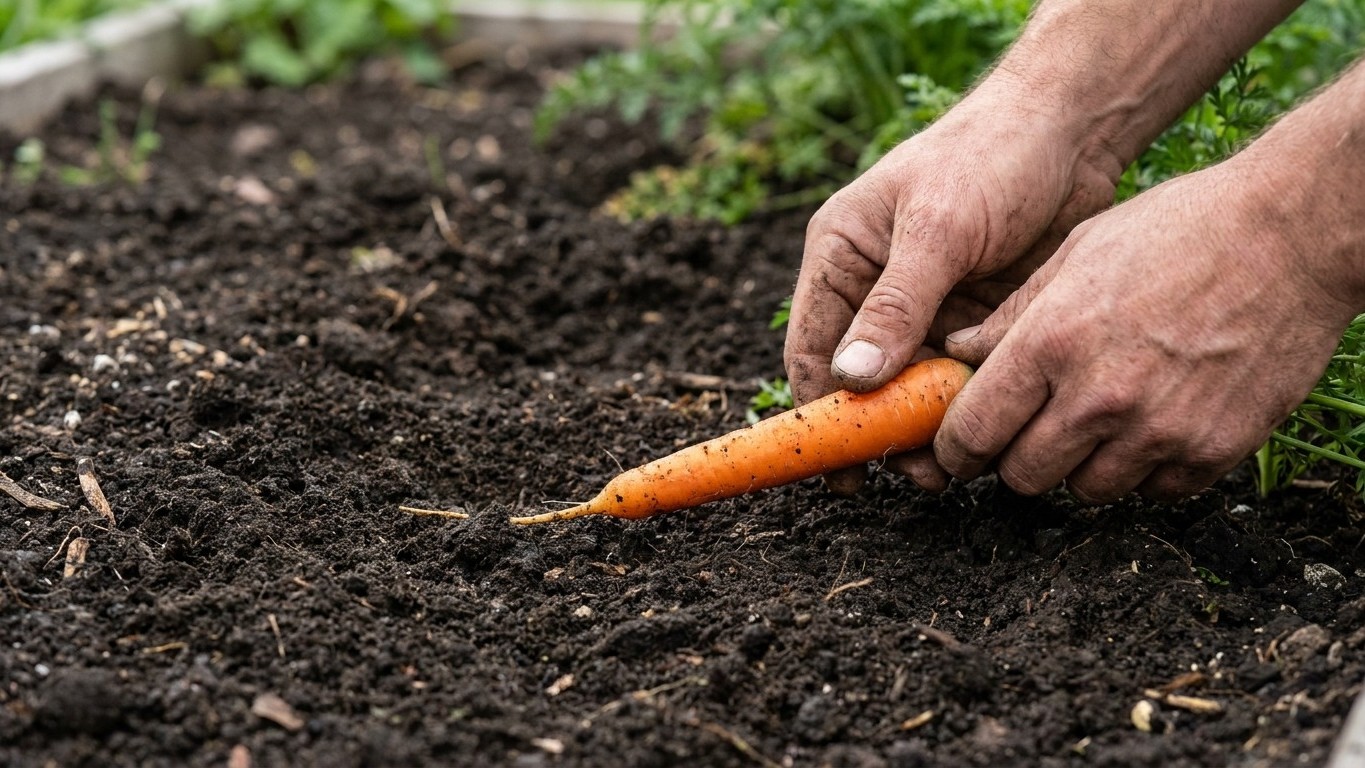

Alberta’s most common soil, the Chernozem that covers roughly 40 percent of the province’s mapped farmland, runs loam to silt with only 21 percent clay. That texture, paired with good natural drainage, means the typical Alberta garden bed is not the kind of dense, sticky ground that forces a carrot root to split around a stone or a hardpan layer. Forking is possible almost anywhere, but the province’s dominant soil profile leans in the gardener’s favor rather than against it.
The short answer
Look at the numbers behind that dominant profile and the picture gets clearer. Alberta’s mapped agricultural soils, drawn from 2,154 surveyed components by Agriculture and Agri-Food Canada’s Canadian Soil Information Service, come out to a median surface texture of 37 percent sand, 21 percent clay and 42 percent silt, classed as loam to silt. Organic matter sits around 5.2 percent, which is high by most garden standards, and drainage is rated well drained. The median surface pH lands near 6.5, slightly acid. After Chernozem, the next most common order is Luvisolic soil, which tends to carry more clay in its subsurface layers even where the topsoil looks workable.
Put that texture next to what a carrot actually wants. Utah State University Extension is blunt about it: carrots need deep, sandy, well-drained soil rich in organic matter, and heavy or rocky ground makes the root fork. Alberta’s typical Chernozem, with its moderate clay share and strong organic matter content, checks most of those boxes on paper. A root pushing down through 42 percent silt and only 21 percent clay is not fighting the same resistance it would in a heavy prairie clay pocket or a compacted subsoil left by construction fill.
That said, this is a province-wide median, not a report card on any single backyard. The survey behind these numbers covers agricultural regions only, so the far north of Alberta is not represented at all, and even within the farmed south a province spans hundreds of individual soil series. Some run heavier in clay, some sit over gravel, some have been stripped and refilled by a home builder decades ago. The Chernozem number tells you what the region’s ground tends to do; it does not tell you what is under your own raised bed or backyard plot.
If a soil test or a simple dig shows more clay than that provincial median, the fix Utah State outlines still applies here: work in generous compost and double dig the bed to loosen the profile a foot or more down, or skip the fight altogether and grow in a raised bed filled with a lighter mix. Either approach removes the mechanical resistance that causes forking, regardless of what the provincial average says.
The test that settles it in your own garden
None of the provincial figures above replace fifteen minutes with a shovel in the actual bed you plan to plant. Alberta’s soil map is built from agricultural survey points, not your yard, so the only way to know what a carrot will meet down there is to check it directly.
- Dig a test hole at least a foot deep. Carrots planted for full-length roots need that much clear space below the surface, so this is the depth that actually matters to the crop.
- Look at what you hit. Note any stones, hardpan, gravel layers or an abrupt color change that suggests fill dirt rather than native topsoil. Any of these at root depth is a strong forking risk regardless of what the surface looks like.
- Feel the texture. Take a moist handful from a foot down and rub it between your fingers. Gritty and loose suggests a sandier mix closer to the province’s loam median; slick, sticky and moldable into a ribbon suggests more clay than that median.
- Watch the drainage. Fill the hole with water and time how long it takes to disappear. Water that lingers for hours points to compaction or a clay-heavy layer that will resist a growing root the same way it resists water.
- Repeat in more than one spot. Garden beds are rarely uniform. A patch near a foundation, a walkway or an old driveway can differ sharply from the rest of the yard even if both sit in the same province, the same town, even the same lot.
None of these steps require lab equipment, and none of them will hand you a precise clay percentage to match against the provincial 21 percent figure. What they will tell you, in plain terms, is whether your particular ground behaves like the well-drained loam that dominates Alberta’s farmland or like something heavier that needs amending before carrot seed goes in.
What goes wrong here
Even a favorable provincial texture doesn’t rule out the specific ways carrots fail in Alberta gardens. Most of the trouble traces back to either the clay pockets that exist within the broader loam-to-silt median, or to weather patterns that stress a root crop no matter how good the soil is underneath it.
- Forking in heavier pockets. Even inside a province where the median soil runs loam to silt, individual beds can sit over Luvisolic subsoil with a heavier clay layer, or over compacted fill from past construction. When a taproot meets that resistance, it splits or forks around the obstruction. The remedy is the same one Utah State recommends for any heavy ground: work compost deep into the bed and double dig to break up the resistant layer, or build a raised bed with a lighter fill so the root never meets the clay at all.
- Poor germination during a hot, dry stretch. Carrot seed is small and sits shallow, so the top inch of soil needs to stay consistently moist for it to sprout. A run of hot, dry days can crust that surface layer and stall germination entirely. Watering lightly but often, sometimes twice a day in a heat spell, keeps that top layer workable until seedlings emerge.
- Splitting from uneven watering. Once roots are established, a long dry stretch followed by a heavy soaking makes the root swell faster than its skin can stretch, and it splits lengthwise. Keeping moisture even, rather than letting the bed dry hard between waterings, prevents the swelling and cracking cycle.
- Stunted or misshapen roots from surface stones. Alberta’s glacial history left plenty of stone in prairie soil even where the fine texture looks clean on a survey table. A rake pass through the top foot of a new bed before sowing catches most of what would otherwise deflect a growing root sideways.
Common questions
Does Alberta’s soil pH affect carrot forking?
The provincial median surface pH runs near 6.5, slightly acid, which sits in a workable range for most vegetables. Utah State University Extension’s guidance on carrots ties forking to soil texture and rock content, not to pH, so a slightly acid reading on its own is not a forking risk. It is worth checking as part of an overall soil test, but it does not replace the texture and drainage checks above.
How deep does an Alberta garden bed need to be for carrots?
The source material does not publish a single depth figure, but the practical guidance is to give the root clear, loose soil for at least a foot down, since that is roughly how far a full-length carrot needs to grow undisturbed. A test hole dug to that depth, as described above, is the way to check whether a given bed can support it.
Is a raised bed always necessary in Alberta?
Not necessarily. The province’s dominant Chernozem soil is loam to silt and well drained, which is close to what carrots want without any amendment. A raised bed becomes the practical answer mainly where a dig test turns up heavy clay, stones, hardpan or compacted fill, since building upward with a lighter mix is often simpler than double digging through resistant ground.
How long do carrots take from seed in Alberta?
Carrots are sown directly in the ground, not transplanted, so any days-to-maturity figure counts from the seeding date. Utah State University Extension’s general range for the crop is 70 to 100 days from seed, though the exact figure depends on the variety chosen, which this source does not specify.