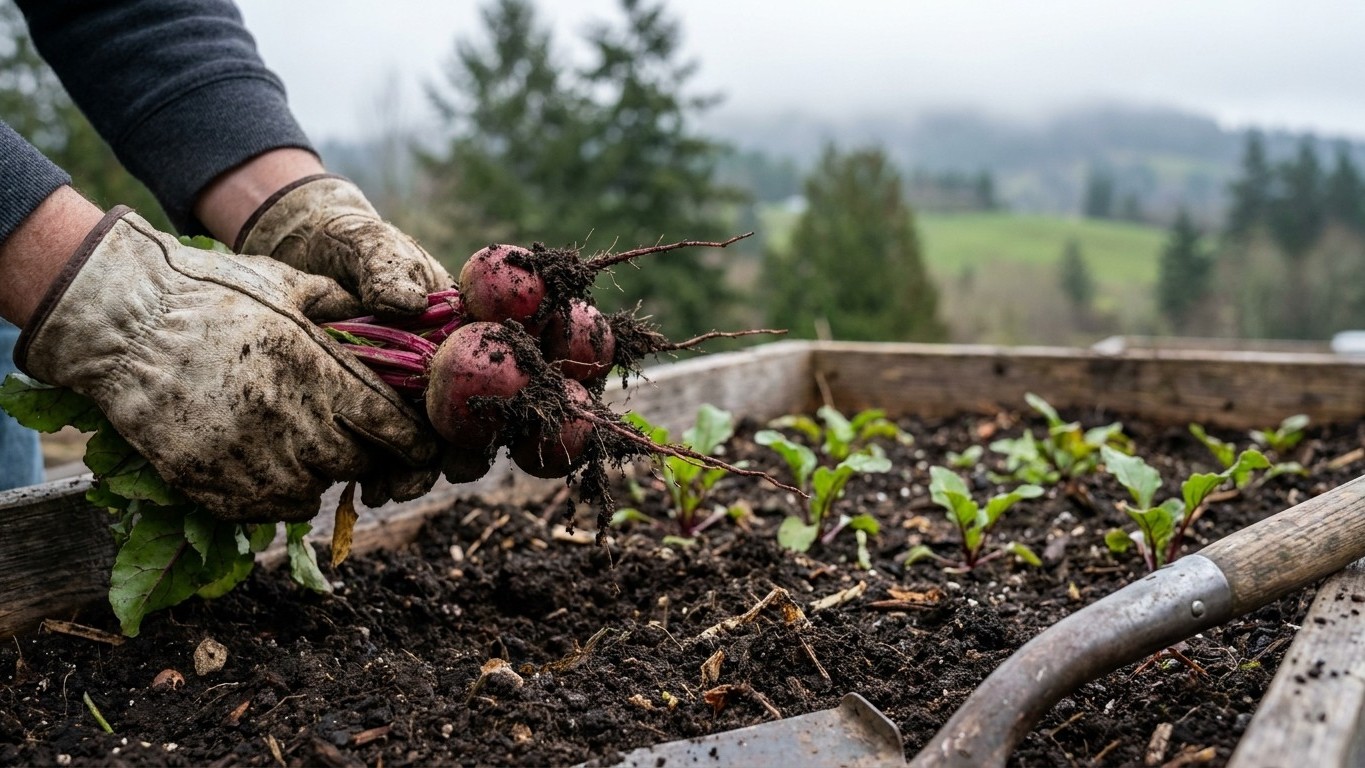

The direct answer: sow beets outdoors 2 to 3 weeks before the last spring frost, which averages March 18 at Vancouver’s reference climate station. That puts most coastal British Columbia gardeners in the ground from late February into early March, with a second window in early summer for a fall crop. Beets are direct-seeded, so the usual 60 to 80 days to harvest count from the day seed goes into soil, never from a transplant date.
The short answer
Start with what’s actually under your boots. Across the agricultural regions of British Columbia, the most commonly mapped soil order is a Brunisol, a young soil whose horizons are still separating out, typical of ground formed on recent or coarse parent material. It shows up on 33 percent of the mapped surface, ahead of Podzolic soils. The median profile runs 52 percent sand, 10 percent clay and 38 percent silt, a loam-to-silt texture with about 5.0 percent organic matter, a surface pH near 5.8 (slightly acid), and well-drained conditions. That combination of drainage and organic matter is not a bad starting point for beets, which want deep, sandy, well-drained soil that’s rich in organic matter, amended with no more than 1 inch of composted material per 100 square feet, according to Utah State University Extension.
The catch is the acidity. A 5.8 surface pH sits on the acid side of neutral, and beets are picky about that. Before you amend anything, a soil test is the only way to know if your own ground needs lime or is already fine, because a Brunisol median is exactly that: a median. British Columbia’s agricultural soils span hundreds of distinct series, and the province’s own survey covers only the farmed regions, not the far north. A garden built on river-bottom silt, reclaimed muskeg, or fill dirt from a construction site can sit nowhere near that 52-10-38 split. Treat the province’s dominant profile as a description of what the ground around you tends to do, not a reading of your own backyard.
On heat, there’s a gap worth naming honestly. Woodiness in beet roots comes from heat above 85 F combined with water stress, per Utah State’s research, but no published count of days above 90 F for the Vancouver reference station is part of the data behind this page. That’s not a small omission, since it’s the number that would tell you how often the woodiness trigger actually fires here. What can be said is that the frost-date station sits in a coastal, marine-influenced spot, and gardeners further inland or at elevation should expect their own heat and cold patterns to diverge from it, sometimes by weeks.
The six weeks that decide it here
Sowing 2 to 3 weeks ahead of the March 18 mean frost date lands seed in the ground somewhere between late February and the first days of March for most coastal growers. The six weeks that follow, roughly early March through mid-April, are the window where a beet seedling’s fate as a bolter or a solid root gets decided, because that’s when water stress does its damage. Utah State University Extension is specific on this: stress in the first six weeks pushes beets toward premature flowering, a different failure entirely from the woodiness that shows up later from heat.
Coastal British Columbia’s spring, at least at the Vancouver reference station, tends to run cool and wet rather than dry, with rain arriving often enough that soil moisture is rarely the scarce resource it can be in a drier climate. That’s mostly good news for the bolting risk specifically, since a soil that’s staying damp on its own isn’t the soil that stresses a beet seedling into flowering. The risk here shifts shape: it’s less about your beets going thirsty and more about a patch of ground that never drains, especially since even a Brunisol classified as well-drained can still perch water in a low spot or a compacted bed. Saturated soil doesn’t cause bolting the way drought does, but it can rot seed and stall germination before the six-week window even starts counting.
The other piece to hold onto is that March 18 is a mean, not a guarantee. In roughly half of all years, the last frost falls later than that date, which means a seed sown right at the “2 to 3 weeks before” mark can still meet a frost it wasn’t expecting. Nothing in the frost-date record makes an early-March sowing risk-free. It just makes it the average bet, and averages leave room on both sides.
What goes wrong here
- Seed rots in cold, wet soil before it germinates. The province’s dominant profile is well-drained on paper, but a compacted or low-lying bed can hold water long enough to rot beet seed in a wet coastal March. Wait for soil that crumbles rather than clumps before sowing, or raise the bed a few inches to shed excess moisture.
- Roots come out woody despite a wet spring. Even where rain is frequent, a dry stretch layered on top of a hot spell above 85 F can trigger the woodiness Utah State describes, because that failure is about heat plus a lapse in watering, not about the season’s average rainfall. Keep watering consistent through any warm snap rather than assuming the region’s usual dampness has it covered.
- Seedlings bolt from an early cold snap. The six-week window after sowing is also the stretch closest to the last frost date, and a late cold spell landing on young beets stresses them in ways that echo the water-stress bolting Utah State flags, even when soil moisture itself is fine. Watch the forecast in the two weeks after sowing rather than treating the mean frost date as a finish line.
- Nutrient uptake lags in acid soil. A 5.8 median surface pH is slightly acid, and beets grown in soil that’s more acidic than they’d prefer can show stunted, pale growth even with adequate water and organic matter. A soil test before amending tells you whether lime is actually needed on your plot, since the provincial median is not your number.
- Over-amending with organic matter backfires. Utah State’s guidance caps composted organic matter at 1 inch per 100 square feet; piling on more in soil that already averages 5.0 percent organic matter can push growth into leafy excess at the expense of the root. Measure the amendment rather than guessing.
Common questions
Is March 18 a safe date to sow beets in British Columbia?
No. It’s the average last frost date at the Vancouver reference station over the 1981-2010 period, which means frost arrives later than that in roughly half of all years. Sowing 2 to 3 weeks before it is a common approach, not a guarantee against frost.
Do beets need transplanting in British Columbia?
No. Beets are sown directly in the garden bed, and the 60 to 80 days to harvest are counted from the seeding date, not from any transplant.
Does the province’s typical soil suit beets without amendment?
Partly. The dominant profile is well-drained with a loam-to-silt texture, both favorable traits, but its median pH of 5.8 is slightly acid, which can hold back beets. A soil test on your own plot is the only way to know if lime is needed, since the provincial figure is a median across hundreds of soil series.
What actually causes woody beet roots here?
Utah State University Extension attributes woodiness to heat above 85 F combined with water stress, a different mechanism from the early-season bolting caused by water stress alone. No published count of days above 90 F for the reference station is available on this page, so gardeners should track local conditions rather than a fixed heat-day figure.