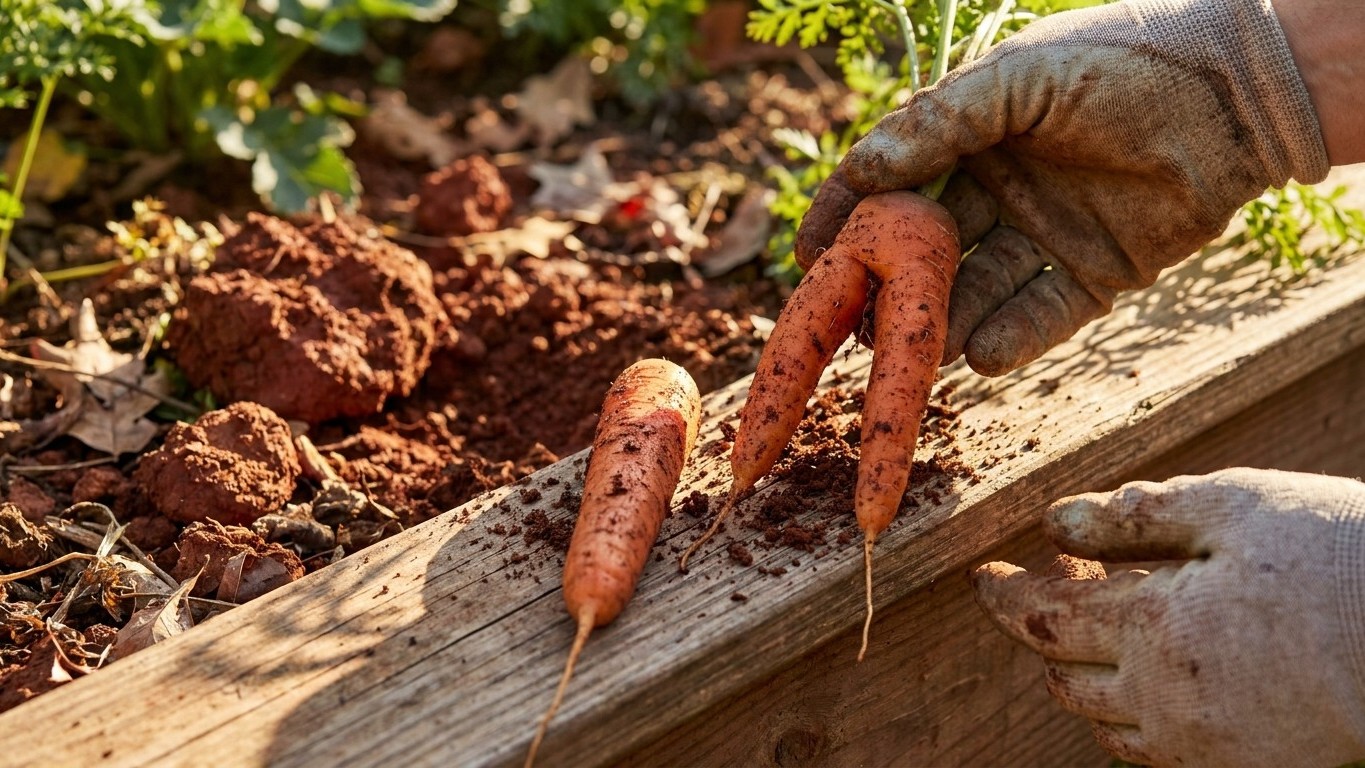

California’s state soil, the San Joaquin series, is a loam that leans sandy rather than clay-heavy, which works in a carrot’s favor. But “leans sandy” isn’t the same as “ideal,” and the low organic matter in that reference soil means compost is still doing real work in most California beds. The honest answer sits in the middle: less forking risk than heavy clay ground, but not a free pass either.
The short answer
The San Joaquin series is California’s official state soil, named by state law in 1997 as part of the USDA NRCS State Soils program. It’s an Alfisol, a forest-derived soil type with moderate natural fertility and a decent ability to hold onto nutrients once they’re in the ground. The surface horizon runs slightly acid, with a pH around 6.1, and the texture sits in loam-to-silt territory: 51 percent sand, 18 percent clay, and 32 percent silt, based on USDA NRCS Soil Data Access records for the series’ major components. Drainage is classed as moderately well drained, meaning water moves through, just not in a hurry.
Set that against what a carrot actually wants. Utah State University Extension puts it plainly: carrots need deep, sandy, well-drained soil rich in organic matter, and heavy or rocky ground is what makes the root fork. By that measure, San Joaquin soil isn’t the heavy, clay-choked ground that typically bends a carrot root sideways. Sand at 51 percent is the dominant fraction, and clay at 18 percent is moderate, not the 30-plus percent that turns a garden bed into a brick after a dry week. A carrot growing in soil that resembles this series has a reasonable shot at growing straight.
The catch is organic matter. The San Joaquin series carries about 0.8 percent organic matter at the surface, well short of what Extension guidance calls “rich.” That number matters less for forking and more for feeding, texture, and moisture retention over the growing season. A carrot root can be straight and still be stunted or woody if the bed underneath it is thin on organic content. So the practical move for anyone gardening in ground like this isn’t necessarily a raised bed to fight clay, it’s working compost into the top layer and loosening that soil by hand or with a fork before seeding, the same double-digging approach Extension recommends for heavier ground, just applied here to boost fertility rather than fix drainage.
None of this is a diagnosis for any one backyard. California spans hundreds of distinct soil series across its valleys, foothills, and coastal strips, and the San Joaquin series describes a representative slice of the state, not a guarantee about what’s under any particular garden. A yard two miles from where this series is mapped can sit on entirely different ground, especially if a builder graded, filled, or compacted it at some point. Treat this as a starting point for what the region tends to do, then confirm it at home.
The test that settles it in your own garden
State soil surveys are built from mapped averages. Your raised bed or backyard plot is one data point, and it might not match the average at all. Here’s how to find out what you’re actually working with before you commit a row of carrot seed to it.
- Dig a hole to shovel depth. Go straight down and look at the profile. Carrots need loose ground with no interruption for the length of the root, so note whether the soil stays consistent or hits a hard, compacted layer partway down.
- Check for stones and obstructions. Pull the dug soil apart with your hands and look for rocks, gravel, or old buried debris. Any solid object in a carrot’s path will force the root to bend or split around it, which reads as forking at harvest.
- Feel the texture. Take a handful of moist soil and squeeze it into a ball. Soil that holds a tight, sticky shape and resists breaking apart leans toward clay. Soil that crumbles and falls apart almost immediately leans sandy. What you’re feeling for is somewhere in between, a texture that holds together loosely but breaks with a light poke.
- Watch how water moves through it. Fill the test hole with water and observe. If it disappears at a steady pace, drainage is workable. If it sits on the surface for a long stretch with little change, that’s standing water, and standing water around carrot roots invites splitting and rot, not just forking.
Run this test in more than one spot if the yard is bigger than a small bed. Soil can change character within a few feet, especially near driveways, foundations, or anywhere fill dirt was brought in during construction.
What goes wrong here
California’s ground and its dry-summer climate create a specific set of carrot problems, and most of them trace back to either soil texture or water timing.
- Forking in heavy or compacted pockets. Even in a region where the reference soil leans sandy, individual yards can carry dense clay lenses, old fill, or compaction from foot traffic and construction equipment. Any of these will split a taproot around the obstruction. The fix is the same one Extension recommends for heavy ground generally: work in plenty of compost and double-dig the bed, loosening soil well below where the root will grow, or build a raised bed filled with a looser mix if the native ground won’t cooperate.
- Poor germination during a hot spell. Carrot seed is slow to sprout under the best conditions, and a stretch of hot, dry weather right after sowing can dry out the seedbed before germination finishes. The remedy is keeping the surface consistently moist with light, frequent watering until seedlings are up, and timing sowing to avoid the hottest run of days where possible.
- Splitting from uneven watering. A long dry stretch followed by a heavy soak, common in a climate where rain is scarce for much of the growing season, makes roots swell unevenly and crack. The fix is a steady watering rhythm rather than a feast-or-famine schedule, so the root grows at a consistent rate instead of surging after each irrigation.
Common questions
Does California’s state soil mean my carrots will definitely fork?
No. The San Joaquin series is a statewide reference point with moderate clay and moderately well drained conditions, which lowers the odds of severe forking compared to heavy clay ground, but it doesn’t predict what’s under your specific yard. Test your own soil before drawing conclusions.
Do I need a raised bed if my soil resembles the state soil?
Not necessarily. The San Joaquin series leans sandy rather than heavy, so a raised bed may not be required for drainage. What it likely needs is compost, since the reference organic matter is low at about 0.8 percent, which affects fertility more than forking.
How long do carrots take from seed in California conditions?
Carrots are sown directly in place and are not transplanted, so the 70 to 100 day maturity window counted by Utah State University Extension runs from the seeding date, not from any later transplant.
What’s the single biggest cause of forked carrots?
According to Utah State University Extension, it’s heavy or rocky soil obstructing the taproot as it grows down. The fix in that ground is compost paired with double digging, loosening the soil well beyond just the top few inches.