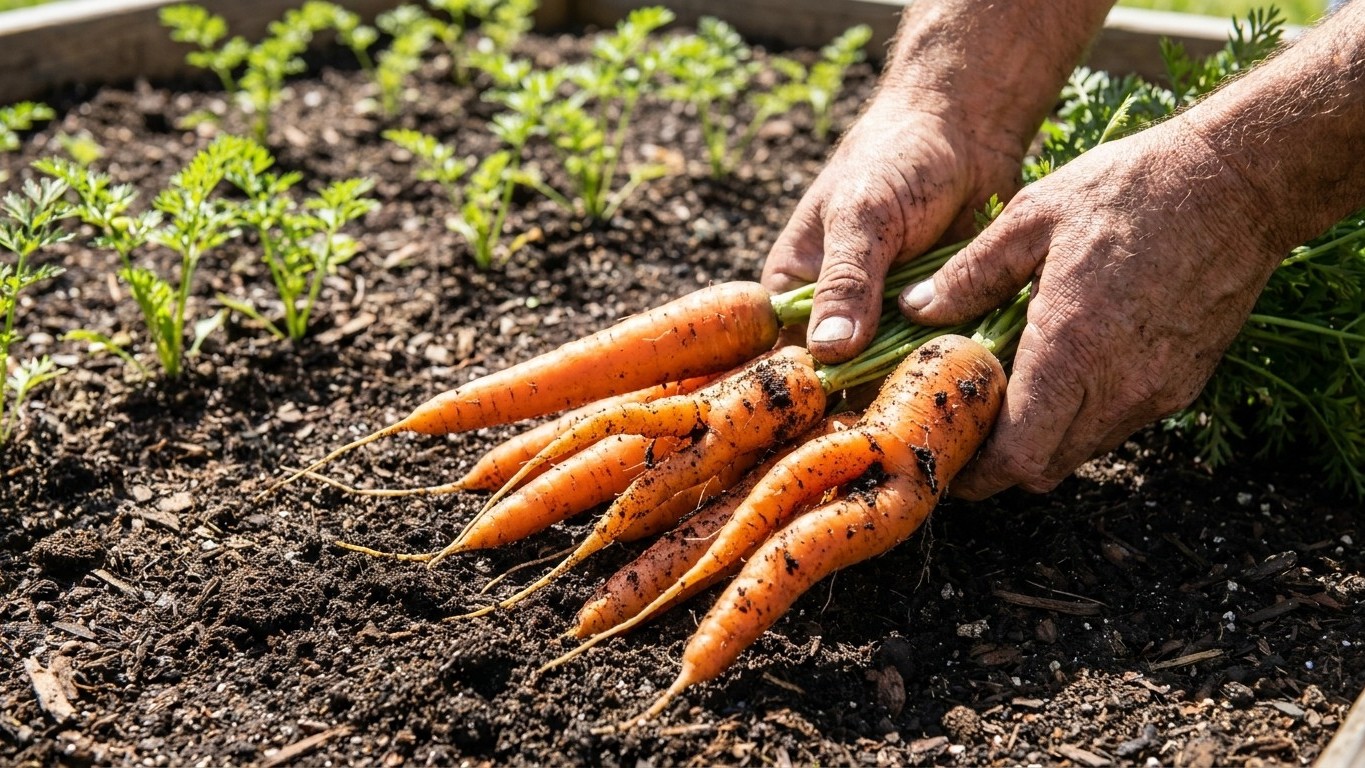

California carrot growers typically count back from their local last-frost date to time seeding, but that date shifts by hundreds of miles across the state’s climate zones, from coastal fog belts to Central Valley heat to high-desert cold snaps. No single frost date covers the whole state, so the more useful starting point is what’s actually under your boots: the ground itself. And the state’s representative soil leans toward a texture that can turn a straight carrot root into a forked one unless the bed gets some work first.
The short answer
California’s official state soil, the San Joaquin series, was named into law in 1997 and represents the ground across a wide swath of the state. It’s classified as an Alfisol, a forest soil of moderate fertility that holds nutrients reasonably well. The surface horizon runs about 6.1 on the pH scale, slightly acid. Texture-wise it’s 51 percent sand, 18 percent clay and 32 percent silt, landing somewhere in the loam-to-silt range rather than in heavy clay territory. Organic matter sits around 0.8 percent, which is thin, and drainage is rated moderately well drained rather than the “well drained” label carrots really want.
Put those numbers next to what Utah State University Extension says carrots need, and a picture forms. Their guidance is blunt: carrots want deep, sandy, well-drained soil rich in organic matter, and heavy or rocky soil makes the root fork. This San Joaquin profile isn’t heavy clay by the numbers, but it isn’t the loose, sandy, organic-rich bed carrots prefer either. The clay fraction is enough to add resistance as a taproot pushes down, and the low organic matter means the soil can compact over a season without help. That combination doesn’t guarantee forking, but it tilts the odds toward it in an untreated bed.
The fix Extension recommends for heavy ground applies here too: work in plenty of compost before sowing, and double dig the bed so the loosened layer runs deeper than the carrot variety’s expected root length. Where a yard sits on shallow or compacted ground, a raised bed filled with a lighter, sandier mix sidesteps the problem entirely, since it lets you control texture and drainage from the start instead of fighting native soil.
None of this is a verdict on your particular yard. California spans hundreds of mapped soil series, and the San Joaquin profile is a statewide average, not a survey of every garden in it. A lot sitting a few miles from a river, on a hillside, or on ground a builder graded and refilled can look nothing like these numbers. Treat this as a starting assumption about what the region’s ground tends to do, then check your own bed before you commit seed to it.
The test that settles it in your own garden
State soil surveys tell you what’s typical for a region. They don’t tell you what’s in your raised bed or the strip along your fence line. A short check before sowing settles the question with more certainty than any statewide figure can.
- Dig a test hole at least a foot deep in the spot you plan to sow. Note how far down you go before hitting rock, hardpan, gravel, or a dense, unbroken layer. Carrots need that depth clear, and stones in the top foot are a direct cause of forked or stubby roots.
- Feel the texture by taking a moist handful and squeezing it into a ribbon between your thumb and fingers. Soil that holds a long, smooth ribbon leans heavy in clay. Soil that won’t hold together at all, and falls apart as loose grains, leans sandy. Something in between that forms a short, crumbly ribbon is closer to a workable loam.
- Watch how water drains by filling the test hole and timing how long it takes to empty. Water that lingers for hours signals poor drainage and a higher risk of the rot and splitting that come with waterlogged roots. Water that vanishes almost immediately signals a soil so sandy it may need extra organic matter just to hold moisture evenly.
- Compare what you find to the compost-and-double-dig standard. If the hole reveals rock, a hard compacted layer, or a ribbon-forming clay, that’s your answer: work in compost, double dig past the obstruction, or build up rather than dig down.
This kind of on-site check costs nothing but a shovel and a few minutes, and it carries more weight for your bed than any regional soil series, because it measures the actual dirt the seed will meet.
What goes wrong here
- Forking in heavy or compacted ground. When a taproot meets clay, a buried rock, or a compacted layer left by foot traffic or machinery, it splits around the obstruction instead of pushing through it. The remedy is the one Utah State University Extension gives for heavy soil generally: work in compost to loosen the structure, double dig to clear a path deeper than the root will grow, or switch to a raised bed filled with a lighter mix so the obstruction never enters the picture.
- Poor germination during a hot, dry stretch. Carrot seed is small and sits shallow, and a soil surface that bakes hard and crusts over in dry heat can trap seedlings before they ever break through. Keeping the top inch of soil consistently damp until seedlings emerge, and laying a light mulch or a thin covering over the row, keeps that crust from forming in the first place.
- Splitting from uneven watering. A root that grows steadily and then hits a sudden soak after a dry stretch can crack from the inside as the interior swells faster than the outer skin can stretch. A steady, even watering routine through the growing season, rather than sporadic deep soaks after long dry spells, keeps root growth even and the skin intact.
All three problems trace back to the same two variables: what the soil is made of, and how consistently it’s managed once seed goes in. Fixing the structure at planting time, with compost, depth, and drainage sorted out, does more for a straight, unsplit carrot than any decision made later in the season.
Common questions
What is California’s state soil and does it affect carrot growing?
It’s the San Joaquin series, an Alfisol with a surface texture of 51 percent sand, 18 percent clay and 32 percent silt, slightly acid at about pH 6.1, and moderately well drained. It matters for carrots because its clay fraction and thin organic matter can lean toward the conditions that cause forking, though it’s a statewide representative figure, not a reading of any single garden.
Do carrots need raised beds in clay soil?
Not necessarily. Utah State University Extension notes that heavy soil can be managed with compost and double digging rather than a raised bed. A raised bed is simply the more reliable route when native soil is shallow, rocky, or heavily compacted, since it lets you control the mix from scratch.
How do you fix soil that causes forked carrots?
Work generous amounts of compost into the bed and double dig it, loosening the soil to a depth greater than the mature root length of the carrot variety you’re sowing. Clearing stones from the top foot of soil during that process removes another common cause of forking.
Why did my carrots split after watering?
Splitting usually follows a dry stretch broken by a heavy soak, which swells the root’s interior faster than its skin can stretch. Keeping soil moisture even across the season, rather than letting the bed dry out between waterings, prevents the pattern from repeating.