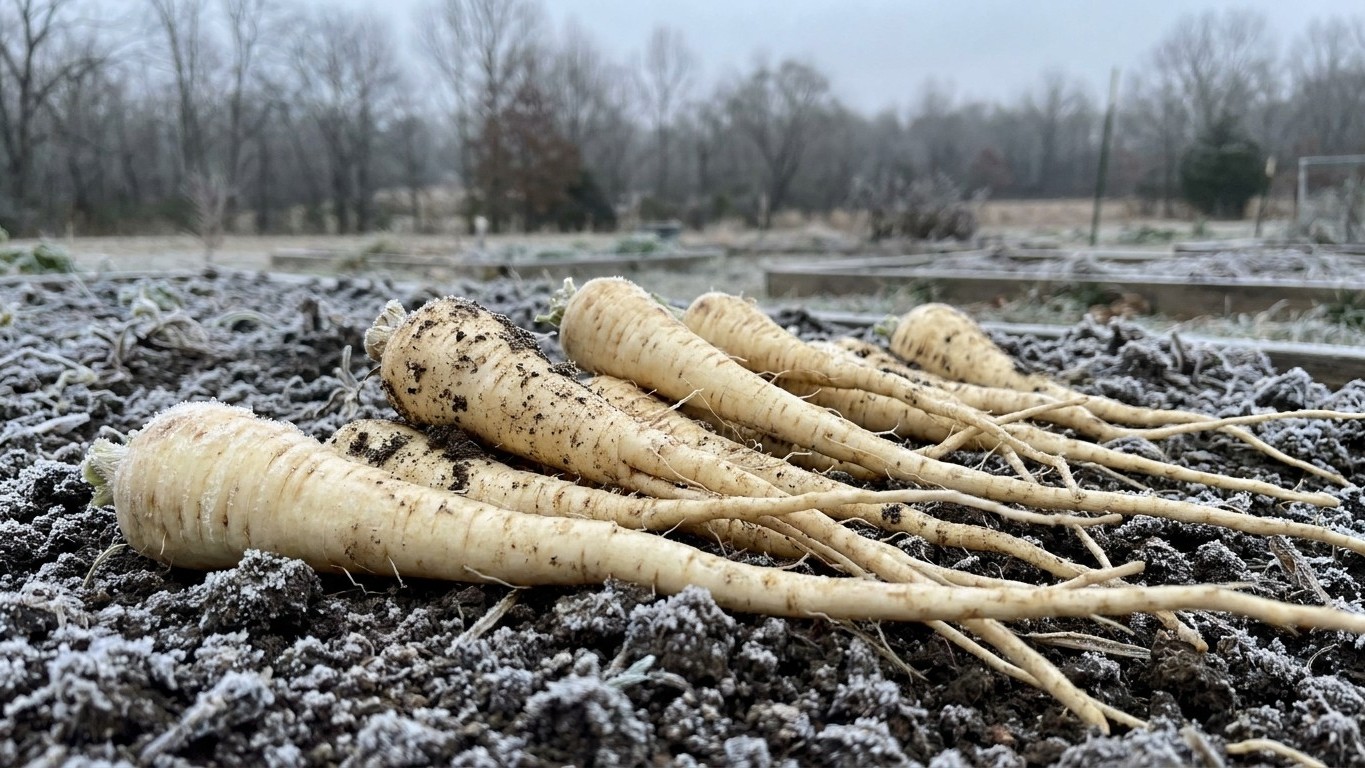

Yes, but only if the roots stay in the ground through several real frosty spells first. Maryland’s coldest month averages a nighttime low of 25.4°F, cold enough to trigger the starch-to-sugar conversion that makes a parsnip worth eating. Pull them too early, before that cold has had time to work on the roots, and you’ll get a fine-looking parsnip that tastes like a bland carrot. The climate here supports sweetening. Timing is what decides whether you actually get it.
The short answer
The number that matters isn’t a hardiness zone label. It’s the mean minimum temperature of the coldest month, because that figure tells you whether the ground actually gets cold enough, for long enough, to convert stored starch into sugar inside the root. For central Maryland, using the Baltimore reference station, NOAA’s 1991-2020 Climate Normals put that figure at 25.4°F. That’s a solid string of hard frosts, not a token dip below freezing that thaws by noon.
A parsnip left in that kind of cold for several weeks will sweeten. The starch inside the root breaks down into sugars as a defense against the cold, the same mechanism that makes a frost-kissed kale leaf taste different than one picked in August. Maryland’s winter delivers that exposure across most of the state, which means a gardener who sows on time and waits through a few good frosts should end up with roots that taste noticeably sweeter than anything pulled in early fall.
Two things can undercut that answer even here. Western Maryland, up in Garrett and Allegany counties, sits in mountainous terrain that runs colder and later than the rest of the state, which generally helps sweetening but can also shorten the harvest window if a hard freeze locks the ground before you dig. The Eastern Shore runs milder, and a soft winter there could mean fewer deep-cold weeks than the statewide figure suggests. Neither of those cancels the state’s answer. They just mean a gardener in Salisbury should watch the forecast a little more closely than one in Frederick.
The other variable is patience, not climate. Plenty of home gardeners dig their parsnips at the first sign of fall color, treating them like any other root crop ready for the table. That’s the single biggest reason people grow parsnips in a state cold enough to sweeten them and still end up disappointed. The cold has to touch the root in the ground, over multiple weeks, not in a paper bag in the refrigerator.
Does the season fit?
Parsnips are sown directly in place, not transplanted, and Utah State University Extension puts the full timeline at 100 to 120 days from seeding to a root worth harvesting, with sowing recommended 2 to 3 weeks before the last expected frost. Maryland’s last spring frost, per NOAA’s 1991-2020 freeze-probability data, falls between April 3 and April 16 depending on location. Here’s how that arithmetic plays out across the state.
- Sowing date: two to three weeks ahead of the April 3-16 last-frost window puts seeding somewhere in mid-to-late March across most of Maryland, earlier in warmer pockets, later in the mountains of Garrett and Allegany counties where frost lingers longer.
- Germination: parsnip seed is slow, taking 14 to 21 days to emerge. A gardener who doesn’t see seedlings after a week hasn’t failed; that’s just how the seed behaves, and re-sowing bare soil at that point wastes a second round of seed.
- Root development: counting 100 to 120 days forward from a mid-to-late March sowing lands root maturity somewhere between late June and late July.
- First fall frost: Maryland’s first frost arrives between October 26 and November 5 in most areas, again running later on the Eastern Shore and earlier in the western highlands.
- The gap: that leaves roughly three to four months between when the root is technically mature and when the first real frost even shows up, plenty of buffer for the plant to keep growing and thickening before the cold starts working on it.
- The verdict: the season fits comfortably almost everywhere in Maryland. The frost-free growing window, roughly 200 days between last spring frost and first fall frost at most reporting stations, is nearly double what the crop requires, which means a late sowing or a slow germination rarely puts the harvest at risk here the way it would in a shorter-season state.
What goes wrong here
- Forked or split roots from heavy or stony ground. Parsnips push a long taproot straight down, and any rock, clod, or compacted clay layer splits it into forks. Utah State University Extension recommends deep, sandy soil for this crop, and says heavy garden soil needs to be double dug, worked and loosened well beyond the top few inches, before sowing. Maryland gardens run the full range from sandy Eastern Shore loam to heavy Piedmont clay, so this is a soil-by-soil call, not a statewide one. Knowing your state’s general soil type is a starting point for planning a bed. It isn’t a diagnosis of what’s actually under your own row, and only digging a test hole or running a soil test tells you that.
- Forked roots from overwatering. This is a separate cause from heavy ground, not the same problem restated. Too much water encourages the root to branch as it searches for air pockets, even in soil that’s otherwise loose and well-prepared. Consistent, moderate watering, not daily soaking, keeps the taproot growing straight down instead of splitting.
- A season that runs out. Sowing weeks late, whether from a cold, wet spring or simple procrastination, eats into the 100 to 120 days the root needs. Maryland’s frost-free window is generous, but it isn’t infinite, and a July sowing gives the plant no realistic path to a mature root before the ground freezes.
- Roots pulled before the sweetening happens. The plant needs several weeks of frosty weather in the ground, not one overnight dip, to convert starch to sugar. Digging at the first cold snap, rather than waiting through a run of hard frosts, is the most common reason a Maryland gardener grows a technically successful parsnip that never tastes the way parsnips are supposed to.
Handling Parsnip Foliage: A Skin Safety Warning
North Carolina State Extension’s Gardener Plant Toolbox states it plainly: “All parts of this plant contain furocoumarins which can make skin sensitive to light causing burns so be sure to wear gloves, long sleeves and long pants when dealing with it.” That’s not limited to the leafy tops. All parts means the whole plant, root included.
What makes this worth taking seriously is the mechanism. The burn doesn’t come from the sap alone. It comes from sap on the skin combined with sunlight, a reaction called phytophotodermatitis. That’s why the injury tends to show up on a bright, sunny day of harvesting or clearing tops, and why the burn often doesn’t appear until hours after the exposure, once the skin has had time in the sun. It’s also why the protection that matters is covering up beforehand, gloves, long sleeves, long pants, rather than washing the skin afterward. By the time you notice sap on bare skin, the sunlight has often already started the reaction.
Checking this against your own county
The figures here come from statewide and regional data, and Maryland’s geography is varied enough that your own backyard can run measurably colder, warmer, wetter, or drier than the numbers cited. A gardener in the Garrett County highlands is working with a different frost calendar than one on the Eastern Shore, even though both are technically the same state.
The University of Maryland Extension, at extension.umd.edu, is the land-grant service for the state and the right place to check local frost dates, soil test recommendations, and planting calendars specific to your county. They can also confirm current guidance on furocoumarin exposure and safe handling practices for parsnips and related crops grown locally.
Common questions
Do parsnips need a hard freeze to sweeten, or does any frost work?
The conversion happens over several weeks of sustained frosty weather in the ground, not from a single light frost. A one-night dip below freezing isn’t the same exposure as weeks of consistently cold nights working on the root.
Can I sow parsnips later than the recommended window and still get a harvest in Maryland?
The state’s frost-free window is wide enough to absorb some delay, but the 100 to 120 day requirement, plus 14 to 21 days just for germination, means a sowing pushed too far into late spring risks running out of season before the fall frosts arrive.
Why did my parsnip roots come out forked even though my soil looked fine?
Forking has two separate causes: rocky or compacted ground splitting the taproot, or overwatering encouraging the root to branch in search of air. Loose, deeply worked soil and moderate, consistent watering address each cause separately.
Is it safe to touch parsnip greens without gloves if I wash my hands right after?
The reaction requires sap on the skin plus sunlight exposure, so the protection that matters is covering skin before handling the plant, not washing afterward. Gloves, long sleeves, and long pants are the guidance from NC State Extension for all parts of the plant.