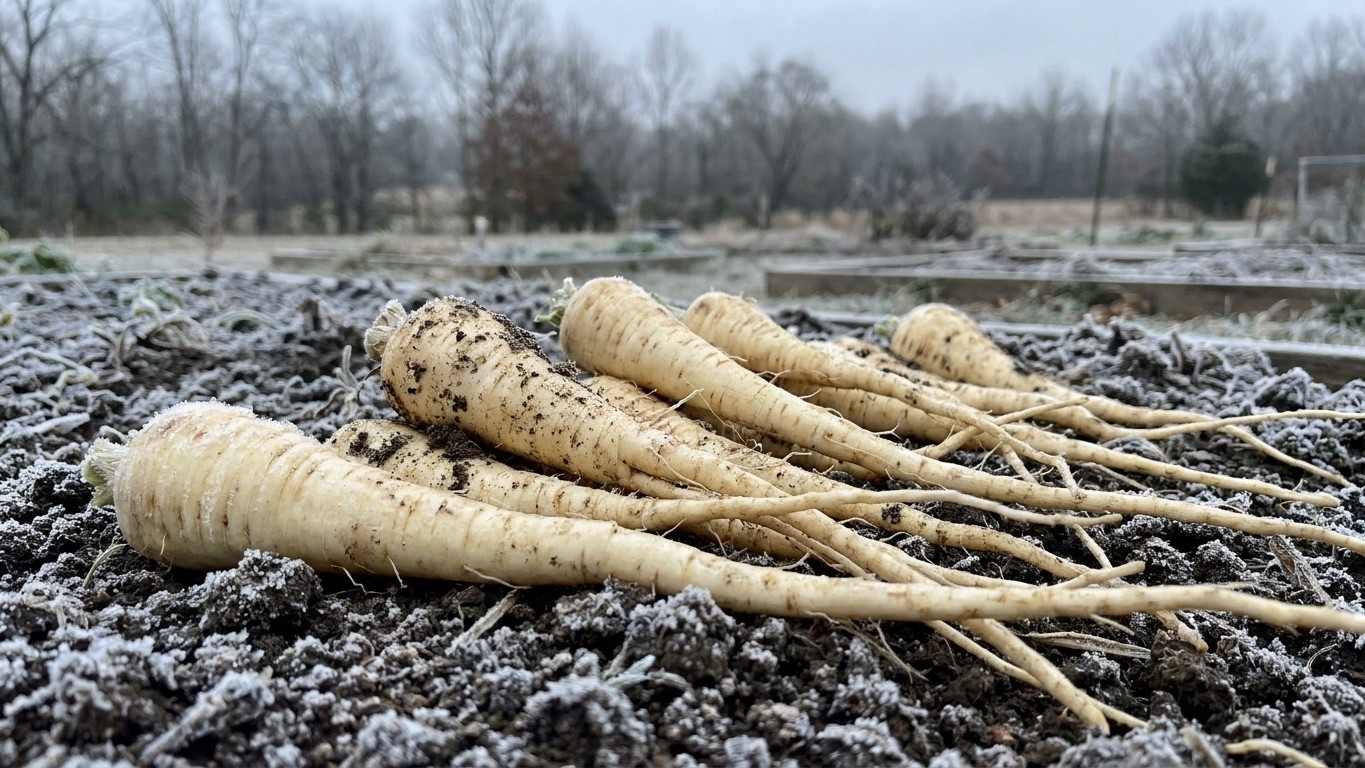

New Mexico’s high, dry winters deliver exactly what a parsnip needs: weeks of real cold. At Albuquerque’s reference station, the coldest month averages a daily minimum of 26.4°F, cold enough to convert stored starch into sugar in a root left in the ground. That’s the short version. Your county’s own frost dates, soil, and elevation decide the rest, and those details separate a sweet parsnip from a merely edible one.
The short answer
Start with the number that actually decides this, not the hardiness zone printed on a seed packet. A zone map tells you whether a perennial survives winter. It says nothing about whether a root vegetable pulled from the ground next November tastes sweet or just starchy. What matters is frost exposure, meaning how many hard, cold nights the crop sits through before you dig it.
At Albuquerque’s reference weather station, the coldest month of the year averages a daily minimum of 26.4°F, based on NOAA’s 1991-2020 Climate Normals. That’s not one overnight dip. That’s the average low across an entire month, which means repeated nights well below freezing are the norm, not the exception, in a typical New Mexico winter at that elevation.
For a parsnip, that’s close to ideal. Utah State University Extension notes that parsnips need several weeks of cool, frosty weather to convert stored starch to sugar, the biochemical process that turns a merely edible root into the sweet, nutty one gardeners actually want. Cold triggers it. A mild winter simply doesn’t supply enough of it, no matter how lush the foliage looked back in August.
So the short answer: yes, across most of New Mexico, a parsnip timed correctly and left in the ground through several hard frosts will sweeten. That holds for the state’s cooler, higher gardens, in and around Albuquerque, Santa Fe, and Taos, where winters are cold and dependable.
It gets shakier in the state’s lower, warmer pockets. New Mexico’s elevation ranges from over 13,000 feet at Wheeler Peak to under 4,000 feet along the Rio Grande near Las Cruces, and that swing changes winter severity a great deal. A parsnip grown in a low desert valley, where nights stay milder later into the season, may sit through a handful of light frosts rather than sustained cold. The root will still grow. It just won’t sweeten as much, because the trigger isn’t there in the same dose.
Hold onto that distinction: a comfortable growing zone and a frosty winter aren’t the same fact. New Mexico as a whole leans toward the second, but the specific answer for your garden depends on where in that elevation range you’re actually planting.
Does the season fit?
- Sowing date. Parsnips are sown directly in place, seed to soil, 2 to 3 weeks before the last spring frost. Using Albuquerque’s reference last-frost window of March 31 to April 12, that puts sowing somewhere around mid-to-late March for most of the state’s cooler regions.
- Germination. Parsnip seed is slow to start. Count 14 to 21 days before you see any green, so a mid-March sowing may not show seedlings until early April. Resist re-sowing what looks like bare soil during that stretch; that’s simply how parsnip germinates.
- Maturity. From that original seeding date, the crop needs 100 to 120 days to reach harvest size, according to Utah State University Extension. Counting forward from a mid-to-late March sowing lands maturity somewhere around late June through mid-July.
- Frost window comparison. Using Albuquerque’s reference dates, the frost-free season runs from roughly mid-April to somewhere between October 29 and November 9, six-plus months of growing time in a typical year at that elevation. A crop maturing by July still has months of spare time before the first fall frost even arrives.
- The verdict. The season fits comfortably, not tightly. Even a gardener who sows two or three weeks later than this calculation, or whose county sees a later last frost, still has ample time to reach maturity well before the ground freezes hard. That slack matters, because it’s what lets mature roots sit in cold soil through several fall frosts, which is exactly the exposure that makes them sweet.
What goes wrong here
- Forked roots in heavy or stony ground. New Mexico’s clay-heavy soils and caliche layers resist a taproot pushing straight down, so it splits and branches around rocks or a compacted layer. Remedy: double dig the bed 12 to 18 inches deep before sowing, break up any caliche, remove rocks, and work in a couple inches of compost to loosen the profile.
- Forked roots from overwatering. Uneven or excessive watering can push a root to send out secondary rootlets rather than growing one long, straight taproot. Remedy: water deeply and on a consistent schedule, aiming for evenly moist soil rather than alternating between soggy and dry.
- A season that runs out at higher elevations. Mountain-adjacent gardens around Taos, Red River, or Angel Fire sit at elevations where the frost-free window is shorter than the Albuquerque reference figures suggest. Remedy: sow the moment soil can be worked in spring, check your county’s own frost data rather than a statewide average, and consider row cover to stretch the fall end of the season.
- A winter too mild to sweeten. In the state’s lower desert valleys, near Las Cruces or Deming, frosts can be lighter and less frequent than in the higher interior. Remedy: leave the crop in the ground as late into the cold season as the soil stays workable, harvesting after the coldest nights arrive rather than ahead of them.
Handle the roots with gloves, not just the harvest fork
Parsnip is a member of the carrot family, and it carries a defense mechanism worth respecting before you kneel down to pull one. North Carolina State University Extension’s Plant Toolbox states it plainly: “All parts of this plant contain furocoumarins which can make skin sensitive to light causing burns so be sure to wear gloves, long sleeves and long pants when dealing with it.”
That’s not limited to the leafy tops, even though foliage handling is when most gardeners get caught out. Furocoumarins are present throughout the plant, root included, and the compound itself isn’t what burns you. It needs a partner: ultraviolet light. Sap touches skin, sunlight hits that same skin within the following hours, and the combination triggers a chemical burn that can look and feel like a bad sunburn, sometimes in odd streaks or handprints tracing exactly where the sap landed.
That two-step mechanism explains why the reaction tends to show up on a bright day spent pulling tops or digging roots rather than an overcast one, and why skin often looks fine in the moment and only reddens or blisters hours later, once you’ve been back out in the sun. It’s also why the fix is prevention rather than cleanup: gloves, long sleeves, and long pants before you touch the plant, not a rinse afterward once the sap has already met sunlight.
Checking this against your own county
Every figure above comes from one reference station, Albuquerque’s airport weather monitor, and New Mexico’s elevation swings too widely for a single station to speak for the whole state. A garden in the foothills near Santa Fe or Taos likely sees its last spring frost later and its first fall frost earlier than the dates above, sometimes by a week or two. A garden near Las Cruces or Carlsbad, sitting lower and warmer, likely sees the opposite, with fewer of the sustained cold nights that actually sweeten a parsnip.
New Mexico State University’s Cooperative Extension Service, at aces.nmsu.edu, maintains county offices across the state and is the right place to check local frost dates, soil recommendations, and planting calendars before committing seed to ground. Its agents work from the elevation and microclimate of your specific county rather than a statewide average, which matters more here than in flatter states.
Common questions
How long do parsnips take to grow in New Mexico?
Plan on 100 to 120 days from seeding to maturity, plus 14 to 21 days of germination before seedlings even appear. Sow 2 to 3 weeks before your local last frost date, not the statewide average.
Can I leave parsnips in the ground over winter in New Mexico?
In most of the state’s cooler, higher gardens, yes, and it’s what develops the sweetness. The state’s cold winters, reflected in Albuquerque’s 26.4°F coldest-month average low, provide the sustained frost exposure the crop needs.
Why did my parsnips fork or split?
Two separate causes produce the same result: heavy, stony, or compacted soil that deflects the taproot, or inconsistent, overly wet watering that pushes secondary rootlets. Double digging and even watering address each cause differently.
Is it safe to touch parsnip foliage barehanded?
No. Every part of the plant contains furocoumarins that, combined with sunlight, can cause skin burns. Gloves, long sleeves, and long pants are the recommended protection before handling any part of the plant.