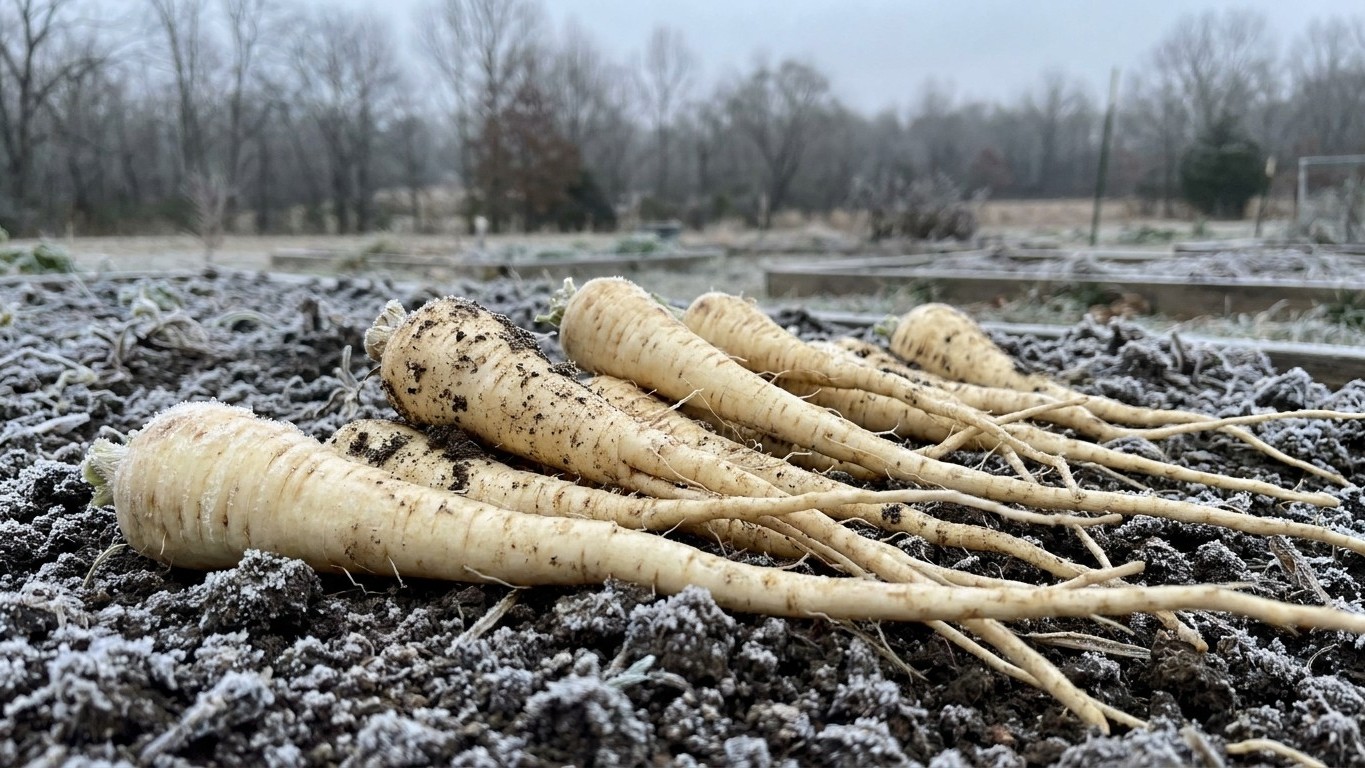

Yes, parsnips grown in Nova Scotia will sweeten, and reliably so. The province’s cold winters deliver exactly what the crop needs: weeks of hard frost that turn stored starch into sugar underground. The catch isn’t whether it happens, it’s timing the planting right and knowing what this heavy maritime soil does to root shape along the way.
The short answer
The question that decides everything isn’t how cold it gets on the worst night of the year. It’s whether the cold sticks around for weeks at a stretch, because that sustained chill is what triggers the starch-to-sugar conversion inside the root. A single hard frost barely nudges the process. Several frosty weeks in a row is what actually rewrites the flavor.
On that measure, Nova Scotia delivers. At the Halifax reference station, the mean daily minimum during the coldest month sits at 13.3°F, according to Environment and Climate Change Canada’s Canadian Climate Normals. That’s not the record low for a freak night, and it’s not a monthly average blending warm afternoons with cold nights. It’s the typical overnight low, repeated across an entire month. A parsnip root sitting in ground that cold for that long isn’t just surviving; it’s being pushed through the sugar conversion the crop is grown for.
This is worth separating from the hardiness zone conversation entirely. A zone rating tells you what a perennial plant can survive over winter. It says nothing about how many consecutive cold weeks a biennial root vegetable sits through before harvest, which is the actual mechanism behind parsnip sweetness. Two locations can share a similar zone and still differ wildly in how much sustained frost exposure they deliver. Nova Scotia’s number here isn’t a zone at all; it’s a direct read on how cold the coldest month runs, and 13.3°F for a full month of overnight lows is firmly in frosty territory.
So the practical answer for most home gardens across the province: grow parsnips here and let them sit through the season’s early frosts before pulling them, and they will sweeten in the way the crop is known for. The one place to stay alert is directly on the Atlantic shoreline, where the water’s moderating effect can blunt overnight lows compared to inland or upland spots even a few miles back from the coast. If your garden sits right on the water, it’s worth watching your own thermometer rather than assuming the regional number applies exactly to your patch of ground.
Does the season fit?
Parsnip seed goes straight into the garden bed, no transplanting, and the clock that matters starts the day you sow it, not the day it sprouts. Run the actual math against Nova Scotia’s frost calendar and the fit turns out comfortable, with real slack built in.
- Nova Scotia’s mean last spring frost falls around May 7, based on Environment and Climate Change Canada’s climate normals for the Halifax Stanfield International Airport station. That’s a mean date, not a promise: roughly half of all years see frost arrive later, so treat it as the middle of a window rather than a green light to plant.
- Parsnip seed can go into cool soil ahead of that date. Sowing 2 to 3 weeks before the mean last frost puts the seeding date somewhere in mid-to-late April for most Nova Scotia gardens.
- Germination is slow, 14 to 21 days, which matters because a bare-looking bed at day 10 is not a failed sowing. Digging it up and re-seeding at that point just restarts the clock for nothing.
- Maturity runs 100 to 120 days from that original seeding date, not from the day seedlings finally show. Counting forward from a mid-to-late April sowing lands harvest-ready roots somewhere between very late July and mid-August.
- Nova Scotia’s mean first fall frost lands around October 18, again from the Halifax Stanfield station normals. Measured against an August maturity date, that leaves roughly eight to ten weeks of slack before the season’s first real cold snap.
- That slack is the whole point. It means the crop isn’t racing the calendar here. There’s room for a late start, a slow germination stretch, or a later-than-average last frost, and still time left for the roots to sit through several early autumn frosts, which is exactly the exposure that builds their sweetness before you dig them.
What goes wrong here
- Forked roots. This has two separate causes worth keeping apart. The first is heavy or stony ground: Nova Scotia’s glacial till soils run to clay or scattered stones in a lot of districts, and a taproot that hits resistance splits rather than growing straight down. Utah State University Extension’s remedy is deep, sandy soil where possible, or double-digging heavy ground to loosen it well beyond the root’s expected length. The second cause is overwatering, which is unrelated to soil texture and happens even in good ground: keep moisture steady rather than alternating dry spells with heavy soaking.
- A season that runs out. Nova Scotia’s frost window has enough slack that this shouldn’t happen in most gardens, but it does when sowing gets delayed past the recommended 2-to-3-week-before-last-frost mark, or when a slow germination stretch near the 21-day end compounds a late start. The fix is simply to sow as early as the soil can be worked, since parsnip seed tolerates cool ground well before the mean last frost date arrives.
- A winter too mild to sweeten. This is not the typical Nova Scotia problem, given a coldest-month minimum of 13.3°F, but immediate coastal gardens moderated by the Atlantic can run noticeably milder than the regional station. Rather than assuming your winter delivered enough frost, leave roots in the ground through at least a few hard frosts before harvesting and judge by taste rather than the calendar alone.
Nova Scotia’s frosty weeks are good news for flavor, but the same plant carries a warning that has nothing to do with cold. The North Carolina Extension Gardener Plant Toolbox states it plainly: “All parts of this plant contain furocoumarins which can make skin sensitive to light causing burns so be sure to wear gloves, long sleeves and long pants when dealing with it.” That’s roots, leaves, stems, all of it, not just the foliage.
The mechanism is what makes this surprising rather than obvious. The burn doesn’t come from the sap alone. It takes sap on the skin plus sunlight hitting that same skin, a reaction called phytophotodermatitis. That’s why it tends to show up on a bright day of harvest or of pulling tops, when bare forearms brush against broken stems or leaves in full sun. It’s also why the burn doesn’t appear right away; it can take hours to show up, long after the gardening is done and the sap has already dried. Because the trigger is exposure, not contact alone, washing hands afterward doesn’t undo the damage the way it would with a simple irritant. The protection that actually works is covering up before you touch the plant: gloves, long sleeves, long pants, exactly as the source describes it, on any bright day you’re handling parsnip tops or roots.
Checking this against your own county
The figures here come from a single reference station near Halifax, and Nova Scotia’s coastline, valleys, and higher inland ground don’t all share one climate. A garden in the Annapolis Valley, on Cape Breton’s highlands, or right on the open Atlantic shore can run measurably different from the Halifax numbers in either direction.
Before betting a season’s planting on the dates above, check them against local guidance from the Nova Scotia Department of Agriculture, which tracks conditions and advisories specific to the province’s growing regions. Local extension staff can also speak to soil type in your particular district, which matters just as much as frost timing when it comes to whether your parsnip roots grow straight or fork.
Common questions
Can I sow parsnip seed directly into Nova Scotia’s cool spring soil?
Yes. Parsnip seed tolerates cool ground and is typically sown 2 to 3 weeks ahead of the mean last frost date, which in Nova Scotia falls around May 7 at the Halifax reference station.
How long does parsnip seed take to come up?
Germination runs 14 to 21 days, according to Utah State University Extension. A bed that looks empty at 10 days hasn’t failed; it needs more patience before you consider re-sowing.
Should I leave parsnips in the ground over winter in Nova Scotia?
Many gardeners do, since the sweetening process depends on sustained cold exposure. With a coldest-month mean minimum of 13.3°F, most of the province offers plenty of frost for this, though roots left in the ground need enough mulch or snow cover to keep the soil workable when you dig them.
Does the variety of parsnip affect how sweet it gets?
The sourced guidance here doesn’t name or compare specific varieties, so no claim about variety-driven sweetness differences is made on this page. What’s established is that the sweetening comes from weeks of frost exposure after the root reaches maturity, not from which seed packet you started with.