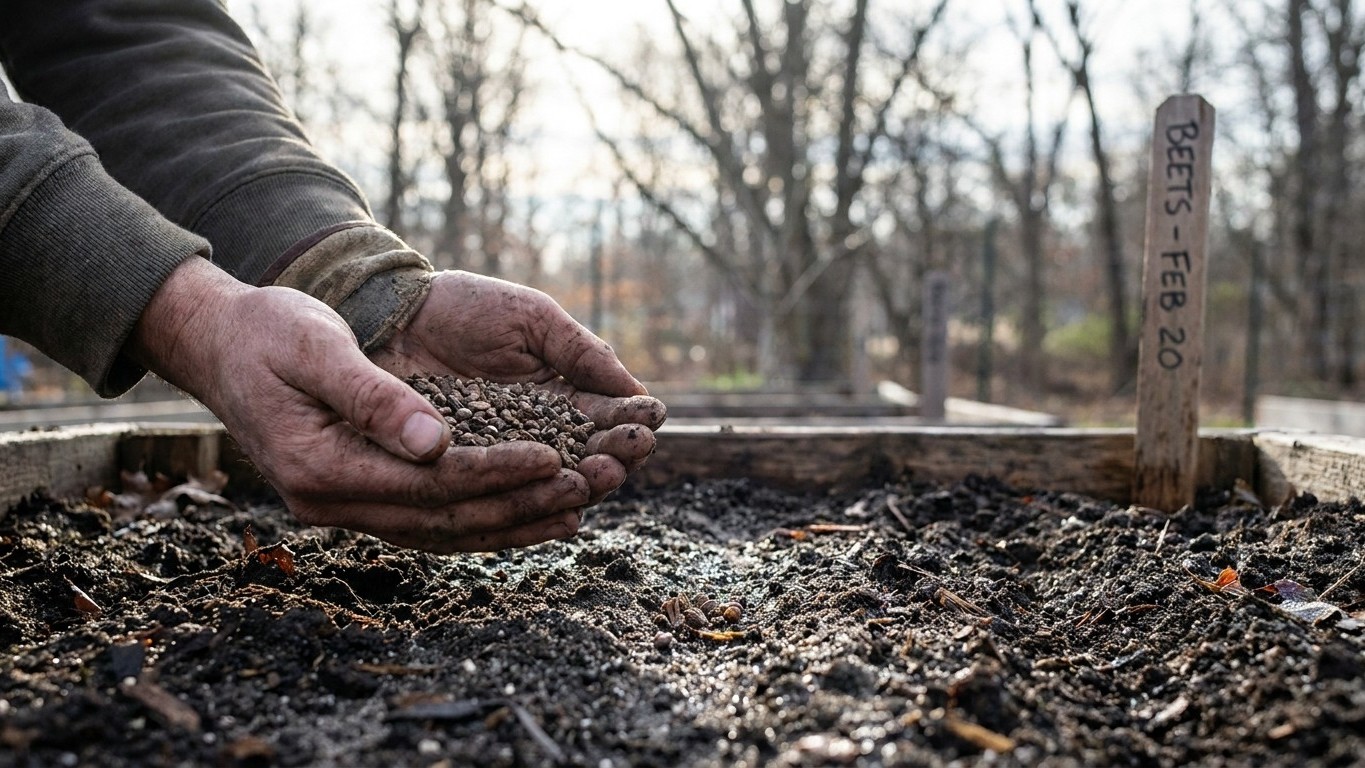

Sow beets in North Dakota 2 to 3 weeks before the last spring frost. At the reference weather station used for this page, that frost date falls between May 4 and May 15, which puts sowing in the window of roughly mid to late April. Because beets are direct-seeded rather than transplanted, this date also starts the 60- to 80-day clock that runs to harvest.
The short answer
Start with the ground itself. The soil USDA lists as representative of North Dakota is the Williams series, a Mollisol, the deep, dark prairie soil that built the Corn Belt further south and shows up across much of the northern plains. Measured at the surface horizon across 549 mapped components, it runs 38 percent sand, 22 percent clay and 40 percent silt, a loam-to-silt texture with a pH near neutral at about 7.2 and organic matter around 4.0 percent. It’s classed as well drained.
For a beet, that’s a mixed report card. Utah State University Extension is blunt about what the crop wants: deep, sandy, well-drained ground rich in organic matter, amended with no more than 1 inch of composted material per 100 square feet. The Williams series clears the drainage bar and the organic-matter bar without much trouble, that near-neutral pH won’t fight the plant, and the moderate clay fraction actually helps hold moisture between waterings. But it isn’t sandy. The 40 percent silt component means a bed can crust over after a hard rain, and a crusted surface is exactly what stalls beet germination, since the seedling has to punch through a cap rather than a loose, sandy top layer.
On heat: this page doesn’t have a published count of days per year above 90°F for a North Dakota reference station, so that figure isn’t part of the record used here. What is documented is the threshold that matters for beet quality, not a day count. Utah State University Extension’s finding is that heat above 85°F combined with water stress is what turns a beet root woody, not heat on its own. That means the risk in North Dakota is tied less to how many scorching days the state logs and more to whether a bed goes dry during a warm stretch, a distinction worth holding onto through the rest of this page.
None of this is a diagnosis of any one garden. North Dakota spans hundreds of mapped soil series, and the Williams series is simply the one USDA names as representative of the state as a whole. A garden on a river terrace, in hill country, or on ground a builder has cut and filled can differ completely from it. Treat these numbers as a starting point for how the region’s ground tends to behave, then confirm your own bed with a soil test rather than borrowing this pH or texture as your own.
The six weeks that decide it here
Sowing 2 to 3 weeks ahead of the May 4 to May 15 frost window puts a North Dakota beet’s first six weeks squarely in the state’s most temperamental stretch of spring, roughly mid-April through early June. That’s the run of weeks when a beet’s fate as a root crop, not a bolted flower stalk, gets decided.
North Dakota spring is known for swinging hard rather than settling in gently. A stretch of raw, dry wind and a hard cold snap can sit right next to a few days that feel like early summer, sometimes within the same week. That swing matters more for beets than steady cold or steady warmth would, because it’s the drying wind and the dry soil surface, not the cold itself, that stresses a young beet. Utah State University Extension’s research is specific on this point: water stress in the first six weeks after seeding is what pushes a beet to flower prematurely, a failure gardeners call bolting, and once a plant bolts, the root stops developing and the harvest is lost regardless of what happens later in the season.
This is why the bolting risk in North Dakota sits earliest in the calendar, not latest. A gardener who sows on schedule but then lets the bed dry out during an April wind event has already set up the failure, weeks before summer heat ever arrives. The fix isn’t complicated, but it does need to start on day one: keep the top couple of inches of soil consistently moist through germination and the following weeks, rather than watering on a fixed schedule and hoping the weather cooperates. A light mulch over the row helps hold that moisture against drying wind without adding the kind of organic bulk that would push past the 1-inch-per-100-square-foot compost guideline.
Later heat, when it does arrive, is a separate problem with a separate symptom, woody roots rather than bolted plants, and it’s covered in the next section rather than folded into this one.
What goes wrong here
- Crusted seedbed blocks germination. The Williams series’ 40 percent silt fraction can cap over after a heavy spring rain, and a beet seedling doesn’t have the push to break a hard crust. Keep the surface lightly moist from sowing through emergence rather than letting it dry into a crust, and rake in a thin layer of fine compost at sowing so the surface stays loose.
- Early water stress triggers bolting. A dry, windy stretch in the first six weeks after sowing, common in North Dakota spring, is the documented trigger for premature flowering. Water consistently through this window regardless of how mild the weather looks; don’t wait for visible wilting as the cue.
- Clay content compacts around developing roots. At 22 percent clay, the Williams series can compact under foot traffic or heavy equipment passes between rows, restricting the straight, unobstructed growth a beet root needs. Stay off the bed when it’s wet and work in compost at sowing, capped at 1 inch per 100 square feet per the Utah State University Extension guideline, to keep the profile loose.
- Late-season heat plus a dry bed turns roots woody. A warm spell above 85°F that coincides with a bed running dry is the documented cause of woody, fibrous roots, a separate failure from bolting and one that shows up closer to harvest. Mulch to buffer soil temperature and keep watering through any hot stretch rather than assuming the plant is past the risk once it’s rooted.
- Sowing too late shortens the harvest window. Because beets run 60 to 80 days from seeding, not from transplant, a bed sown well after the local last-frost date can push harvest into a period when quality has already started slipping from heat stress. Sow as close to the 2- to 3-week-before-frost target as the county’s own frost record allows, rather than defaulting to the reference city’s May window if local frost typically breaks earlier or later.
Common questions
Is May 4 to May 15 the right frost date for my county?
That window comes from a single reference weather station, and NOAA’s own climate normals note it reflects that station’s record, not the whole state. Suburban and rural gardens, especially at higher elevation or away from a moderating city heat effect, typically see the last spring frost later and the first fall frost earlier than an airport station shows, often by one to two weeks. Check your own county’s frost history before locking in a sowing date.
Can I sow beets earlier than 2 to 3 weeks before the last frost?
The 2- to 3-week window is built around the crop’s cold tolerance as a seed and young seedling, but sowing well ahead of that pushes the six-week establishment period into colder, wetter soil that can rot seed before it germinates. Sticking to the window keeps germination timing predictable without giving up much on the calendar.
Does the Williams series soil mean I don’t need a soil test?
No. The Williams series is the soil USDA lists as representative of North Dakota as a whole, drawn from hundreds of mapped components, not a reading of any individual yard. A state has hundreds of distinct soil series, and river bottoms, hill ground, and any site that’s been graded or filled can differ completely from this profile. Use it as a general read on regional tendencies and confirm your own bed’s pH and texture with a test.
What’s the difference between bolting and a woody root, and do they need different fixes?
They’re two separate failures with two separate causes. Bolting is premature flowering triggered by water stress in the first six weeks after sowing, and once it happens the root stops developing for good. A woody root develops later, when heat above 85°F combines with a dry bed, and it’s a texture problem in an otherwise viable root rather than a failed plant. Both fixes point back to the same practice, consistent watering, but they apply at different points in the season and address different symptoms.