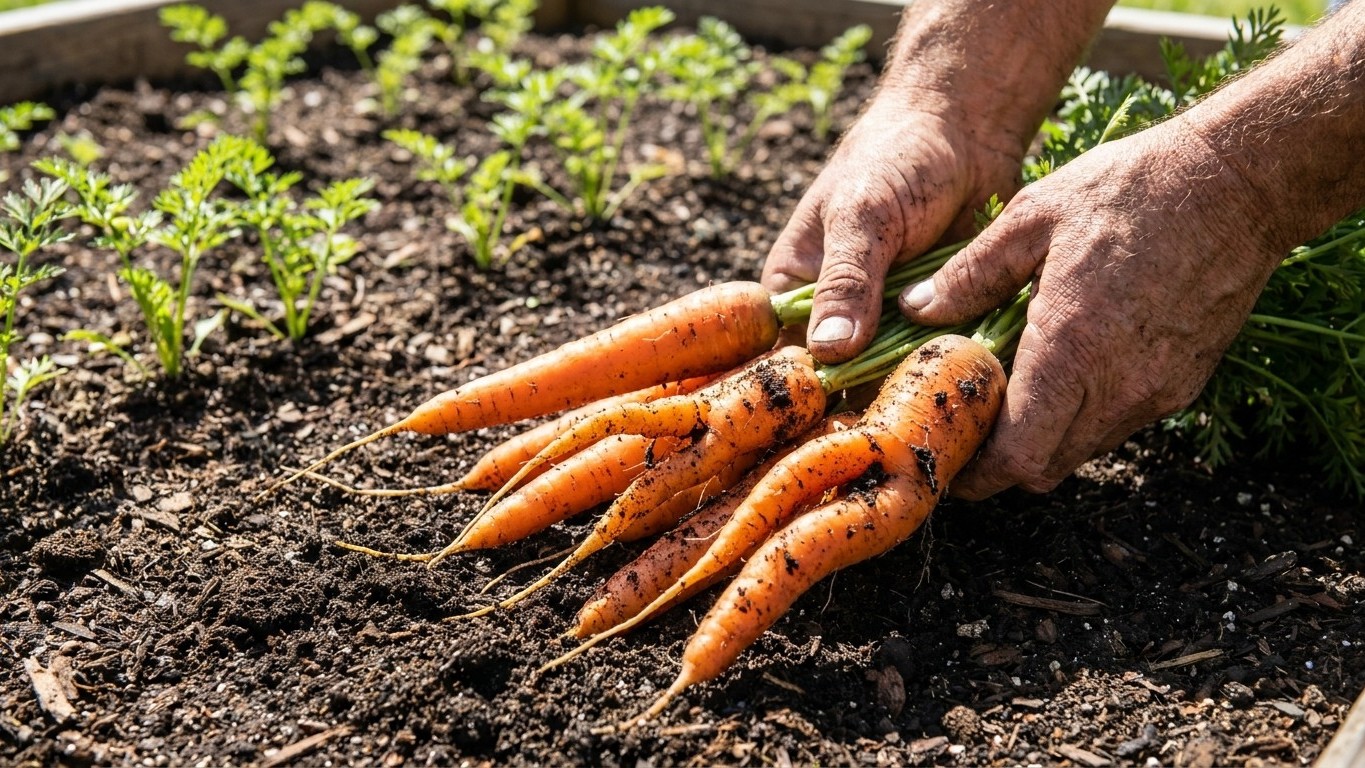

Nova Scotia gardeners often plan carrot sowing by counting backward from the average last spring frost date, since a young carrot seedling shrugs off a light chill better than the seed does when it’s sitting in cold, crusted ground. But no frost countdown fixes a root that forks the moment it hits clay or a compacted layer. Before the calendar math matters, the ground under your feet decides whether that carrot grows straight or twists into a Y.
The short answer
Across the mapped agricultural ground of Nova Scotia, the most common soil order is a Podzol, the acid, leached soil type that forms under conifers once rain has washed the bases out of the surface layer. It covers 53 percent of the mapped surface, with Gleysolic soils making up most of the rest. Where that Podzol shows up, the median surface reading runs a pH near 5.2, which counts as strongly acid. The texture works out to 52 percent sand, 10 percent clay and 38 percent silt, a loam that leans toward silt loam, with organic matter around 2.1 percent and drainage classed as imperfect, meaning water moves through the profile slowly enough that the root zone can stay damp longer than a carrot prefers.
Utah State University Extension puts it plainly: carrots want deep, sandy, well-drained soil rich in organic matter, and heavy or rocky ground makes the root fork. The texture numbers for Nova Scotia’s typical soil aren’t disastrous on their own, with sand well above clay, but the imperfect drainage rating is the part that should give you pause. A shallow hardpan or a seasonal high water table under an otherwise decent loam can still perch water against the taproot and send it sideways just as effectively as a solid clay bed would. Where that’s the case, Extension’s fix is the same either way: work in generous compost and double dig the bed to break up the compacted layer, or skip the fight entirely and build a raised bed filled with loose, sandy soil.
None of this is a diagnosis of your particular garden. A province spans hundreds of individual soil series, and the figures above describe a median across nearly 500 mapped components in the agricultural regions, not any one plot. River bottoms, old bogland, and anywhere a builder has scraped topsoil or trucked in fill will read completely differently from the provincial median, sometimes in ways that make carrot-growing easier and sometimes harder. Treat these numbers as a starting point for what the region’s ground tends to do, then confirm what your own bed is actually doing before you commit a whole row of seed to it.
The test that settles it in your own garden
- Dig a hole the depth of a spade in the bed you plan to sow, and set the soil in a loose pile beside it so you can look at it layer by layer.
- Check what came up: count the stones, and note how deep you hit a color change or a dense, compacted layer. Carrots need open ground for their full length, and any hardpan sitting close to the surface will turn the growing tip sideways or split it.
- Take a handful of moist soil from partway down the hole and roll it between your palms. Sandy soil won’t hold a shape at all. Clay-heavy soil rolls into a ribbon that holds sharp edges when you bend it. A loam somewhere in between will hold together in your hand but crumble apart at the ends when you try to bend it.
- Fill the hole with water and watch how it behaves. Ground that drains cleanly disappears and stays open. Ground that holds a standing puddle for a long stretch is showing you the same pattern the province’s imperfectly drained median describes: expect the surface to stay wet longer than you’d like after a hard rain.
- If you want an actual acidity number for your plot rather than the provincial median, send a sample to a soil testing lab. That’s the only way to know where your own bed sits relative to the 5.2 figure above, since your garden may run more acid, less acid, or land right on it.
What goes wrong here
- Forking roots in heavy, imperfectly drained ground. When the taproot meets a compacted layer or standing water instead of open soil, it splits around the obstruction rather than growing straight down. The fix, per Utah State University Extension, is generous compost worked in with double digging to break up the compacted layer, or a raised bed filled with loose, sandy soil where the whole root run stays open.
- Poor germination during a warm, dry stretch. Carrot seed sits shallow in the row and has no reserve to fall back on if the top layer of soil dries out before it sprouts. Keep that surface consistently damp with light, frequent watering, and a board or thin mulch laid over the row until seedlings break through helps hold moisture without smothering them.
- Split roots from uneven watering. A dry spell followed by a heavy soaking makes the root swell unevenly and crack along its length. Regular, even watering through the growing season, rather than letting the bed dry out and then flooding it, keeps growth steady and the skin intact.
Common questions
Is Nova Scotia’s soil naturally good for growing carrots?
It’s mixed. The typical texture, over half sand with only about a tenth clay, leans in carrots’ favor, but the imperfect drainage rating and the strongly acid median pH both work against a clean, straight root. The soil isn’t a lost cause, but it usually needs some correction rather than being left as-is.
What if my garden’s soil feels heavier or wetter than the provincial average described here?
Follow Utah State University Extension’s guidance for heavy soil: work in plenty of compost and double dig the bed before sowing, or build a raised bed and fill it with loose, sandy soil so the root never meets a compacted layer.
How long does it take to get a harvestable carrot from seed in this climate?
Carrots are sown directly in place, since they don’t transplant well, and the count runs from seeding, not from any transplant date. Utah State University Extension notes carrots generally need 70 to 100 days from seeding to reach harvest size, though that range covers the crop broadly rather than any one variety.
Does the province’s acidic soil mean I need to add lime before sowing carrots?
The 5.2 median pH describes the typical mapped surface soil, not your particular bed, and no ideal pH figure for carrots is established here. The only way to know if lime is worth adding is to test your own soil first and go from that number, rather than assuming the provincial median applies to your garden.