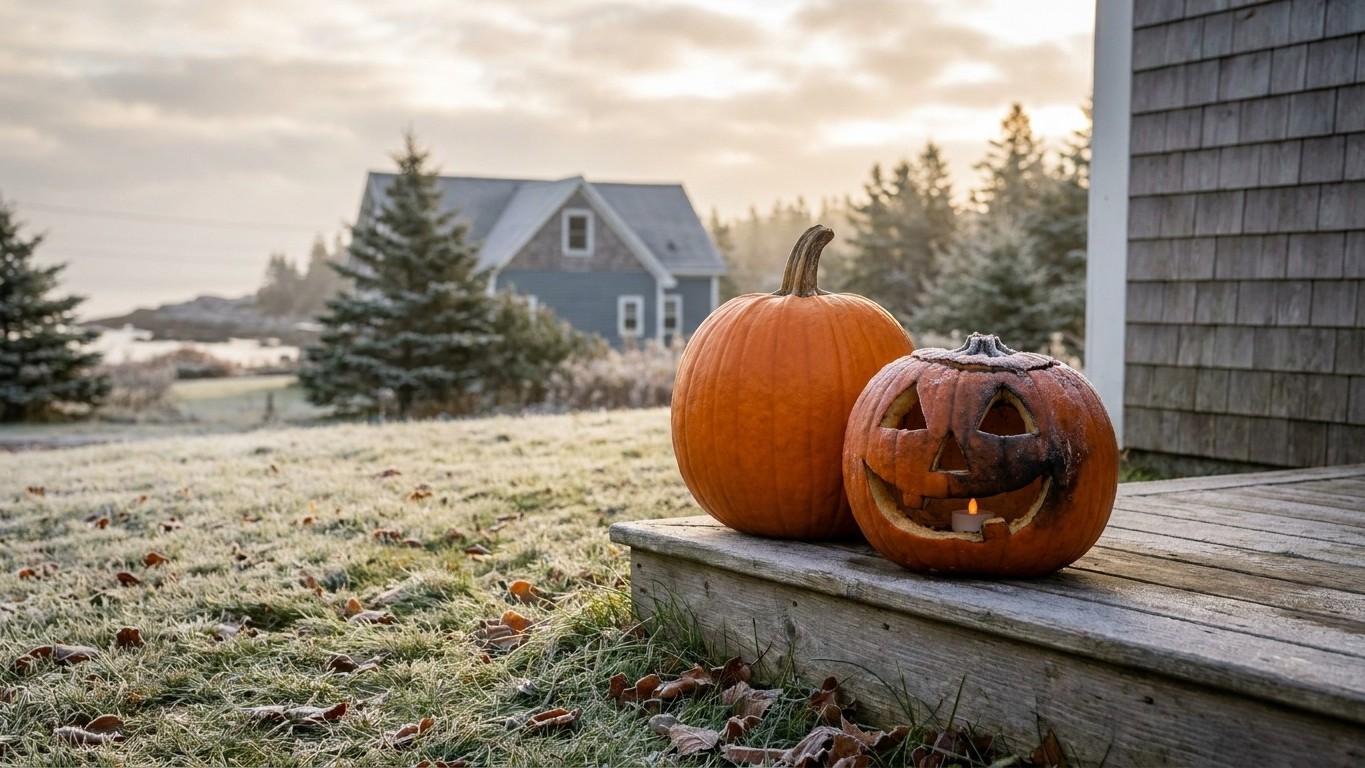

Around Halifax, the mean first fall frost lands close to October 18, roughly thirteen days before Halloween. That’s an average, not a promise, but it tells you something useful: if you carve early and leave a jack-o’-lantern out on the step through the whole month, you’re carving right into the window when the air starts working against you. The safer play is to buy early, store the pumpkin whole, and carve close to October 31 itself.
The short answer

Halifax Stanfield’s climate normal puts the average first fall frost around October 18. That figure comes from three decades of Environment and Climate Change Canada records at the Halifax Stanfield airport station, and it’s a midpoint, not a cutoff. In roughly half of all years, frost arrives later than that date; in the other half, it comes sooner. So when someone asks whether a pumpkin can safely sit out from early October until Halloween, the honest answer is: probably not without some help, because frost is already knocking on the door before the month is even over.
What that means in practice is a window of about thirteen days between the average frost date and Halloween night. During that stretch, a whole, uncarved pumpkin sitting outdoors is exposed to temperatures that can dip well below the range it actually wants. A carved one is even more exposed, since the cut flesh has no skin left to slow down moisture loss or chilling damage. The safest strategy, then, is to treat late October in Nova Scotia as a countdown: pick the pumpkin early if you want the best selection at the farm stand or market, but keep it whole and keep it cool rather than carving it the day you bring it home.
None of this means carving has to wait until Halloween morning. It means the gap between “carve it” and “display it” should be as short as you can reasonably make it, especially in years when frost shows up ahead of that October 18 average, which happens about as often as it doesn’t. If your household tradition is to carve a week or two out, know that you’re accepting a higher chance of a soft, sunken jack-o’-lantern by the time trick-or-treaters arrive. If you’d rather have a crisp, firm pumpkin on the night itself, carving in the last two or three days before Halloween is the more reliable approach given what the frost data actually shows for this part of the province.
There’s also a regional wrinkle worth keeping in mind. Halifax Stanfield sits near the coast, and coastal Nova Scotia tends to hold onto mild air a little longer than inland valleys or the higher ground toward Cape Breton. If you’re carving somewhere away from the immediate Halifax area, treat October 18 as a rough guide rather than a local guarantee, and lean toward the earlier end of “close to Halloween” if you’re farther inland or at higher elevation.
Frost or heat: which one gets it here
A pumpkin, whole and uncarved, keeps best somewhere between 45 and 50 degrees Fahrenheit, in a dark spot, according to University of Illinois Extension. That’s a fairly narrow band, and in Nova Scotia the challenge almost never comes from too much warmth. It comes from the cold.
The cold end
The coldest month at the Halifax reference station has a mean daily minimum of 13.3 degrees Fahrenheit. That’s a winter figure, not an October one, but it shows how quickly the region’s temperatures drop once the season turns, and it explains why the average frost date sits as early as it does in mid-October. Once that first frost passes, overnight temperatures routinely fall below the 45-50 degree storage band a pumpkin actually wants, and they keep falling as November approaches. A pumpkin left outside on a step or railing after the frost date isn’t just risking a light chill, it’s risking real cold damage to the rind and the flesh underneath, which speeds up softening and rot. In Nova Scotia, cold is the dominant threat, not heat, and it arrives earlier than in most of the Maritimes’ neighboring regions to the south.
The warm end
Early October can still be genuinely mild here, sometimes with afternoon temperatures pushing past that 50-degree upper edge of the ideal storage band. That’s a minor issue by comparison. A few warm afternoons won’t ruin a whole pumpkin the way a hard freeze will, and any shaded, breezy spot easily brings the temperature back down at night. The real risk window in Nova Scotia isn’t a stretch of unseasonable warmth, it’s the arrival of frost weeks before Halloween, which is exactly what the average date suggests happens more years than not. Anyone weighing the two risks here should weight their planning toward the cold end almost entirely.
Where to keep it until you carve
Given that frost, not heat, is the thing working against a Nova Scotia pumpkin, where you store it matters more than most people assume. Here’s a practical order of preference for keeping one whole and in good shape until carving day.
- An unheated but enclosed space like a mudroom, back porch closet, or attached garage that doesn’t dip to outdoor temperatures overnight. These spots often land closest to that 45-50 degree band even after the first frost has passed outside.
- A cool basement corner, away from the furnace or any heat source, works well in most Nova Scotia homes, since basements tend to stay several degrees cooler than the rest of the house and hold steady regardless of what’s happening outdoors.
- A shaded shed or barn, if you have one, as long as it isn’t sealed up tight with no airflow and isn’t so cold that it matches outdoor overnight lows once frost sets in.
- Away from ripening fruit, always. Apples, potatoes, and tomatoes give off ethylene gas as they ripen, and that gas speeds up a pumpkin’s aging. Don’t store one in the same crate or bin as fall apples from the orchard, even if the temperature there looks right.
- Never carried by the stem, wherever you store it. Handle a pumpkin by its base or with both hands under the body. If the stem breaks off, that spot becomes an open wound where rot sets in fast, according to University of Illinois Extension.
- Out of direct light, since a dark spot slows down the internal changes that eventually soften a pumpkin, whether that light comes from a sunny windowsill or a bright porch lamp left on all evening.
On the question of how long a pumpkin lasts once it’s been carved, there isn’t a published research answer, not from University of Illinois Extension, not from Utah State University Extension, not from anyone with actual data behind it. Bleach dips, petroleum jelly coatings, and specific day counts you might see elsewhere aren’t backed by extension research. What is backed by research is simpler: choose a pumpkin with an intact stem and a heavy feel, keep it whole in a cool dark spot until you’re ready, and carve as close to the day you’ll display it as your schedule allows.
Checking this against your own county
The October 18 average comes from one station, Halifax Stanfield, and Nova Scotia’s climate isn’t uniform from the South Shore to Cape Breton or up into the Annapolis Valley. If you’re carving somewhere other than the immediate Halifax area, it’s worth checking conditions closer to home rather than assuming the airport’s normal applies exactly where you live.
The Nova Scotia Department of Agriculture, at novascotia.ca/agri, is the province’s resource for exactly this kind of local growing and climate question. Provincial agricultural staff can point you toward frost data and seasonal guidance specific to your district, which matters more in a province with as much coastal-to-inland and elevation variation as Nova Scotia has. A five-minute look at what your own area typically sees beats relying on an airport average alone, especially if Halloween tends to run colder or milder where you are than it does downtown.
Common questions
Does frost ruin a pumpkin instantly?
No. A light frost damages the rind gradually rather than all at once, but repeated exposure to freezing overnight temperatures accelerates softening and speeds up rot, especially once the flesh underneath has been chilled more than once.
Should I bring my pumpkin inside once frost is forecast?
Yes, if it’s still whole and you want it to last until Halloween. Moving it to a cool, dark spot indoors, like a garage or basement corner, keeps it closer to the ideal storage range than leaving it out once frost has arrived.
Is it better to buy a pumpkin early or right before Halloween in Nova Scotia?
Buying early for selection is fine, as long as you store it whole and cool rather than carving it right away. Given how early frost tends to arrive here, carving should happen close to the day you’ll display it, not weeks ahead.
What’s the single biggest storage mistake people make?
Storing a pumpkin near ripening fruit like apples or potatoes. The ethylene gas those foods release ages a pumpkin faster than temperature alone, and it’s an easy mistake to make in a kitchen or pantry during fall.