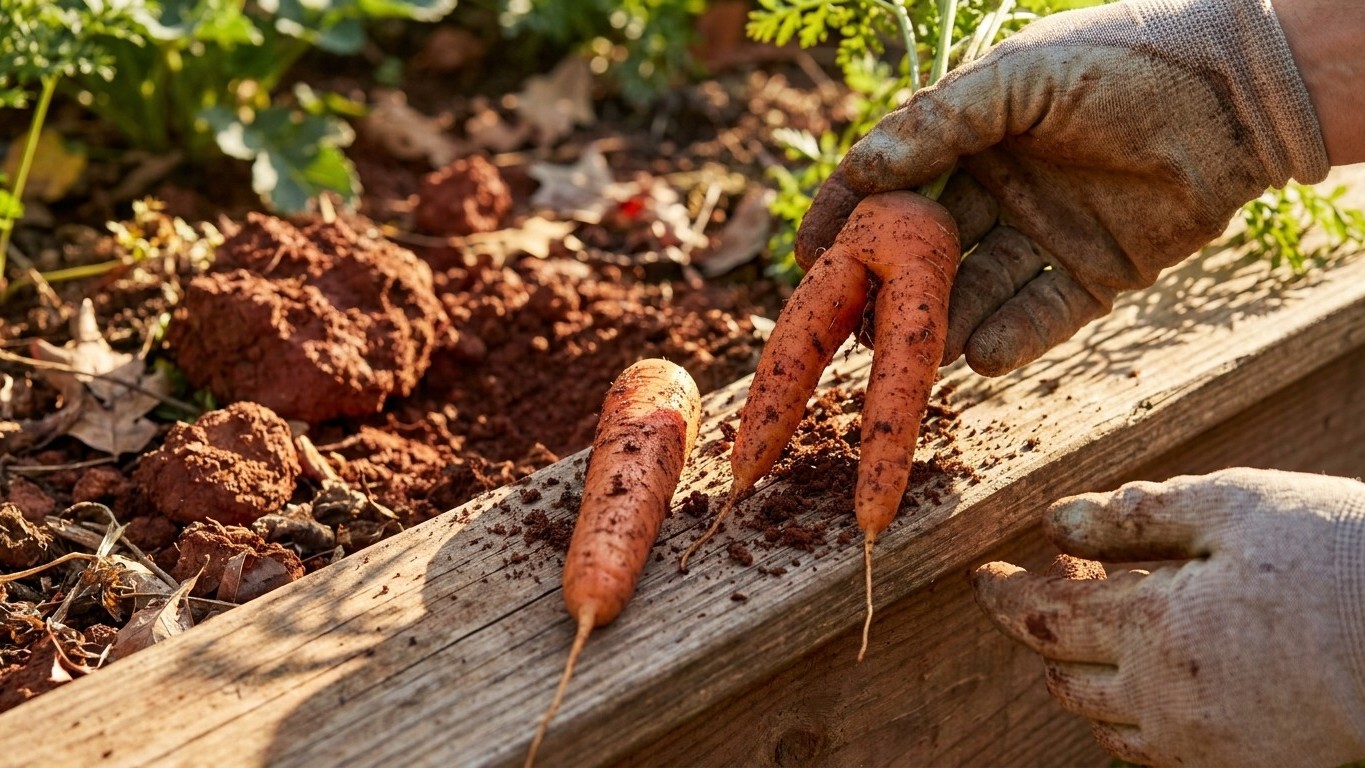

Yes, in this state’s representative soil carrots will almost certainly fork. That soil, the Bohicket series, runs 35 percent clay and drains so poorly it’s classified very poorly drained. Carrots want the opposite: deep, sandy, loose ground. The fix isn’t a different variety, it’s compost, double digging, or a raised bed built to the root’s own terms.
The short answer
South Carolina’s official state soil is the Bohicket series, and the numbers explain a lot about why home carrot crops in this state come out twisted, stubby, or split into two legs. The surface horizon runs 17 percent sand, 35 percent clay, and 48 percent silt, a combination that leans heavy and fine-textured rather than loose. Drainage is classed as very poorly drained, meaning water sits rather than moving through. Organic matter sits around 15.0 percent, and surface pH lands close to 7.3, essentially neutral. This is an Entisol, a soil order defined by having almost no developed profile, geologically young ground that hasn’t had time to build the layered structure older soils show.
Put that texture next to what a carrot root actually needs and the mismatch is obvious. According to Utah State University Extension, carrots want deep, sandy, well-drained soil rich in organic matter, and heavy or rocky soil makes the root fork. Thirty-five percent clay is heavy by any gardener’s definition, and “very poorly drained” is about as far from the carrot’s preference as a soil classification gets. A taproot pushing down through that kind of ground meets resistance, splits around clumps, or simply stalls and swells sideways instead of going deep, which is exactly what forking looks like when you pull the crop.
The remedy Utah State lays out for heavy ground is not a different carrot variety, it’s soil preparation: work in plenty of compost, and double dig the bed so the loosened, organic-rich layer runs deeper than the root needs to travel. In practice for a gardener working clay-heavy ground, that often means going a step further and building a raised bed filled with a lighter, blended mix, since double digging native Bohicket-type clay only goes so far before the surrounding compacted soil chokes drainage again anyway.
None of this means every yard in the state is sitting on Bohicket clay. It’s the series USDA NRCS lists to represent South Carolina under its State Soils program, drawn from surface-horizon data across 27 mapped components, not a soil sample from any particular garden. A state spans hundreds of distinct soil series, and coastal marsh ground, river-bottom silt, sandy ridge country, and anything a builder has cut, filled, or graded will read completely differently under a shovel. This figure is a starting point for understanding what the region’s ground tends to do, not a diagnosis of the dirt behind your own house.
The test that settles it in your own garden
State-level soil data can’t tell you what’s under your own raised bed or backyard plot. The only way to know if your ground will fork a carrot is to go look at it directly, and it takes about fifteen minutes with tools you already own.
- Dig a test hole. Pick a spot where you’d actually plant carrots and dig straight down, noting how far you get before you hit something solid, whether that’s undisturbed clay, a rock layer, or hardpan left behind by construction.
- Check the depth of loose ground. Carrots need open, unobstructed soil to grow straight. Shallow loose soil sitting on top of a hard or rocky layer is the classic setup for a forked or stubby root, even if the top few inches feel fine.
- Look for stones and debris. Pull out anything you find as you dig. Gravel, buried roots, and construction rubble all deflect a growing taproot exactly the way clumped clay does.
- Feel the texture. Grab a handful of moist soil and rub it between your fingers. Gritty and loose means sand-heavy ground that drains fast. Sticky, smooth, and able to hold a ribbon shape when pressed between thumb and finger means heavy clay.
- Watch how water drains. Fill the hole with water and time how long it takes to disappear. Water that lingers for hours signals the same very poorly drained condition that shows up in heavy-clay soil series, and it’s a strong warning sign for carrots specifically.
Run through those five steps and you’ll know more about your carrot bed’s real potential than any state average could tell you. If the loose layer is shallow, if the water sits, or if the soil balls up sticky in your palm, that’s your answer, and it points straight back to the same fix: compost, deeper digging, or a raised bed built with soil you control from the start.
What goes wrong here
- Forking in heavy, clay-rich ground. This is the headline problem in soil built like the Bohicket series, where 35 percent clay and very poor drainage give a taproot nothing but resistance. The root splits around dense clumps instead of pushing straight down. Utah State University Extension’s remedy is direct: work in generous compost and double dig the bed before you sow, loosening the ground well beyond the depth the root will need.
- Poor germination during a hot spell. Carrot seed is small and slow to sprout under the best conditions, and a heavy soil surface that crusts over in heat sheds water fast, leaving seed sitting in dry, hardened ground. Keeping the seedbed consistently moist during germination, rather than letting it dry and crack between waterings, gives the seed the steady conditions it needs to break through.
- Splitting from uneven watering. A root that grows through a dry stretch and then gets hit with a heavy soak swells unevenly and cracks along its length. This shows up worst in soil that alternates between waterlogged and bone-dry, which is a real risk in very poorly drained ground that holds water after rain and then bakes hard once it finally dries. A steady, even watering routine matters more in soil that behaves this way than in soil that drains and dries gradually on its own.
- Stubby or blunt roots from shallow loose soil. Even without heavy forking, a carrot growing into a compacted or undisturbed layer just below the surface will stop elongating and swell into a short, blunt shape instead of the long tapered root you’re after. Double digging deep enough to give the entire projected root length loose ground is the fix, not just amending the top few inches.
Common questions
Does a raised bed guarantee straight carrots in this state’s soil?
A raised bed filled with a loose, well-drained mix removes the native clay from the equation entirely, which solves the forking problem tied to heavy ground. It doesn’t remove every risk on its own, uneven watering can still split a root growing in a raised bed, so consistent moisture still matters even once the soil itself is right.
Is the state soil the same as what’s in my backyard?
No. The Bohicket series is the soil USDA NRCS lists to represent South Carolina, drawn from data across 27 mapped components statewide, but a state contains hundreds of distinct soil series. Your yard could sit on something entirely different, especially if it’s been graded, filled, or built up during construction. Digging a test hole in your own bed is the only way to know for certain.
How long do carrots take to mature from seed in this soil?
Carrots run 70 to 100 days from seeding, since they’re sown directly in place rather than transplanted. There’s no transplant date to count from with this crop, the clock starts the day the seed goes into the ground, whatever the soil texture underneath it.
Does adding compost change the soil’s pH as well as its texture?
Compost mainly loosens texture and improves drainage rather than shifting pH in a predictable, measurable way. This page can’t state a pH for your own garden bed, since the 7.3 figure recorded for the Bohicket surface horizon describes that specific mapped soil series, not a cultivated backyard plot. A separate soil test is the only way to know your bed’s actual pH.