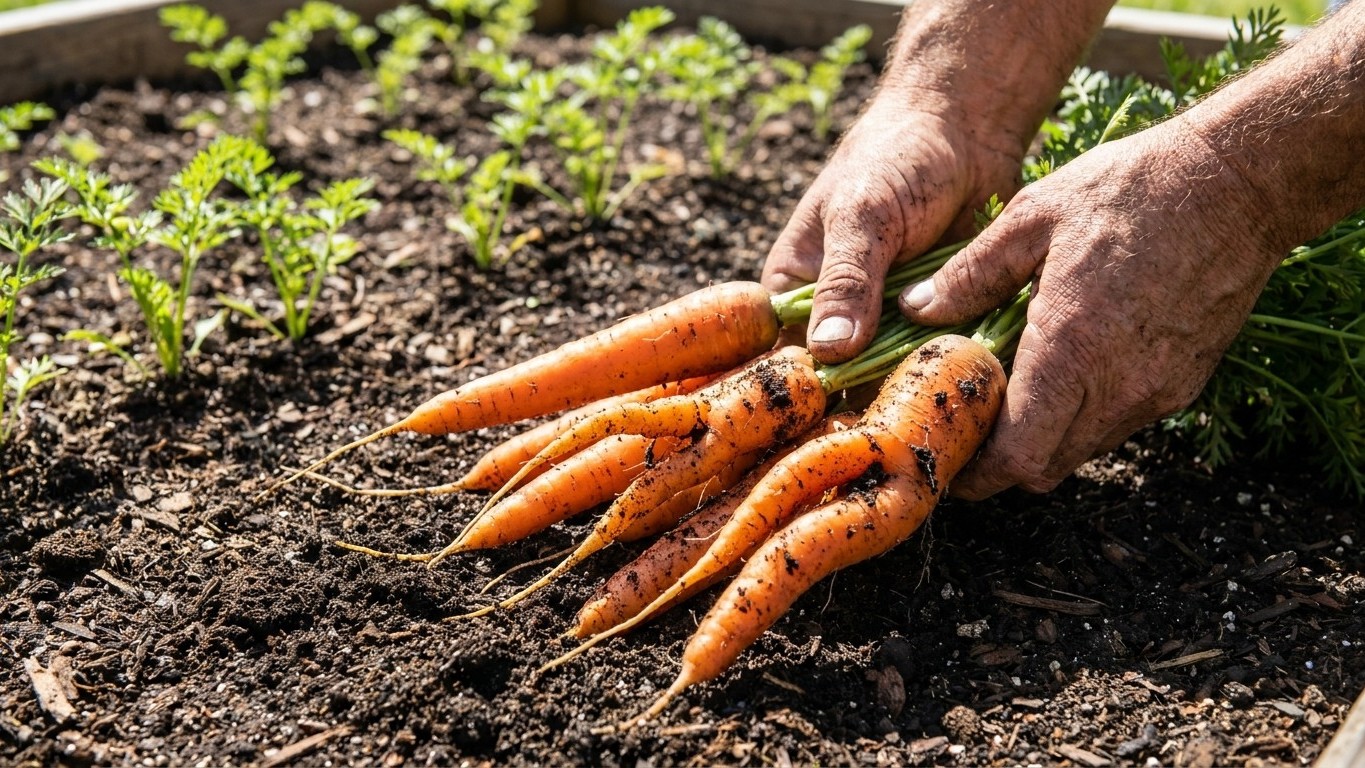

In South Carolina, the calendar matters less than the ground under your boots. Carrots are sown directly into the bed, no transplanting, and they need 70 to 100 days from seed to harvest. The real question isn’t just “how many weeks before the last frost” but whether your soil will let a straight root grow at all. In much of the state, it won’t without help.
The short answer
South Carolina’s representative soil, the one USDA lists as the state’s benchmark series, is called Bohicket. It’s an Entisol, which is soil scientist shorthand for young ground with almost no layered structure built up over time. The surface horizon runs 17 percent sand, 35 percent clay, and 48 percent silt, with a pH near neutral at about 7.3 and organic matter around 15.0 percent. Drainage is classified as very poorly drained.
Put a carrot seed in that mix as-is and the odds aren’t good. Carrots want deep, sandy, well-drained soil rich in organic matter, according to Utah State University Extension. Heavy or rocky soil makes the root fork, splitting into two or three legs instead of growing down as one clean taproot. Bohicket’s numbers, nearly half silt, over a third clay, and standing water for much of the year, describe close to the opposite of what a carrot is built for.
The fix isn’t a different variety. Utah State’s guidance is direct on this: heavy soil needs plenty of compost worked in, along with double digging to loosen and aerate down past the depth where the root will travel. In ground as dense and wet as Bohicket, many gardeners skip the double-digging step entirely and build a raised bed instead, filling it with a loose, sandy loam mix that never has to fight the clay underneath. A raised bed twelve to eighteen inches deep gives a carrot root the open runway it needs, regardless of what’s happening in the native soil six inches down.
Here’s the piece that gets lost when people quote a single “state soil” figure: South Carolina holds hundreds of distinct soil series, from the sandy ridges of the Sandhills region to the heavy clays of the Piedmont to the wet flats near the coast where Bohicket itself is mapped. This series is a starting point for thinking about the state’s general tendencies, not a reading of what’s actually in your yard. A garden two counties away, or even two properties down the same road, can sit on ground that behaves nothing like this. The organic matter figure alone is a tell: at 15 percent, this is a wet, low-lying mapped surface, closer to a marsh or bottomland condition than a typical cultivated bed. Treat the state soil as a hint about what to watch for, not a lab result for your own dirt.
The test that settles it in your own garden
Skip the guesswork and check the bed you’re actually going to plant. None of this takes special equipment, and it tells you more than any state-level soil map can.
- Dig a hole about 12 to 15 inches deep in the spot you plan to sow. Note whether you hit a hardpan, a layer of compacted clay, rock, or old construction fill before reaching that depth. Carrots need that full run of loose soil to grow straight.
- Look at what comes out of the hole. Are there stones, chunks of broken concrete, or heavy root mats mixed in? Any solid obstruction in the top foot of soil is a likely fork point for a growing root.
- Grab a handful of moist soil from the hole and rub it between your fingers. Gritty and loose means more sand; slick, sticky, and able to be rolled into a ribbon means more clay. This rough feel test tells you which end of the texture spectrum you’re dealing with.
- Refill the hole with water and time how long it takes to drain. Water that’s still standing after several hours points to poor drainage, the same condition that marks the Bohicket series. Water that disappears quickly suggests a sandier, better-drained profile.
- Repeat the test in more than one spot if your yard has any slope, low corners, or areas that stay soggy after rain. Drainage can change drastically within the same small yard.
None of these steps require a lab, and none of them should be skipped in favor of assuming the state average applies to your bed. A soil test through your local Cooperative Extension office can add a pH reading and nutrient numbers if you want that level of detail, but the dig-and-feel test above is what actually tells you whether a carrot root has a fighting chance where you’re about to plant it.
What goes wrong here
The combination of heavy, wet, clay-leaning ground and a long, humid growing season creates a specific set of failure points for carrots in South Carolina. Knowing which one is hitting your bed makes the remedy obvious.
- Forking in heavy ground. Roots hit resistance from compacted clay or buried stones and split into two or three legs instead of one straight taproot. This is the direct outcome of soil like Bohicket’s 35 percent clay content. The remedy is working in generous compost and double digging the bed before sowing, or building a raised bed filled with loose, sandy soil so the root never meets that resistance in the first place.
- Poor germination during a hot spell. Carrot seed is slow and finicky to begin with, and a stretch of high heat right after sowing can dry out the top inch of soil faster than the seed can sprout. The fix is keeping that surface layer consistently moist, whether through light daily watering or a thin mulch layer, until seedlings are established.
- Splitting from uneven water. Roots that go through a dry stretch and then get soaked, a common pattern with South Carolina’s scattered summer thunderstorms, can split or crack as they swell unevenly. Steady, even watering on a set schedule rather than reactive watering after a dry week keeps roots growing at a consistent rate.
- Slow, stunted roots in waterlogged spots. In ground that drains as poorly as the state’s representative soil, carrots sitting in saturated soil for extended periods often stall out short and stubby rather than forking outright. Improving drainage, whether through raised beds, added organic matter, or grading the bed slightly, addresses the root cause rather than the symptom.
Common questions
Do I need to know my exact last frost date to sow carrots?
It helps, but no single frost date applies statewide. South Carolina stretches from cooler upstate elevations to a much milder coastal plain, and a date that fits one region can be weeks off for another. That specific figure isn’t published on this page; check with your local Cooperative Extension office for the date that applies to your area, then count backward using the 70 to 100 day maturity window.
Can I improve heavy clay soil without building a raised bed?
Yes, through double digging combined with generous compost, as Utah State University Extension recommends for heavy soil. It’s more labor upfront than a raised bed, but it works the organic matter and looser structure directly into the existing ground rather than layering new soil on top.
Why did my carrots come out short and forked even though I added compost?
Compost helps with nutrients and texture, but forking usually points to something still solid below where you dug, an old hardpan layer, buried debris, or clay that wasn’t loosened deep enough. Go back to the dig test and check depth past 12 inches, not just the top few inches where compost typically gets mixed in.
Is the state’s official soil the same as what’s in my backyard?
Almost certainly not exactly. The Bohicket series represents the state for broad classification purposes, but South Carolina holds hundreds of mapped soil series with very different textures and drainage. Your own dig-and-feel test tells you far more about your specific bed than any state-level figure can.