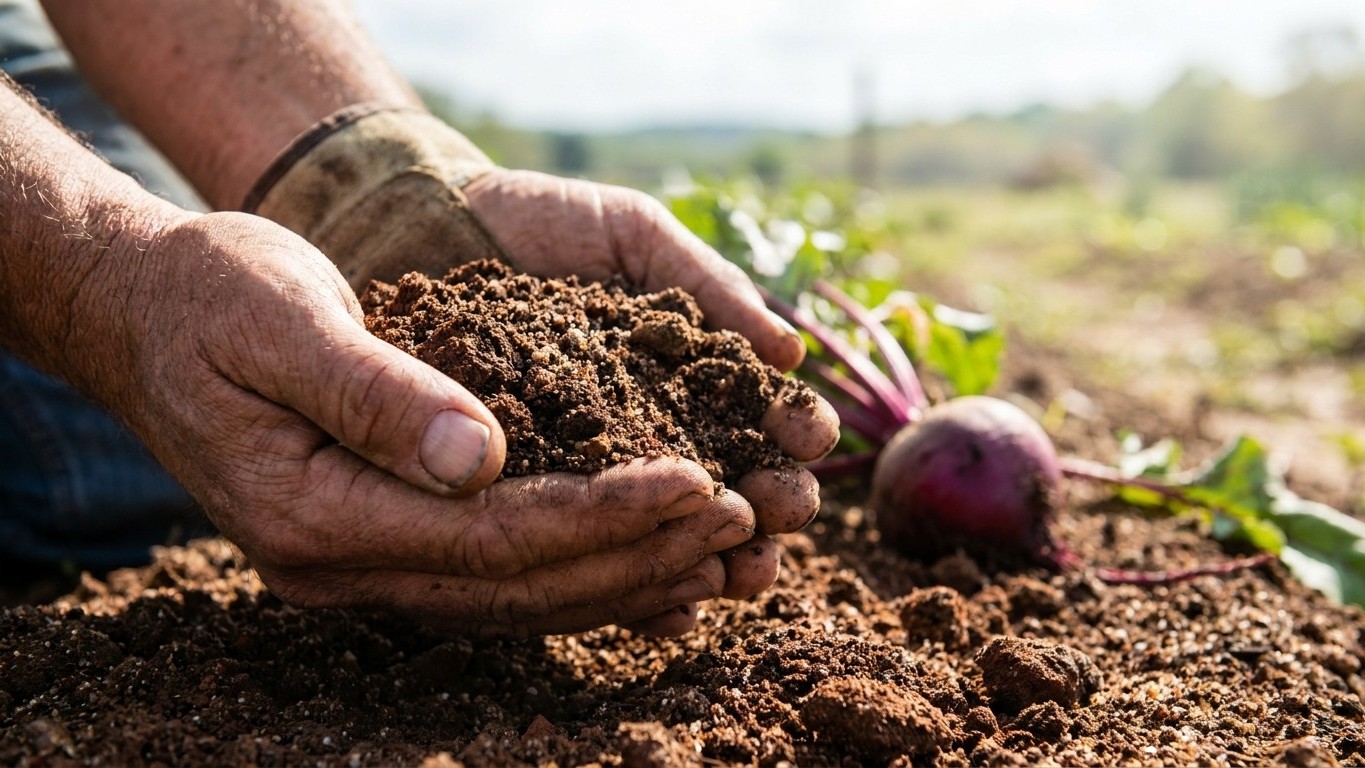

South Dakota’s benchmark soil, the Houdek series, is a well-drained loam that lines up reasonably well with what a beet root wants: deep ground, decent organic matter, no standing water at the crown. That’s the good news. The catch is timing, not texture. Sow too close to a warm spell, or let the seedbed dry out in week one, and the soil quality on paper won’t save the crop.
The short answer
The Houdek series, a Mollisol, is South Dakota’s official state soil, named so by state law in 1990 and tracked by the USDA NRCS State Soils program. It’s the dark, deep prairie soil that built the Corn Belt’s reputation, and the surface horizon runs close to neutral, about pH 6.7. Texture-wise it’s a loam to silt loam: 38 percent sand, 22 percent clay, 40 percent silt, with organic matter around 3.0 percent in the surface layer. Drainage class is listed as well drained.
For a beet root, that combination is close to workable out of the gate. Utah State University Extension describes the ideal beet bed as deep, sandy, well-drained, and rich in organic matter, amended with no more than 1 inch of composted organic matter per 100 square feet. Houdek’s 38 percent sand and well-drained rating check two of those boxes without any work from the gardener. The 22 percent clay is moderate, not the heavy, root-splitting clay that turns beet growing into a fight, and 3.0 percent organic matter is a reasonable starting point rather than a deficiency to correct from scratch.
Where the picture gets less tidy is heat. Beets get woody when temperatures climb above 85 F while the plant is also short on water, according to the same Utah State University Extension guidance. That’s a two-part failure: heat alone doesn’t do it, water stress alone doesn’t do it, the combination does. This page does not have a published count of how many days a year South Dakota’s reference weather station crosses 90 F, so that number won’t be stated here. What can be said is that the risk window is real in a Plains summer, and it lands on a beet that’s already sizing up its root, which is exactly when woodiness sets in.
None of this describes any single backyard. South Dakota spans hundreds of mapped soil series, and the Houdek profile is a statewide representative, not a survey of anyone’s actual raised bed. River bottoms tend to run sandier and drain faster. Hill country and anywhere a builder has cut or filled ground can differ entirely from the state series, sometimes compacted, sometimes stripped of topsoil altogether. A soil test of the actual bed, not a lookup of the state soil, is the only way to know the starting pH and texture for a specific patch of ground.
The six weeks that decide it here
Beet seed goes in the ground directly, no transplanting, and the standard advice is to sow 2 to 3 weeks before the last expected frost. At the reference weather station tracked by NOAA, the last spring freeze at 32 F falls somewhere between April 29 and May 9, based on the 1991-2020 Climate Normals record. That timing puts the first six weeks after sowing, the window Utah State University Extension flags as the critical stretch for water stress and bolting risk, squarely in South Dakota’s spring, not its early summer.
That matters because South Dakota spring is not a gentle, steady ramp. It’s a season known across the northern Plains for swinging hard between dry stretches and sudden wet ones, sometimes within the same week. A cold, dry snap can crust the seedbed just as germination is trying to happen, and a fast-moving front can dump enough rain to swing the soil the other direction before the beet has even put out true leaves. Either extreme, dry crust or saturated ground, stresses a young beet’s root system in a way that pushes it toward bolting, sending energy into a flower stalk instead of a root.
The practical takeaway is that the bolting risk here sits earliest in the calendar, right at germination and the first true leaves, because that’s when the six-week window overlaps with the least predictable part of South Dakota’s weather year. Once the plant is past that early stretch and into the warmer, more settled stretch of early summer, the bolting risk from water stress eases. It doesn’t disappear, but the dominant threat shifts from bolting toward the heat-plus-drought woodiness Utah State University Extension describes for later in the season. Watching the calendar against the local last-frost date, and treating the two or three weeks after sowing as the highest-stakes stretch for consistent moisture, is the single move that does the most here.
One caution on the frost date itself: it’s measured at an airport weather station, and suburban and rural gardens away from that station typically see their own last frost run later, often by one to two weeks, more at elevation. A gardener planning six weeks of careful watering off the wrong start date is planning around the wrong window.
What goes wrong here
- Bolting before the root sizes up. Water stress in the first six weeks after sowing, right when South Dakota spring is most likely to swing dry, tells the beet to flower instead of bulk up its root. The remedy is keeping the seedbed evenly moist from the day of sowing through the first true leaves, not just watering when the surface looks dry, since the crust can hide dryness underneath.
- Woody roots from a hot, dry stretch later in the season. Temperatures above 85 F combined with water stress, per Utah State University Extension, toughen the root’s texture. This is a separate failure from bolting, tied to later-season heat rather than the early germination window, and the fix is consistent watering through any heat spell, especially one that arrives while the roots are actively sizing up.
- Compacted or clay-heavy pockets that don’t match the state soil profile. Houdek’s 22 percent clay is moderate, but plenty of South Dakota yards, especially anywhere fill dirt or grading has happened, run heavier. A dense pocket restricts root growth and splits or forks the beet. Working the bed to a full spade’s depth before sowing, and pulling a soil test if roots keep coming out misshapen, catches this before a second season is lost to it.
- Over-amending organic matter past what the root needs. Houdek’s surface organic matter sits around 3.0 percent, already a reasonable base, and Utah State University Extension caps compost amendment at 1 inch per 100 square feet. Piling on more compost than that doesn’t help a beet the way it helps leafy greens, and can actually push nitrogen levels in a direction that favors top growth over root development.
- Skipping a soil test and assuming the state soil applies. The Houdek numbers describe a representative surface horizon as mapped, not a worked garden bed, and definitely not every county in the state. A bed on a river bottom, a hillside, or scraped construction fill can differ completely. A basic soil test for texture and pH is the only way to know whether the state’s numbers apply to the actual ground being planted.
Common questions
Does South Dakota’s state soil mean beets will grow well anywhere in the state?
No. The Houdek series describes a representative surface horizon mapped by USDA NRCS, not a guarantee for any individual garden. South Dakota contains hundreds of soil series, and river bottoms, hillsides, and any site altered by construction can differ substantially from the state series. Treat the Houdek figures as a starting reference, then confirm with a soil test of the actual bed.
How many weeks before the last frost should beet seed go in the ground?
Utah State University Extension’s guidance, applied to South Dakota’s last spring freeze window of April 29 to May 9 at the reference weather station tracked by NOAA, points to sowing 2 to 3 weeks ahead of that date. Because that station date can run one to two weeks earlier than a suburban or rural garden’s actual last frost, checking local conditions before sowing is worth the extra step.
Is bolting the same problem as a woody beet root?
No, and treating them as one issue is the most common mistake. Bolting comes from water stress in the first six weeks after sowing and results in a flower stalk instead of a root. Woodiness comes from heat above 85 F combined with water stress later in the season, and results in a tough, fibrous root. Both trace back to water, but they happen at different points in the plant’s life and need attention at different times.
How much compost should be worked into a South Dakota beet bed?
Utah State University Extension recommends no more than 1 inch of composted organic matter per 100 square feet. Given that the state’s representative soil already carries about 3.0 percent organic matter in its surface horizon, a bed close to that baseline may need little or no additional compost, and a soil test is the more reliable way to decide than assuming more is better.