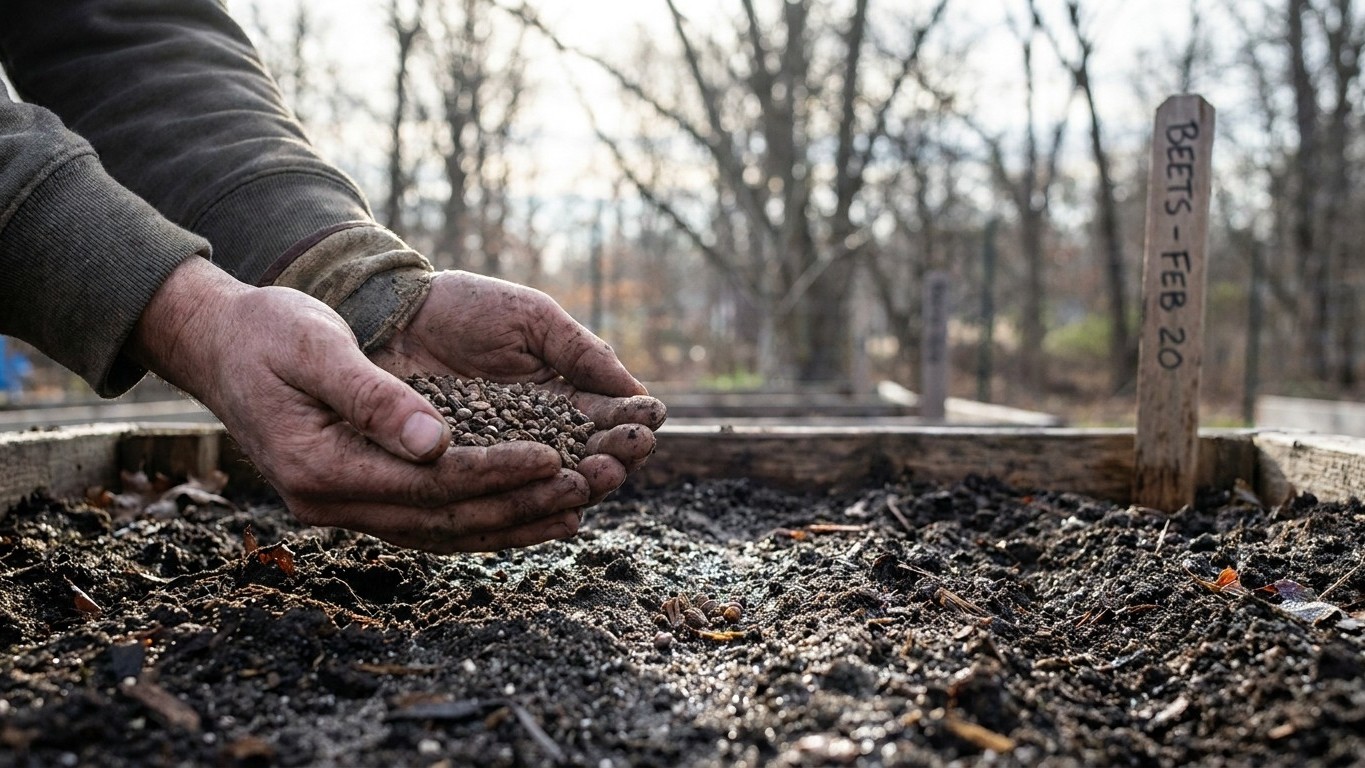

Sow beet seed directly into the garden bed two to three weeks before the last spring frost. NOAA’s 1991-2020 climate normals place that frost date between April 29 and May 9 for the reference weather station used to track South Dakota’s growing season, which puts most sowing windows somewhere in the first three weeks of April. Beets take 60 to 80 days from seeding, not from a transplant, to reach harvest size.
The short answer
South Dakota’s official state soil, the Houdek series, gives a useful starting picture of what a beet root is working with once it’s in the ground. Houdek is a Mollisol, the deep, dark prairie soil that built the Corn Belt, and its surface horizon runs close to neutral at a pH around 6.7. Texturally it sits at 38 percent sand, 22 percent clay and 40 percent silt, a loam-to-silt mix, and it drains well, with organic matter around 3.0 percent. That’s a reasonably good match for a root crop that, according to Utah State University Extension, wants deep, sandy, well-drained ground rich in organic matter. The 22 percent clay fraction is the one number worth watching: it’s not high enough to call this a clay soil, but it’s enough to crust over after a hard rain, which matters a lot for a seed as small and shallow-planted as a beet.
The organic matter figure, 3.0 percent, is a decent baseline but not generous. Utah State’s guidance caps amendment at no more than 1 inch of composted organic matter per 100 square feet, so a gardener working ground like Houdek isn’t starting from zero, just from average, and shouldn’t overcorrect by piling on compost past that limit.
On heat, the published record used for this page doesn’t carry a day-count of how often the reference station crosses 90 F in a given year, so that specific figure isn’t stated here. What’s relevant instead is the mechanism: Utah State’s research ties woodiness in the root directly to heat above 85 F arriving while the plant is also short on water. South Dakota’s growing season regularly produces stretches of heat in that range through mid and late summer, which is exactly why the sowing date matters more than the calendar might suggest, pushing root maturity earlier into the season and away from the hottest stretch.
None of this is a diagnosis of any one backyard. South Dakota spans hundreds of mapped soil series, and Houdek is the one chosen to represent the state, not a survey of every garden bed in it. River bottoms, hill ground and any lot a builder graded or filled will read completely differently. Treat Houdek as a description of what the region’s soil tends to do, then confirm your own numbers with a soil test before planting.
The six weeks that decide it here
Sowing beets two to three weeks ahead of the April 29 to May 9 frost window means the first six weeks of the plant’s life land in South Dakota’s early spring, a stretch of the calendar known for swinging hard between dry, wind-scoured spells and sudden, heavy moisture. That variability is the whole story for beets, because Utah State’s research is specific on this point: water stress in those first six weeks is what triggers premature flowering, or bolting, in a plant that hasn’t yet built a usable root.
Pair that climate pattern with the Houdek soil profile and the risk gets sharper. A well-drained loam to silt texture, the kind Houdek represents, sheds water efficiently after rain, which is generally an asset for beets but becomes a liability the moment a dry spell sets in without supplemental watering. Seedlings in that kind of ground dry out faster than they would in a soil that holds more moisture at the surface, and a beet seedling under stress doesn’t wait around. It responds to that dry stretch by shifting into reproduction mode, sending up a flower stalk instead of thickening a root, and once that switch flips, the root’s future is already decided.
This is also why the exact sowing date within that two-to-three-week window is worth thinking through rather than treating as a fixed rule. A gardener who sows right at the edge of the frost date, closer to early May, is betting on a spring that stays cool and lets the seedling establish slowly. A gardener who sows earlier, closer to mid-April, is betting the seedling can handle a cold snap but needs a plan for keeping soil moisture even through whatever dry stretch shows up in the following weeks. Neither bet is wrong. What matters is knowing which risk you’re managing and watering accordingly, rather than assuming the calendar alone will protect the root.
It’s worth repeating that the April 29 to May 9 window comes from one weather station’s 30-year averages. Suburban and rural gardens in this state commonly see their own last frost land later than that station shows, sometimes by one to two weeks, and gardens at higher elevation can run later still. Check county-level frost data before locking in a date rather than sowing strictly off the reference station’s number.
What goes wrong here
- Bolting from a dry April or May. A stretch of wind and no rain in the first six weeks after sowing is the single most common trigger for premature flowering in this state’s spring. Water consistently through that window rather than waiting for the soil surface to look dry, since well-drained loam like Houdek can look fine on top while the root zone underneath is already short.
- Woody roots from a late sowing that matures during peak heat. If seeding gets pushed into late spring, the 60- to 80-day maturity clock can land root development squarely in a hot, dry stretch of summer, and heat above 85 F combined with water stress is exactly what toughens the root. Sow at the early end of the recommended window and water deeply during any hot spell that overlaps with root sizing.
- Surface crusting that blocks germination. The clay fraction in soils like Houdek, at 22 percent, is enough to seal the surface after a hard rain and physically stop small beet seedlings from pushing through. Keep the top inch of soil consistently moist after sowing, and break up any crust gently with a rake tine as soon as it forms.
- Trusting the reference frost date too literally. The April 29 to May 9 window comes from a single station’s averages, and many South Dakota properties, especially rural ones or those at higher ground, see frost land one to two weeks later. Sowing on the reference date alone can put tender seedlings in the ground before a local frost risk has actually passed.
- Over-amending organic matter and creating uneven moisture. Piling on compost past the recommended 1 inch per 100 square feet doesn’t just waste material, it can create a spongy surface layer that holds water unevenly against the more moderate organic matter of the native soil below, which confuses root development. Stick to the 1-inch limit and mix it in rather than layering it on top.
Common questions
Do I need to start beets indoors and transplant them?
No. Beets are sown directly into the garden bed where they’ll grow. The 60- to 80-day maturity window Utah State University Extension cites runs from the seeding date, not from a transplant date, so there’s no indoor head start built into that timeline.
How do I know my exact last frost date if I’m not near the reference station?
Treat April 29 to May 9 as a regional reference point, not a guarantee for your address. NOAA’s climate normals are drawn from one weather station, and gardens elsewhere in the state, particularly rural properties or anything at higher elevation, often see frost linger one to two weeks past that window. Local county extension offices or a personal frost log are the more reliable check.
My soil doesn’t look anything like the Houdek description. Does that matter?
It matters a lot, and it’s expected. Houdek is the soil chosen to represent South Dakota as a whole, not a prediction of what’s under any one garden. The state contains hundreds of distinct soil series, and anything in a river bottom, hill country, or a yard that’s been graded or filled during construction can differ completely from Houdek’s texture, pH, and organic matter. A soil test of the actual bed is the only way to know what you’re working with.
Can I sow a second round of beets later in the season?
The figures gathered for this page cover the spring sowing window and don’t include a first fall frost date for this state’s reference station, so a fall sowing date isn’t published here. Gardeners considering a second planting should work backward from their own county’s typical fall frost date and the 60- to 80-day maturity window, leaving enough margin that the roots size up before cold weather arrives.