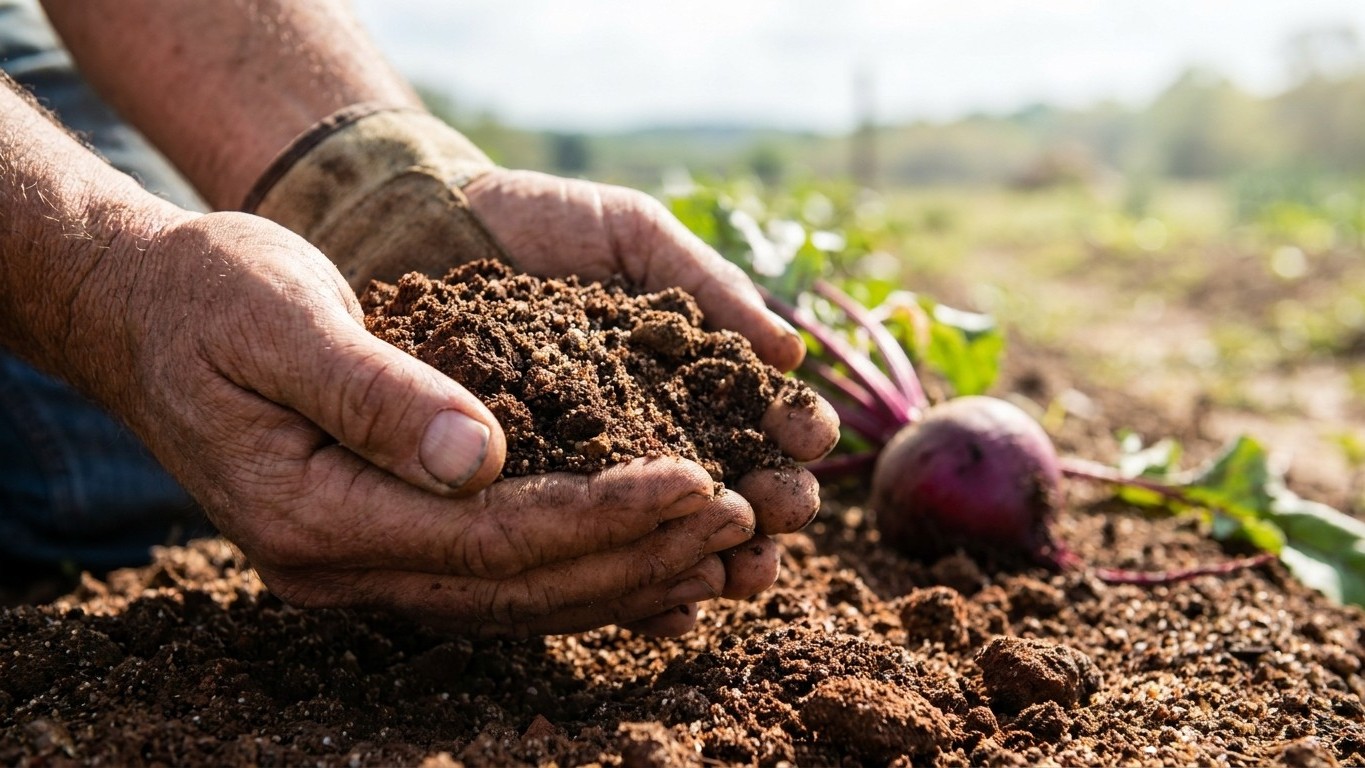

Vermont’s official state soil, the Tunbridge series, is a sandy, strongly acid Spodosol that drains fast and holds almost no natural buffering against thirst or nutrient swings. For a beet, that combination means good structure but a rough chemical welcome, and a growing season short enough that timing matters more than most gardeners expect. Here’s what that actually looks like in the ground.
The short answer
Pull a spade of Tunbridge soil and you’d find something close to 79 percent sand, 21 percent clay, and no measurable silt in the surface horizon, sitting well drained over bedrock the glaciers left behind. Sand at that ratio is exactly the texture a beet wants: loose enough for a taproot to push straight down without forking around clay clumps. The problem is the pH. Tunbridge surface soil runs around 3.5, strongly acid, the kind of number you’d associate with a spruce-fir forest floor, not a vegetable bed, and beet roots sit far outside the range most garden crops tolerate at that level. Add an organic matter reading near 75 percent and you’re not even looking at a cultivated soil anymore. That figure describes a natural forest litter layer, duff and needle mat built up under conifers over centuries. No worked garden bed carries organic matter anywhere close to that; if your soil test comes back with a number like that, you’re reading undisturbed ground, not a planting row.
None of this means your own garden matches the Tunbridge series. Vermont’s soil survey maps hundreds of distinct series across the state, from river-bottom silt loams in the Champlain Valley to shallow, rocky ground in the Green Mountains to fill and subsoil in anywhere a house lot got graded. The Tunbridge series is the one the legislature picked in 1985 to represent the state, largely because it’s so widespread across Vermont’s uplands, not because it’s what sits under your raised bed. Use it as a signal of what the region’s ground tends to do, drain quickly and run acid, then confirm your own numbers with a soil test before you decide anything about lime or amendment.
On the heat side, the exact count of days above 90 degrees for a Vermont reference station isn’t part of the data reviewed for this page, so it isn’t stated here as a number. What is established is the mechanism: beets exposed to heat above 85 degrees while under water stress turn woody, fibrous, and unpleasant to eat. Vermont’s summers run shorter and milder than most of the country’s, which works in the beet’s favor for that specific failure, but a well-drained sandy soil like Tunbridge can still let a root dry out fast enough during any hot stretch to trigger the same result, heat or no extreme heat record.
The six weeks that decide it here
Beets get sown directly in the ground, seed to soil, no transplanting step to buffer the timing. Standard practice puts that sowing two to three weeks ahead of the last spring frost, which for the Burlington station runs between April 30 and May 10. That places the first six weeks of a beet’s life, the stretch that determines whether it bolts or grows on, somewhere in the middle of April through the back half of May for the mildest part of the state. Burlington sits on Lake Champlain, the warmest pocket Vermont has to offer; the Green Mountains and the Northeast Kingdom run substantially shorter seasons, which pushes that same six-week window later and compresses it against a shorter frost-free stretch overall.
What makes that window risky isn’t cold, it’s moisture, and the state soil’s drainage class is the reason why. A well-drained, sandy profile like Tunbridge doesn’t hold snowmelt or spring rain the way a clay-heavy soil would. Vermont’s early spring famously turns to mud as frost leaves the ground and surface water has nowhere to go, but on sandy ground that saturation clears fast. Once it clears, especially on a slope or a bed that’s been worked and loosened, that same soil can swing to dry within days, and a beet doesn’t need weeks of drought to bolt. The established mechanism is straightforward: water stress in the first six weeks after seeding causes premature flowering, meaning the plant abandons root growth to throw a seed stalk instead. A gap of a week without rain during that window, on a soil that drains as readily as the state soil does, is enough to set that off.
The practical takeaway isn’t complicated, but it does require attention at a specific moment rather than general care all season. The six weeks right after seeding are the ones to watch closely for moisture, checking the bed rather than assuming April’s mud season will carry through. Once beets are past that early stage and rooted, the drainage that made spring risky becomes an asset for the rest of the season, keeping the root zone from sitting waterlogged through Vermont’s wetter stretches.
What goes wrong here
- Strongly acid ground stunts the root before it starts. Tunbridge surface soil runs around pH 3.5, a level built for conifers, not root vegetables. Left untested and unamended, a garden bed on similar ground will produce stunted, pale roots regardless of watering. The fix is a soil test before planting, followed by whatever lime application the test recommends, since guessing at a correction for soil this acid usually overshoots or undershoots by a wide margin.
- Fast drainage empties the root zone during the six-week establishment window. Sandy, well-drained soil like the state series sheds water quickly once spring saturation clears, and a week without rain during those first six weeks is enough to trigger premature flowering. Keep that window watered on a schedule rather than waiting for visible wilting, since bolting is often already underway by the time the plant shows stress.
- A hot stretch late in the season turns roots woody. Heat above 85 degrees combined with water stress fibers the root, and even Vermont’s short summers produce stretches warm enough to do it if the soil has dried out. Watch soil moisture through any hot spell in July or August rather than assuming the state’s generally mild climate makes watering optional.
- Over-amending organic matter on ground that’s already organic-heavy. The guidance is no more than 1 inch of composted organic matter per 100 square feet. On a bed that sits over or near a natural organic-rich layer, like the deep litter horizon the state soil survey records, adding compost on top of that assumption without checking actual garden soil can push organic matter far past what a beet root wants to push through. Test the actual bed rather than assuming the state soil’s organic matter figure applies to it.
- A shortened season at elevation cuts maturity short. Higher ground in the Green Mountains and the Northeast Kingdom runs a later last frost and an earlier first fall frost than the Champlain Valley, squeezing the frost-free window. Since beets need their full run from seeding to reach size, sow as early as the local last frost date allows rather than following a Champlain Valley calendar in a higher, colder part of the state.
Common questions
How long do beets take to mature in Vermont?
Beets reach harvest size in roughly 60 to 80 days, and that count starts from the day the seed goes into the ground, not from any transplant date, since beets are sown directly in place rather than started indoors and moved.
Does Vermont’s soil need lime before planting beets?
The state soil, the Tunbridge series, runs strongly acid at a surface pH near 3.5, well outside what most vegetable roots tolerate. Whether your own bed needs lime depends entirely on a soil test of your actual garden, since the state soil figure describes forested upland ground, not a worked bed, and garden soils vary widely even within the same county.
When is the last frost in Vermont?
For the Burlington reference station, the last spring frost typically falls between April 30 and May 10. That’s the mildest corner of the state, sitting along Lake Champlain; the Green Mountains and the Northeast Kingdom run their last frost considerably later, so a garden there should plan sowing dates around a later local frost rather than the Burlington window.
Can sandy Vermont soil be improved for beets?
Beets actually prefer sandy, well-drained soil rich in organic matter, so the texture itself isn’t the obstacle. The guidance caps composted organic matter at 1 inch per 100 square feet worked into the bed, and that limit matters more on ground that already carries a naturally high organic layer, where adding compost on top of an untested assumption can overshoot what the root wants.